


 177 / 196

[
] 175
The first tsunami early warning
centre in the Indian Ocean
Shailesh Nayak and T. Srinivasa Kumar, Indian National Centre for Ocean Information Services
T
he oceans are a cornerstone of the life support system for
all creatures on the planet Earth, and the source of several
natural phenomena that are beneficial to humankind.
However, oceans are also associated with disastrous events such
as tsunami, cyclones and associated storm surges. Tsunami is a
system of ocean gravity waves formed as a result of large-scale
disturbance in the sea that occurs in a relatively short duration
of time. A series of oscillations both above and below sea level
take place during the process of the water returning to an equi-
librium position by the force of gravity. Thus tsunami waves are
generated, propagating outwards from the source region.
Most tsunamis are caused by earthquakes (of the magnitude of more
than 7 on the Richter Scale), with a vertical disruption of the water
column generally caused by a vertical tectonic displace-
ment of the seabed along a zone of fracture in the Earth’s
crust which underlies or borders the ocean floor.
Tsunamis are also generated by volcanic eruptions and
submarine landslides. The speed of tsunami waves
depends on the depth of the water, typically varying
from 500 to 1,000 kilometres per hour in the deep ocean
and a few tens of kilometres per hour near shore. The
time period of the tsunami wave ranges from a few
minutes to an hour or even more.
The Indian Ocean tsunami (26 December 2004) was
one of the strongest in the world and the deadliest of all
time by an order of magnitude. The Pacific Rim coun-
tries are affected frequently by tsunamis (about 900
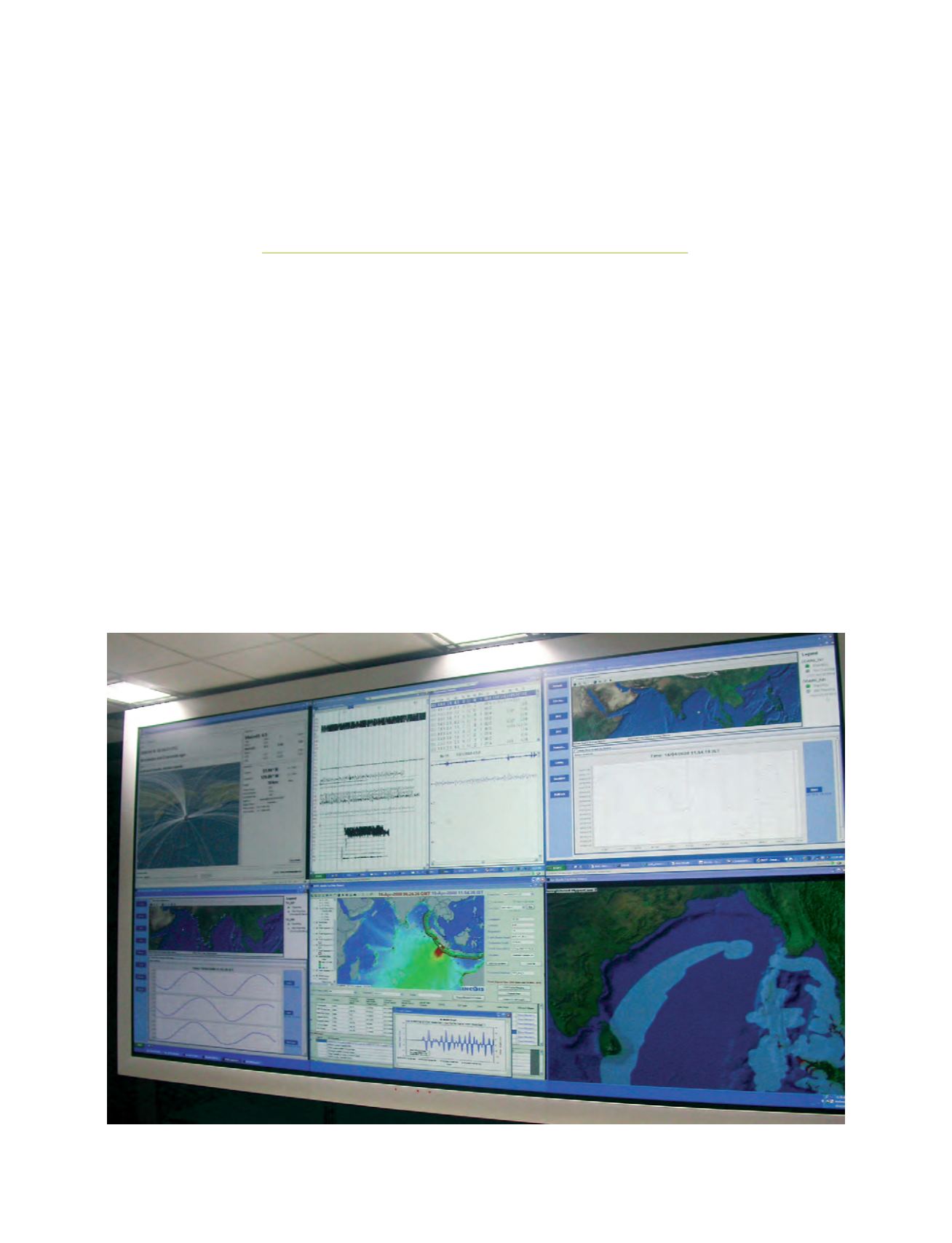
The tsunami early warning centre at INCOIS
Image: INCOIS