


 172 / 196

[
] 170
internal atmosphere-land-surface feedback actually strengthens the
monsoon in subsequent summer months. Land-surface processes,
once triggered by anomalous aerosol concentrations, are important
mediators in monsoon evolution.
8
According to the fourth assess-
ment report of the Intergovernmental Panel of Climate Change
(IPCC), aerosol-cloud-precipitation-climate interactions remain as
the largest uncertainties in our current understanding of the climate
system.
The fourth report by Working Group I of IPCC notes a greater than
66 per cent probability that more areas of the world will be affected
by drought. Furthermore, recent studies have reported the effect of
drought and heat on the carbon cycle by using direct and long-term
carbon flux measurements and yield data, as well as by inferring
regional-scale fluxes from satellite-based MODIS and a carbon-cycle
model. For example, the 2003 Europe drought (50 per cent below
the long-term average in Europe) and heat (6
o
C above the long-term
average since 1851) caused a Europe-wide reduction in primary
productivity, resulting in an annual loss of 0.5 Gt C m
-2
yr
-1
.
9
A number of major droughts in mid-latitudes have contributed to
the weakening of the growth rate of terrestrial carbon sinks in these
regions. An increase in future drought events could turn temperate
ecosystems into carbon sources. Also, regional droughts during El Niño
events promote large biomass fires, contributing to high atmospheric
CO
2
growth rates.
10
Over the last 50 years, the efficiency of natural
carbon sinks has decreased by 10 per cent and will continue to do so
in the future,
11
implying that the more vulnerable the region is to future
drought, the larger the burdens needed to reduce carbon emission.
In July 2008 the G8 summit over climate change invited eight
major economies to Japan to discuss a new global agreement.
Developing countries, including China, India and Korea refused to
sign the G8’s pledge to cut carbon emission by half, by 2050. The
aforementioned participant nations did, however, sign a joint state-
ment, officially committing to play by international rules to fight
pollution. The ball is now in our court and we cannot refuse to play.
At the time of writing the 2008 Beijing Olympics is just around
the corner and China, which has the largest rainmaking operation in
the world, is aiming for a dry opening ceremony. The
chemicals used in the production of artificial rain,
however, could affect climatic patterns, ecosystem, water
sources, soil, and most likely the natural hydrological
cycle, as well as the energy budget.
Reaching a useful and usable understanding of the
sustainability, dynamics, vulnerabilities and resilience
of the complex socio-ecological systems associated with
drought will require a strong push to advance focused
scientific research with a clear vision – foresight with
insight, based on hindsight.
12,13
This will include build-
ing up classical disciplinary knowledge from the natural
and social sciences, and an even stronger development
of interdisciplinary and trans-disciplinary research.
Bruno Latour wrote in
Science
14
about the transition
from the culture of ‘science’ to the culture of ‘research’
in the past 150 years: “Science is certainty; research is
uncertainty. Science is supposed to be cold, straight, and
detached; research is warm, involving, and risky. Science
puts an end to the vagaries of human disputes; research
creates controversies.” Truly, we as informed stewards
are standing at a turning point where the risks can be
minimized by developing and transferring the true
knowledge of contextualized science to our society.
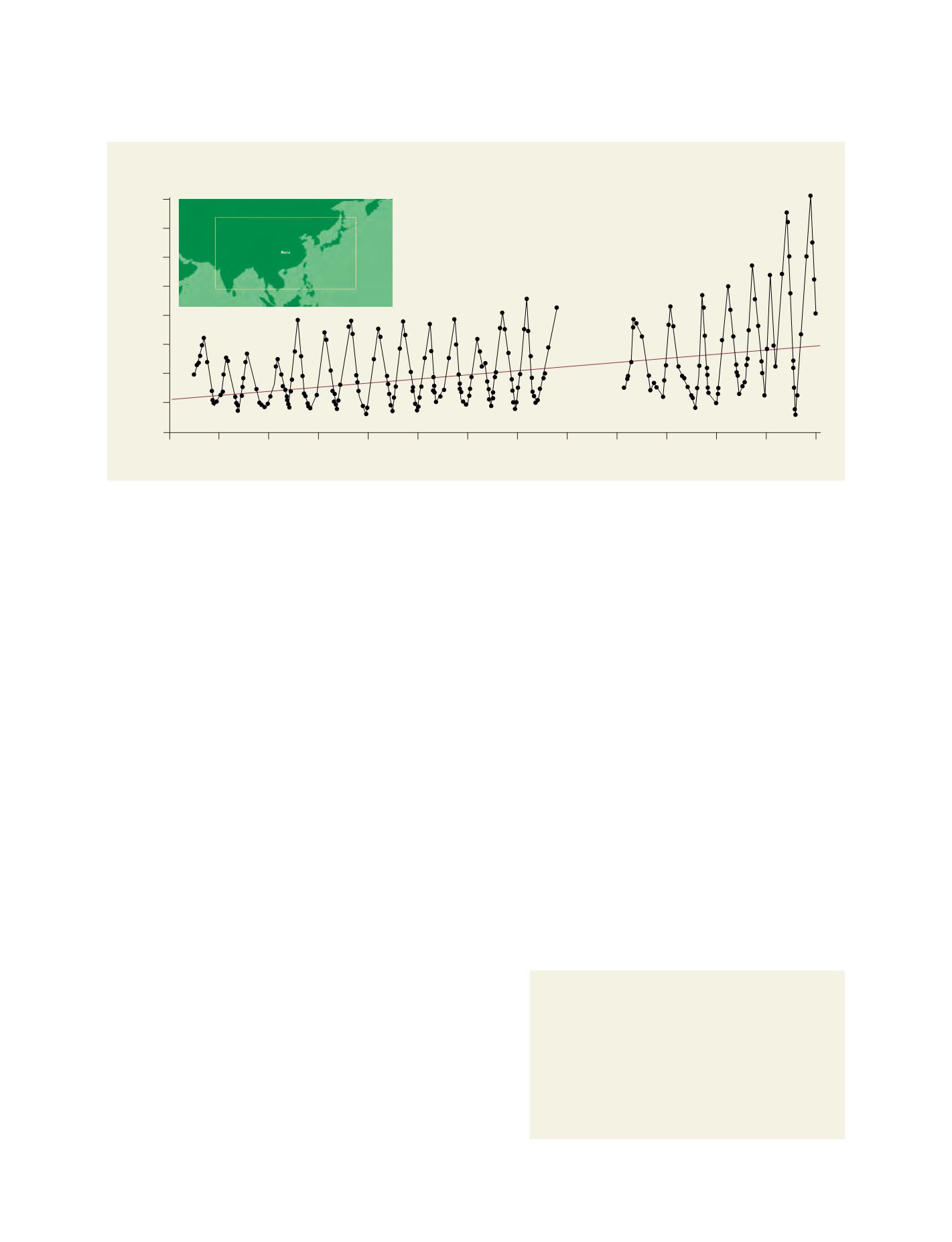
Aerosol index (AI)
1978 1980 1982 1984 1986 1988 1990 1992 1994 1996 1998 2000 2002 2004
0.0
0.2
0.4
0.6
0.8
1.0
1.2
1.4
1.6
Year
TOMS. y=1.54*10
-2
yr
-1
X+0.26
(1978.11--2003.8)
Aerosol index in South and East Asia from 1978 to 2004
Source:
http://disc.sci.gsfc.nasa.gov/data/datapool/TOMS“Here is wisdom that has impressed me as I have watched
the way our world works. There was a small town with only a
few people, and a great king came with his army and
besieged it. A poor, wise man knew how to save the town, and
so it was rescued. But afterward no one thought to thank him.
So even though wisdom is better than strength, those who
are wise will be despised if they are poor. What they say will
not be appreciated for long. Better to hear the quiet words of
a wise person than the shouts of a foolish king.”
15
King Solomon