


 171 / 196

[
] 169
• Sea surface temperature (SST) anomalies
• Soil moisture anomalies
• Atmospheric initial conditions favourable to such a
climate extreme.
A drought can also be exacerbated through a regional
positive feedback in which low soil moisture reduces
local evaporation and in turn precipitation. For
example, the strong drought of the US States of
Oklahoma and Texas in 1998 was established by the
SST anomalies combined with a favourable atmospheric
circulation during April and May. In June-August, the
regional positive feedback associated with lower evap-
oration and precipitation contributed significantly to
the maintenance of the drought. In the autumn, the
drought ended as stronger large-scale weather systems
penetrated the region and overwhelmed the soil-mois-
ture feedback.
4
The interplay of SST anomalies and atmospheric inter-
nal forcing on local precipitation may be examined using
the long-term measurement of precipitation in Seoul and
the monthly SST data with a resolution of 2.5 degrees
for the period of 1854-1997.
5
Many modelling studies have shown the significant
effect of soil moisture anomalies in late spring on the
summer rainfall anomalies in North America. On the
other hand, the role of soil moisture seems insignificant
in East Asia.
6
This conflicting impact of local feedback
and dynamic forcing is attributed to a weakened sensi-
tivity of the monsoonal circulation to the initial soil
moisture. Hence, drought production mechanisms in
Asia are further complicated by large-scale variations in
the Asian monsoon evolution, which affect more than
60 per cent of the world’s population.
South and East Asia are two of the areas with the
highest air pollution and aerosol concentrations due to
rapid population and economic growth. In this region,
air pollution emissions containing aerosol particles
produce widespread layers of brownish haze, so called
‘atmospheric brown clouds’ (ABC). The particles in ABC
(including black carbon, ash, dust and NO
2
) result in
millions of deaths annually, decreased photosyntheti-
cally active radiation and global dimming (having direct
impacts on ecosystems), stabilized surface-atmosphere
system during dry seasons, altered SST gradients, and
altered regional rainfall patterns – thereby leading to
global cooling and drying.
7
The aerosol index (AI) is a measure of how much the
wavelength dependence of backscattered ultraviolet
radiation from an atmosphere containing aerosols differs
from that of a pure molecular atmosphere. In South and
East Asia, AI has been continuously increasing with
greater interannual variability, indicating growing
aerosol emissions for the past three decades. Numerous
modelling studies have described the potential effects
of aerosols on monsoon rainfall over the South Indian
subcontinent. Recent observational studies suggest that
although anomalously high aerosols are associated with
deficient precipitation in South Asia in early spring,
• Positive feedback through coupling between water and carbon
cycles in terrestrial ecosystems.
Indebted to the invention of the first rain gauge in 1441 and the pioneer-
ing measurement network around the Korean Peninsula by King Sejong
of the Chosón dynasty, the cyclic nature of drought at a local scale can
be traced through one of the longest precipitation records in Seoul.
Typically, drought is considered relative to some long-term average condi-
tion such as normal. In the case of the annual precipitation from the
traditional Korean rain gauge,
Chugugi
(1777-1907)
3
and the modern
rain gauges (1908-2007), the recent 30-year normal precipitation is about
1,400 mm. Such a normal can change, however, by more than 30 per
cent depending on the averaging intervals selected from the 230-year
period, reflecting dramatic changes in climate for the last two centuries.
The recurrent dry and wet periods particularly with a prolonged drought
approximately from1880 to 1910 are worth noting. Considering its cyclic
nature, such a severe and extended drought, that has fortunately not
occurred in the past century, may return sooner or later.
The impacts of strong and persistent drought span environmental,
economic and social sectors and can be reduced through proactive
mitigation and preparedness. Establishing drought climatology for a
region provides a better understanding of its characteristics and prob-
ability of recurrence at different levels of severity. Such information
is extremely valuable in the development of mitigation strategies and
preparedness plans. On the other hand, the onset, end and severity
of drought is difficult to determine, requiring better understanding
of the mechanisms that originate, maintain and end an extreme
drought. The potential mechanisms that can produce drought condi-
tions are:
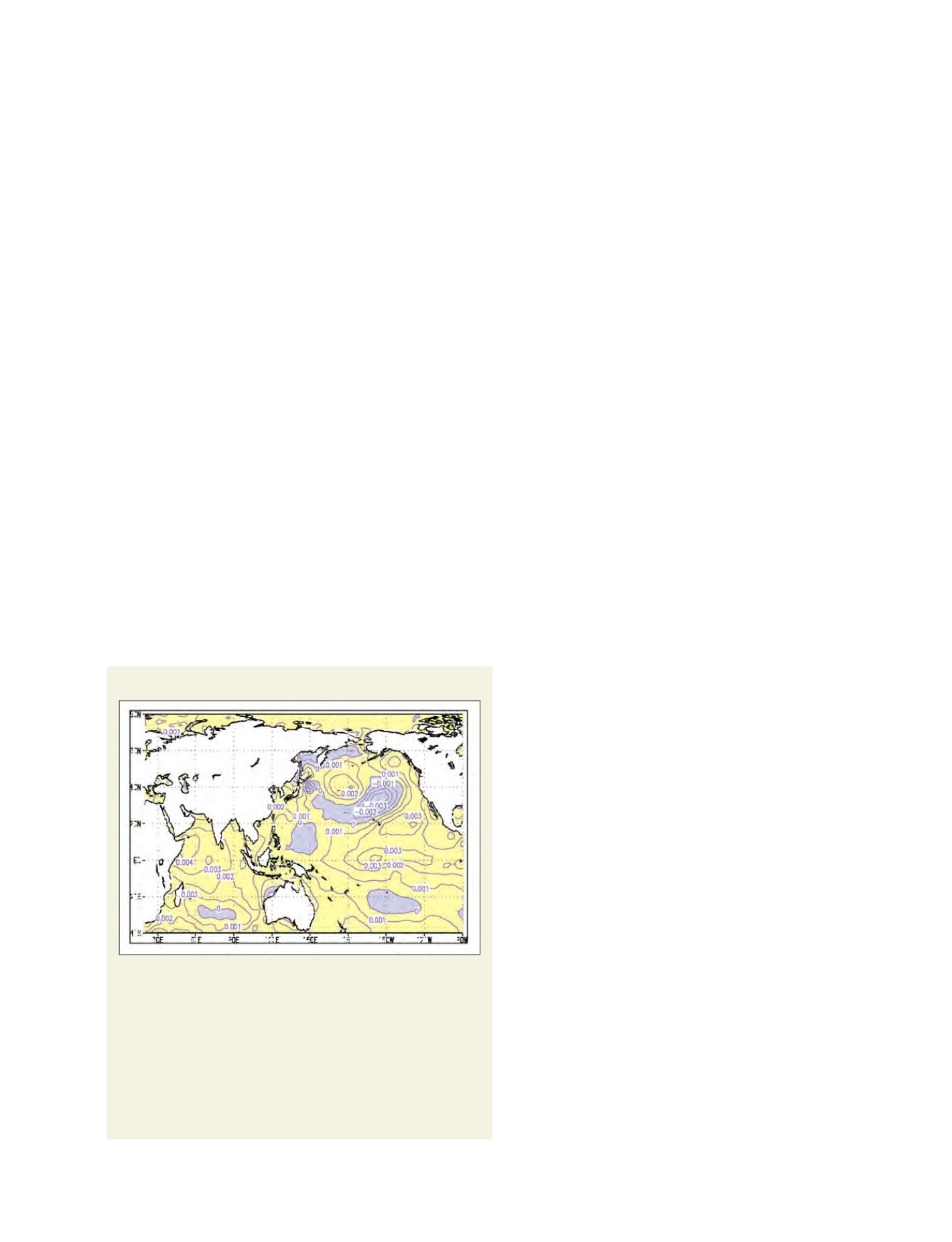
ENSO-like patterns in the tropical pacific
This image was obtained by regressing the unfiltered global Sea Surface
Temperature (SST) field (upon the annually anomalous precipitation time
series of Seoul for the period of 1854-1997). What we observe is an El
Niño Southern Oscillation (ENSO)-like pattern over the tropical Pacific. The
leading pattern of analysis for lowpass-filtered (8-yr) SST indeed reveals
features similar to interdecadal variability of the tropical Pacific (not
shown). These results suggest that there is a link between the long-term
anomalous precipitation of Seoul and ENSO-like variability. It is also
evident that precipitation in Seoul is associated with the Indian Ocean
basin-wide warming. In this analysis, due to the lack of long-term soil
moisture data, it is impossible to examine a physical interaction with soil
moisture anomalies