


 170 / 196

[
] 168
Coping with drought – the
tragedy of the commons
Joon Kim, Song-You Hong and Jhoon Kim, Department of Atmospheric Sciences and Global Environment Laboratory,
Yonsei University, Seoul; Sung Kim, Sustainable Water Resource Research Center/KICT, Korea
O
n arriving in Korea, Horace G. Underwood wrote the follow-
ing: “Oh, Lord! Now we see nothing. Nothing but the
withered and deprived land. You have brought us to this
barren land where not even a stump of a tree can arise refreshingly.”
This is a part of the prayer of Underwood who came to Korea with a
vision in the late 19th century and founded Yonsei University in 1885
in Seoul. His prayer is intriguing, because it suggests that there may
have been a severe drought in Korea in the late 1800s. In fact, British
geographer Angus Hamilton
1
who visited Seoul around this time
wrote: “An even more emphatic evidence of the effects of a drought,
where the population live upon the rice crop, is afforded by the
appalling loss of life and the grave eruption of disorder, which took
place in Korea as the consequence of the famine in 1901.” Contrary
to our common understanding, drought is not a rare and random event
but a normal, recurrent feature of climate. It is an insidious hazard of
nature, originating from a deficiency of precipitation over an extended
period of time, typically for a season or longer. Defining drought,
however, is difficult because it depends on differences in regions and
disciplinary perspectives (for example, meteorological, hydrological,
agricultural and socioeconomic).
2
Drought definitions can be either
conceptual or operational. The former is formulated in
general terms to help people understand the concept of
drought whereas the latter helps people analyze and iden-
tify the beginning, end, frequency, and degree of severity
of a drought for a given historical period.
However, drought should not be viewed merely as a
natural event. In fact, inadvertent human activities are
exacerbating the impact of drought. Severe droughts and
the resulting environmental and societal hardships in the
past decades, in both developing and developed countries,
may have been the results of the interplay between these
natural events and
the tragedy of the commons
. With regards
to the latter, American ecologist Garrett Hardin wrote: “In
a crowded world of less-than-perfect human beings,
mutual ruin is inevitable if there are no controls.” In our
case, the commons is our entire planet. Mutual ruin due
to more severe and frequent droughts may result from:
• Enhanced aerosol loading through increasing air
pollution
• Rapid changes in land use (e.g. deforestation) and land
degradation
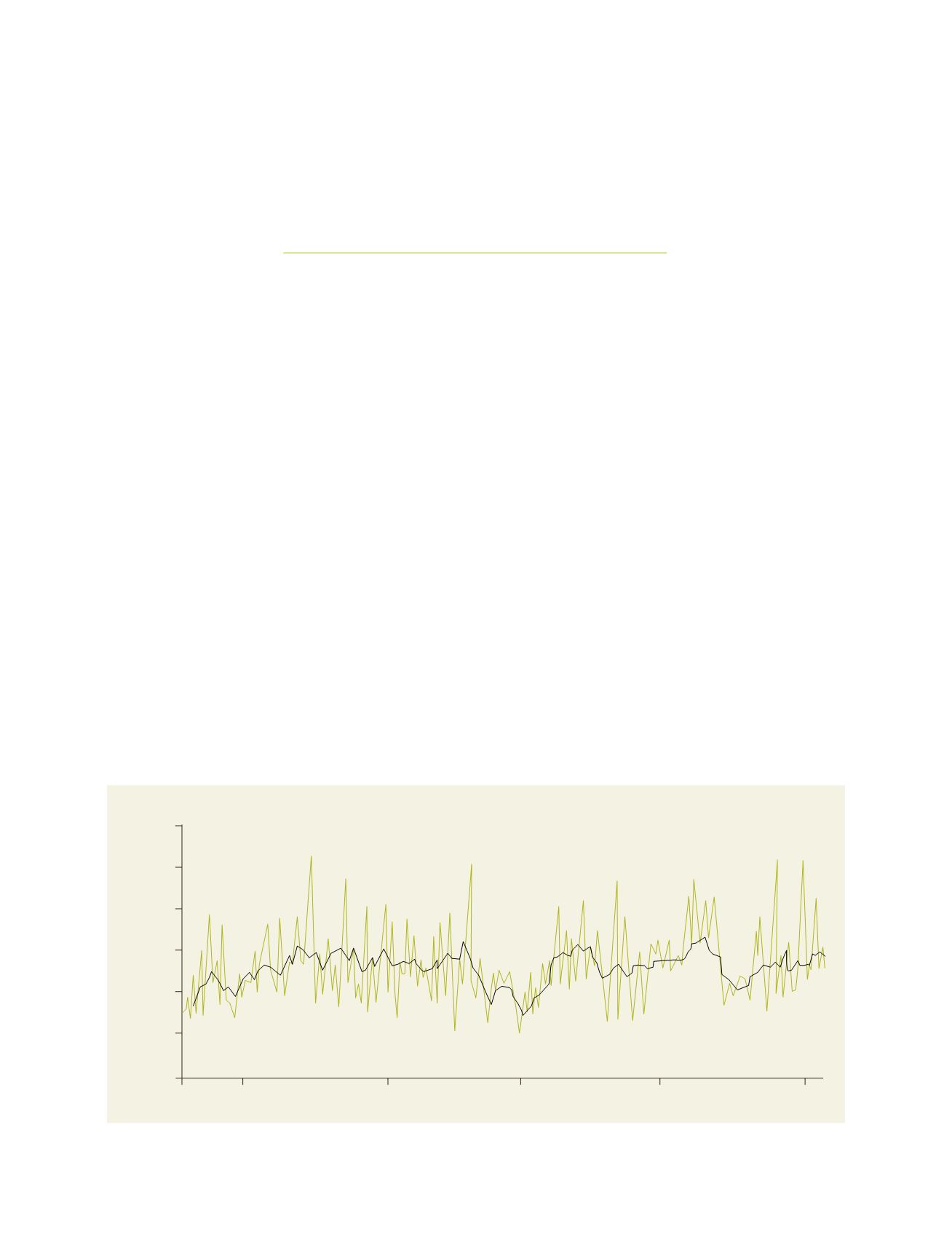
Precipitation (mm)
1777
1800
1850
1900
1950
2000
0
500
1000
1500
2000
2500
3000
Year
Annual precipitation with five-year moving average in Seoul, Korea from 1777 to 2007
Source: Jung et al, 2001