


 163 / 208

[
] 163
Green growth: the way to
achieve sustainable development
Young-sook Yoo, Minister of Environment, Republic of Korea
I
t is a common aspiration for all humanity to lead a happy
life. There are many elements that determine one’s happi-
ness, but of all things, creating a life of material sufficiency
is crucial. Humanity has pursued development and growth to
secure material prosperity, resulting in mass production and
excessive consumption. Economic growth during the 1970s
relied upon the use of fossil fuels, and the increase of green-
house gases in the atmosphere due to human activities further
led to the destruction of the ecosystem.
In 1992, leaders across the world gathered in Rio de Janeiro, Brazil to
come up with an all-round solution to address the major challenges
that humanity faces. In pursuit of a prosperous and sustainable
future, they adopted a strategy of sustainable development, which
encompasses economic development, environmental preservation
and social integration.
The United Nations Conference on Sustainable Development
(Rio+20), which will be held in Rio in 2012, 20 years after the
Rio Summit, bears extremely meaningful significance as it looks
back on our past footpath, as well as looking ahead to our future
journey towards global sustainable development. If we are to make
significant progress, the whole of humanity needs to join this move
to safeguard our precious planet. If there are shortcomings in our
efforts, we would certainly need to do more to make up for them.
After the mid-1990s, developing countries underwent rapid
economic growth, and we witnessed vast international agreements
being signed in the areas of climate change, biodiversity,
and anti-desertification. Yet we still have a long way to
go. People across the world are still struggling to make
ends meet, and the challenges of climate change and
resource scarcity are adding to such difficulties. Recently,
extreme weather conditions as well as frequent droughts
and floods across the world are threatening the survival
of humanity. This is especially true for the poor and the
vulnerable in developing countries. Last winter saw very
unusual cold weather and heavy snowfall around the
world. China recently suffered the worst drought in 50
years, which is likely to hurt its crop production.
At a time when the international oil price has soared
to well over US$100 a barrel, a continuous rise in energy
prices not only puts a huge burden on production, but
also hampers consumption. Needless to say, the damage
is especially profound on the poor and vulnerable.
Today, environmental disasters and economic crises
are not challenges confined to a single country. They
are global phenomena, and need to be tackled by both
advanced and developing countries.
The main agenda for Rio+20 is ‘Green Economy in
the context of Sustainable Development and Poverty
Eradication’. This is a very important point for discus-
sion in dealing with the environmental, economic and
social challenges of today and tomorrow, and in achiev-
ing the goal of sustainable development. According
to the 2011 Green Economy report from the United
Nations Environment Programme (UNEP), green
economy refers to a low-carbon, resource-efficient,
socially integrated economy. It is an economy that deals
with environmental risks and bioresources scarcity, and
improves social equity. At the same time, it contributes
to poverty eradication through investment and innova-
tion in the environmental sector.
There is no single set of rules for implementing a green
economy. Each country needs to set its own strategy, taking
into account its socioeconomic conditions and national
priorities. And each of these national green economy strat-
egies must be able to create synergies to achieve the ultimate
goal of global sustainable development.
Korea has made tireless efforts to achieve sustainable
development and a green economy. Since the middle of
the twentieth century, Korea has achieved remarkable
economic growth and democracy through a system-
atic economic development plan. Since President Lee
S
ustainability
P
olicies
, P
rogrammes
and
their
E
conomic
I
mpact
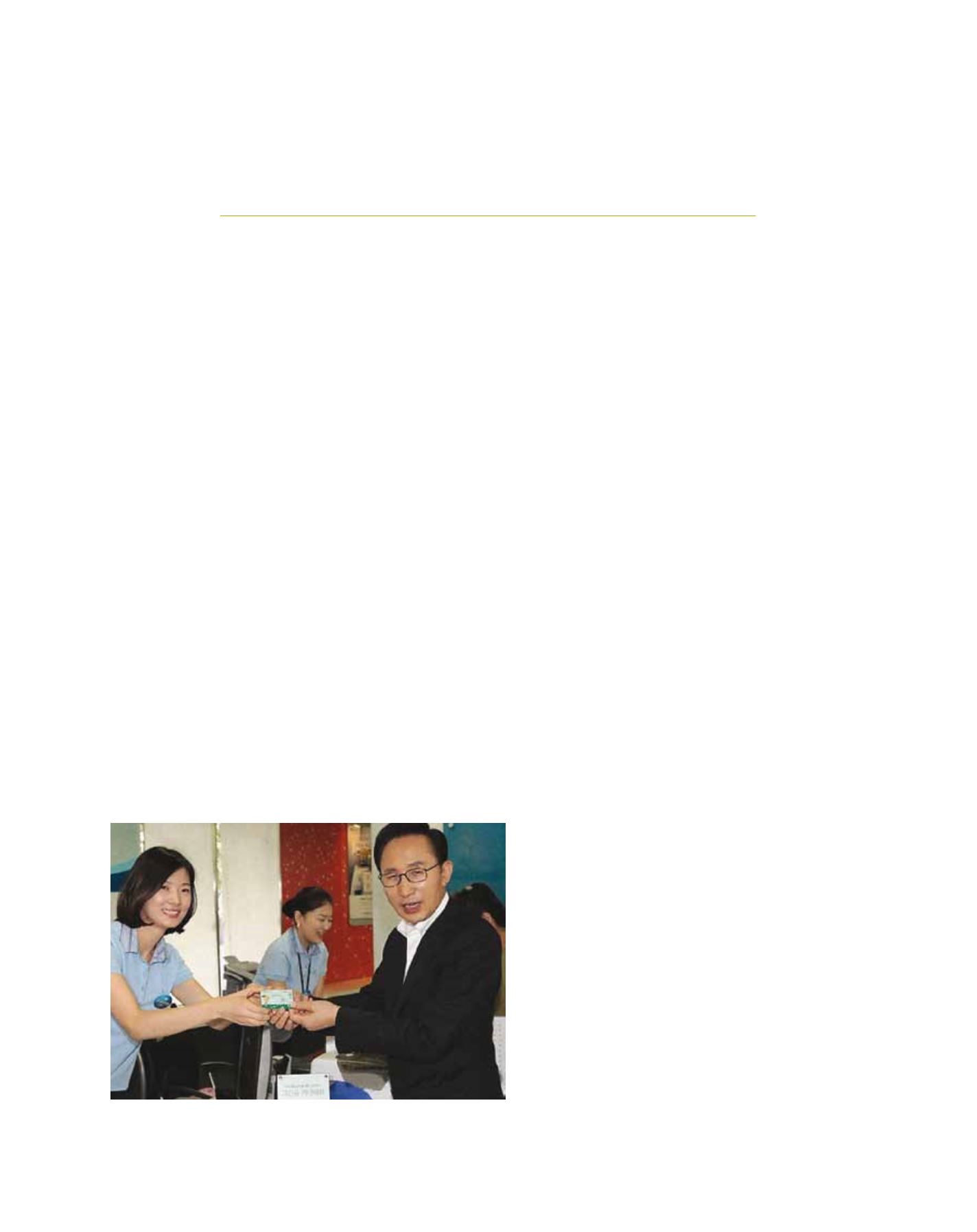
Green Card encourages people to become greener in their daily lives. President Lee
became the first Green Card holder
Image: Min of Env. Rep of Korea