


 164 / 208

[
] 164
S
ustainability
P
olicies
, P
rogrammes
and
their
E
conomic
I
mpact
On top of that, the Korean Government expanded
available eco-friendly energy sources while prepar-
ing regulatory measures and support for efficient
energy use, in order to encourage the general public
to consume less resources and turn to ecologically
friendly products with high energy efficiency. As part
of such efforts, incandescent light bulbs will no longer
be sold after 2013, and wider use of light-emitting
diode light bulbs with high energy efficiency will be
encouraged. In addition, strengthening of greenhouse
gas emission standards for vehicles has facilitated
the high-efficiency and low-emission vehicle market.
Households which demonstrate a green lifestyle –
such as purchasing eco-friendly products, using public
transport and saving energy – will receive ‘Green
Card.’ The ‘Green Card’ will reward them financially
and encourage them to become greener in their daily
lives. Moreover, daily household waste such as plastic
and bottles is recycled, and out of the waste that used
to end up in landfill, flammable waste is turned into an
energy source through refuse-derived fuel production.
Biomass produced from waste is also widely used for
Myung-bak declared a new national strategy of ‘Low Carbon, Green
Growth’ in 2008, the Korean Government has strongly pursued
green growth strategies. To this end, the Green Growth Committee
was established, together with Low Carbon, Green Growth Act. The
Government also committed to scale up the greenhouse gas emis-
sion reduction target to 30 per cent compared to the projection
rate, and made a decision to invest 2 per cent of the national gross
domestic product in the green growth sector. Green growth refers to
a strategy that creates jobs, boosts income, and promotes economic
growth, while avoiding environmental degradation. This is a Korean
model of sustainable development, and we believe that it is the most-
effective and substantive means to achieve a green economy.
The initiative that is especially notable is the Four Rivers
Restoration Project, which was launched in order to effectively
manage water resources and to strengthen our capacity to deal
with natural disasters such as droughts and floods caused by
climate change. This project is an exemplary case of Korea’s green
growth strategy. The Korean Government invested KRW22.2 tril-
lion in this project, created 340,000 jobs and reaped economic
benefits equivalent to KRW40 trillion. Despite last year’s record
level of torrential rain, the damages were reduced to 10 per cent
of those in previous years with similar precipitation.
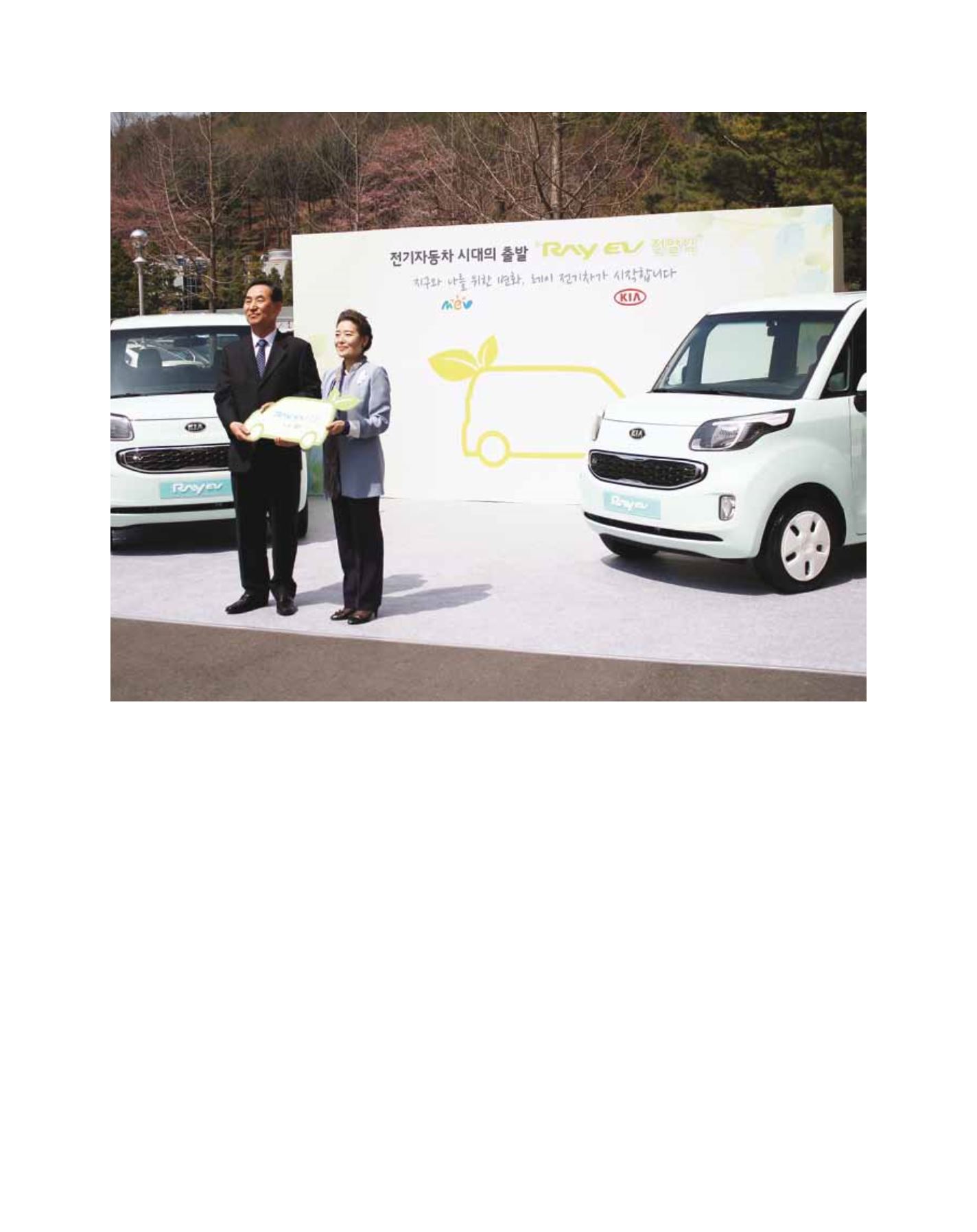
The Korean government implemented policies to commercialize electric vehicles which will help people lower their carbon emissions in their daily lives
Image: Min of Env. Rep of Korea