


 129 / 168

[
] 129
ability prevails. The ACF pastoral surveillance and early warning
system has benefited from a series of local-level assessments and
studies aimed at achieving a better understanding of pastoral
vulnerabilities.
The GIS-based surveillance and early warning system has been
progressively improved over the years – and it is still being
improved today. The ACF system can provide useful indications of
the vulnerability of pastoral populations or warn of possible disas-
ters and food shortages resulting from drought. It can also be used
to target the most drought-affected populations. The National Early
Warning System (SAP) in Mali and Niger and the Livestock Ministry
are now the main users of the system
(http://www.sapmali.net).
During the 2004-2005 crisis affecting Mali and Niger, the system
was used to support the Mali SAP in identifying the most vulnerable
areas and to assist operational agencies (such as the United Nations
World Food Programme and non-governmental organizations) to
target the most vulnerable areas in an appropriate way. In 2009-
2010, ACF again supported the Mali SAP in targeting the vulnerable
areas. The maps produced have been overlaid with data on move-
ment patterns gathered from local partners and associations. At this
time, the security context in Sahel worsened, and using satellite
imagery has been considered as a suitable option to avoid threats
while collecting ground data. In both cases, the surveillance system
has proved its efficiency and allowed a quicker and sharper response
to support vulnerable people and livestock, thus avoiding food and
nutrition crises.
Future developments
The GIS-based surveillance and early warning system
can be improved, particularly since currently, existing
tools and methods only provide macro-level analyses,
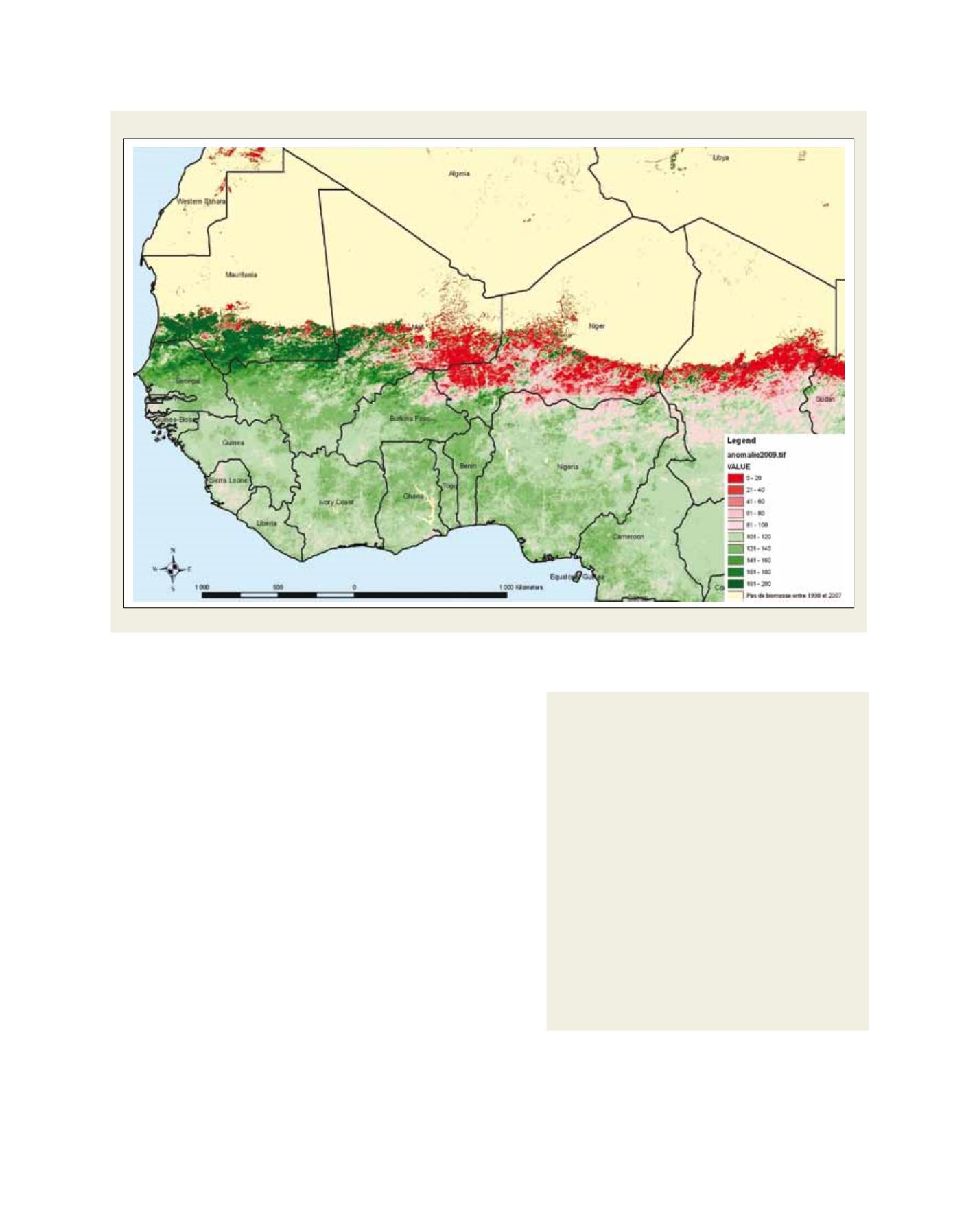
Biomass anomaly, rainy season 2009. West African Sahel
Source: ACF International and VITO
Collaborative efforts towards an early warning
system and DRR
The ACF system has been progressively developed
and implemented in partnership with multiple partners
including local, national, regional and international
governmental institutions and research centres. These
partners include the breeders associations and corporate
bodies, National Early Warning System (
Systèmes d’Alerte
Précoce
or SAP) and the Livestock Ministries in Mali
and Niger (at present the main users of the system);
the Agrhymet centre in Niamey (Niger); the Institute of
Research and development (IRD) in Bamako (Mali) and
the Research Group for Rural Development (GRDR) in
Nouakchott (Mauritanie).
ACF is at present building more partnerships, in Sahelian
countries and also at international level, for example with
the University of Louvain La Neuve (Belgium) and University
of Geneva (Switzerland), the Joint Research Centre of the
European Commission in Ispra, Italy and the
Vlaamse
Instelling voor Technologisch Onderzoek
(VITO) company
in Belgium (which produces digital data and makes them
available to users on the internet).