


 17 / 196

[
] 15
As such, the event now serves as the global forum for
disaster reduction and provides for the coming years’
strategic guidance and coherence for implementing the
Hyogo Framework. This needs to be grounded in devel-
oping more opportunities and abilities for sharing
experiences and expertise among all its stakeholders. In
practical terms, this means the development of more
and better ways to accomplish the following actions:
Raising awareness and understanding about reducing
disaster risks by
– increasing the profile of disaster risk
reduction as part of development and climate change
adaptation; recognizing that it is ‘everyone’s business’,
advancing as a multi-stakeholder undertaking, but with
governments playing a central role; and re-enforcing
policy and decision-makers’ commitments to implement
the Hyogo Framework for Action.
Sharing experience by
– learning from good practice
and others’ experience; and providing practical guid-
ance for nations and communities to reduce disaster
risks.
Guiding the ISDR system by
– assessing progress made
in implementing the Hyogo Framework, and identify-
ing obstacles, critical problems and emerging issues that
must be addressed to enhance national and local imple-
mentation; and improving cooperation and concerted
action by the international community to support
national and local implementation of disaster risk reduc-
tion.
To appreciate what this means in practical terms, and
how that may guide future educational directions and
emphasis, the opening remarks of Under-Secretary
General John Holmes to the first session of the Global
Platform are noteworthy:
“To be genuinely convincing, we need to know what
we can and must do in practice. First, we must priori-
The goal of the Global Platform for Disaster Risk Reduction, as
the main body of the ISDR system, is to sustain worldwide momen-
tum to build the resilience of nations and communities to disasters.
1
It provides the main global forum for representatives of governments
and other stakeholders including UN agencies, regional bodies, inter-
national financial institutions, civil society, the private sector and
the scientific and academic communities to:
1. Assess progress made in implementing the Hyogo Framework
for Action
2. Enhance global awareness of disaster risk reduction
3. Share experiences among countries and learn from good practice
4. Identify remaining gaps and actions needed to accelerate
national and local implementation of the Hyogo Framework.
The Global Platformmeets every two years, under the chairmanship of
the United Nations Under-Secretary General for Humanitarian Affairs.
The first session was held in June 2007 in Geneva, Switzerland and
was chaired by John Holmes. The second session of the Global Platform
is scheduled to take place in Geneva, Switzerland 16-18 June 2009.
This first session brought together over 1,100 participants includ-
ing representatives of 124 member states of the United Nations, and
105 regional, inter-governmental and non-governmental organiza-
tions engaged in the International Strategy for Disaster Reduction.
In meeting together, these participants also engaged the interests of
international financial institutions, civil society, the private sector
and the scientific and academic communities to raise awareness of
disaster risk, to share experience and to guide the ISDR system.
To address these needs, the participants were drawn from many
professional interests and various programme sectors, particularly
those related to development and humanitarian fields along with
environmental and scientific subject areas relevant to disaster risk
reduction. They all shared the purpose of supporting countries to
increase their commitments and capacities for disaster risk reduc-
tion through the implementation of the Hyogo Framework for
Action.
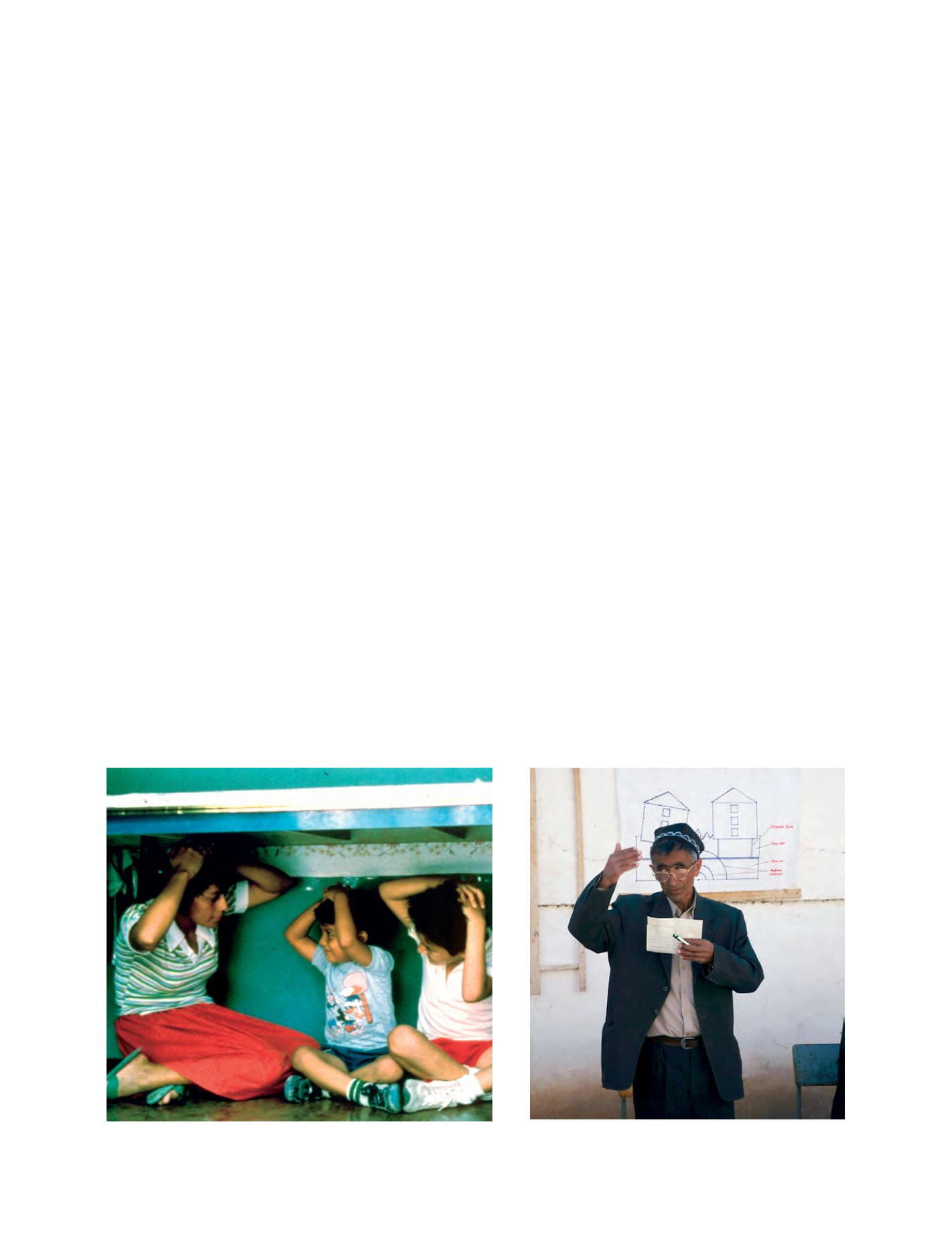
This young Mexican family practices protective action in preparing for an earthquake
Image: Program on Emergency Preparedness and Disaster Relief,
of the Pan American Health Organization (PAHO/WHO)
Community training in Tajikistan
Image: UN/ISDR, Tine Ramstad, 2006