


 18 / 196

[
] 16
tize those countries and areas at greatest risk from earthquakes,
floods and other natural hazards. We must build ‘smarter and safer’
where populations are most vulnerable. Second, we must act to
protect the world’s investment in development. We can reduce these
huge losses by weaving risk reduction policies into the overall fabric
of international lending and development policies. Finally, we must
continue to strengthen the institutional pillars that support disaster
risk reduction, through reinforcing our partnerships – amongst ISDR
members, between government and non-governmental organiza-
tions, and between the public and private sectors.”
Sustained educational and technical
support for the Global Platform
In considering how sustained educational and technical support may
be accomplished most effectively, there may be some value in taking
a cue from the three primary principles of McDonald’s global
hamburger marketing strategy – famously referred to as: ‘location,
location and location’. In the case of developing deep and sustained
understanding for the commitment and engagement of disaster
reduction, it may be altered somewhat to ‘education, education, and
education’. While there is indeed much that can, and should be done
in national governments, through local communities, and with
private sectors, the area of greatest presently unrealized opportunity
for impact is through our schools and educational programmes. In
countries and communities around the world, education, training
and schools in their many types are universally valued and unques-
tioned as being in the public interest. They extend honour and
respect for past knowledge, even as, more importantly, they represent
investments in the future.
For individual people, education is an accessible tool extended by
key social institutions that provide knowledge and shape behaviour.
Educational systems at all levels of personal and professional devel-
opment, should be the first line of awareness and enlightenment –
but how many departments of education or local school boards
consider themselves to be at the forefront of public well-being and
protection from disaster risks? The media and other
public communicators are also crucial means of provid-
ing sustained and informed public education. Public and
commercial advertising both seek to influence the
public’s knowledge and habits, but to what extent are
shared public risks and concerns currently evident in
advertising campaigns?
At another level of education, scientific, technical and
other ‘practitioner’ communities can do much to guide
and inform the work of governments. There is a consid-
erable amount of experience that they can draw upon
to carry out the practical work of implementation –
whether their skilled individuals are employed by
universities, companies, government departments, local
authorities or civil society organizations. While one may
most immediately look to educators for individual exam-
ples of specialist knowledge, as a group practitioners are
too seldom sought or engaged for their considerable
power of collective influence.
As disaster reduction becomes more widely embraced
with more professional and public interests involved, a
new group of educators will become essential. These are
the communicators and ‘connectors’ who have the skills,
abilities and contacts that make them unequalled in
being able to bridge gaps between single or otherwise
self-focused academic or professional disciplines.
However to be effective and useful in advancing the
understanding and practice of disaster reduction they
have to be identified, enlisted, informed and engaged.
It may be timely to ask to what extent the ‘disaster and
risk management communities’ have yet sought such
connectors, translators and motivators as crucial collab-
orators for education?
Taken together, these comments may illustrate some
of the current limitations. Namely, not enough attention
or resources are yet devoted by existing institutions
either for ‘applied education for disaster risk reduction’
or in efforts to express ‘risk communications’ sufficiently.
These concerns may apply between different professions,
or amongst various academic departments and study
programmes within individual institutions. They can
also exist between people who generate knowledge and
convey technical abilities through research and educa-
tion on one hand, and other professionals who are
primarily involved in using that knowledge in practice.
Effective communication and shared understanding
of common values and concerns has frequently been
cited as an area of frustration or disappointment between
technical experts and decision or policy makers. Equally,
one may cite often-varying viewpoints on disaster risks
of local concerns expressed by the public, in contrast to
the roles and responsibilities demonstrated by govern-
ment officials at various levels.
Many of these unfulfilled opportunities for more
emphasis on education, for greater disaster risk aware-
ness and understanding have been seen in evidence
following crises such as: the Indian Ocean tsunami, the
devastation and social disparities associated with
Hurricane Katrina, the often politically motivated
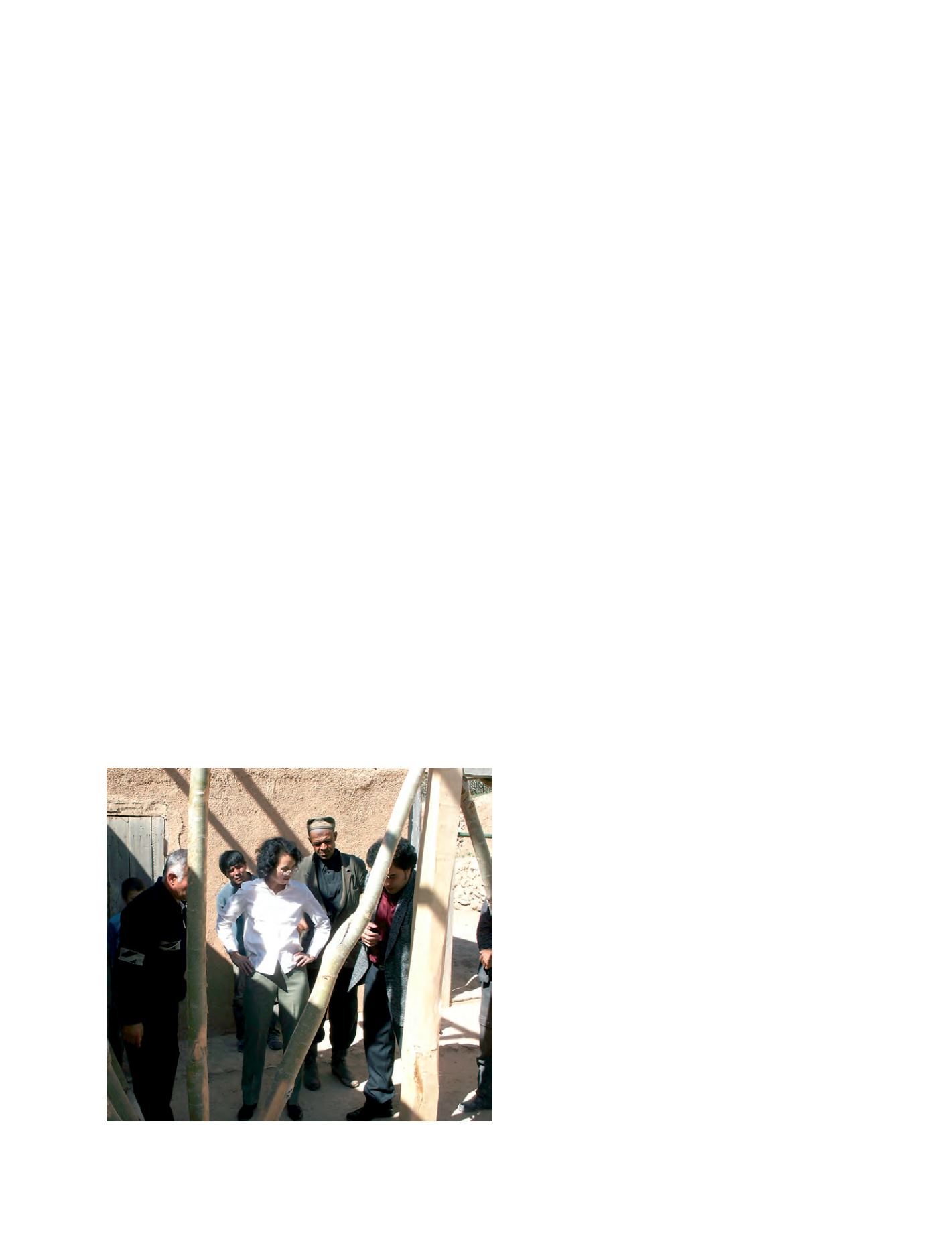
UN/ISDR visits building in Tajikistan site to look at reinforcements inside the house
Image: UN/ISDR, Tine Ramstad, 2006