


 24 / 196

[
] 22
Preparing now – international
cooperation for future resilience
Tony Pearce, Director General, Emergency Management Australia, Attorney-General’s Department, Australian Government
A
ustralia is a relatively isolated island continent which
experiences an extreme range of disaster-related crises.
Completely bound by oceans, the country is somewhat
less vulnerable to many diseases and migratory disturbances
suffered by the interlinked continents in the northern hemi-
sphere. Yet it suffers from some of the worst droughts, bushfires,
heatwaves and floods on Earth, is bombarded by devastating
cyclones and severe storms, and is vulnerable to much coastal
storm impact including the threat of tsunami.
On top of all this the country must accommodate climatic variation
from monsoon and desert temperatures upwards of 55 degrees
Celsius, down to icy conditions of minus 10 degrees or more. And
this is not including the country’s Antarctic territory. Australia has a
current population of around 21 million who reside mostly on the
eastern seaboard.
So it is not surprising that, as a developed western
democracy, Australia has needed to make substantial
advances in emergency management and has developed
sophisticated community safety procedures. All this has
led to a remarkably low death rate from natural disasters
in recent decades.
The nation’s premier emergency management body –
Emergency Management Australia (EMA) – was origi-
nally created as the Natural Disasters Organisation in
1974, just a few months before the northernmost city
of Darwin was completely destroyed by cyclone, forcing
the evacuation of almost its entire population of 35,000
residents. We have learned a great deal since that event
and are now envied by many countries for the extent of
public preparedness and degree of community safety.
Though Australia has an indigenous history going
back millennia, its westernized civilization is just 220
years old. Now it has the widest mix of nationalities of
any nation and continues to embrace immigration from
across the globe. We have three tiers of government –
federal, state and local. However, under the country’s
constitution it is the state governments that take the lead
responsibility for emergency response.
Towards self-reliance
Australia, like other countries, faces a raft of new chal-
lenges brought about by the impact of climate change.
It is inevitable that we will see an increase in the impact,
intensity and severity of natural disasters over the
coming decades. These challenges should be respected,
not feared. They should be seen as creating opportuni-
ties for us to test the bounds of our ability and ingenuity.
In doing so these challenges should allow us to be better
placed to ensure that by working together within our
country, and within our region, we are truly delivering
enhanced public safety outcomes towards more resilient
communities.
However, emergency managers in this country recog-
nize that there is a need for a paradigm shift in the
approach to emergency management by both govern-
ments and communities – a shift from expectation and
dependence towards self-reliance and resilience.
In recent decades, the number of people affected by
what could be called ‘climate disasters’ such as droughts,
floods, landslides and storms has been rising. Recent
natural disaster events include the Indian Ocean
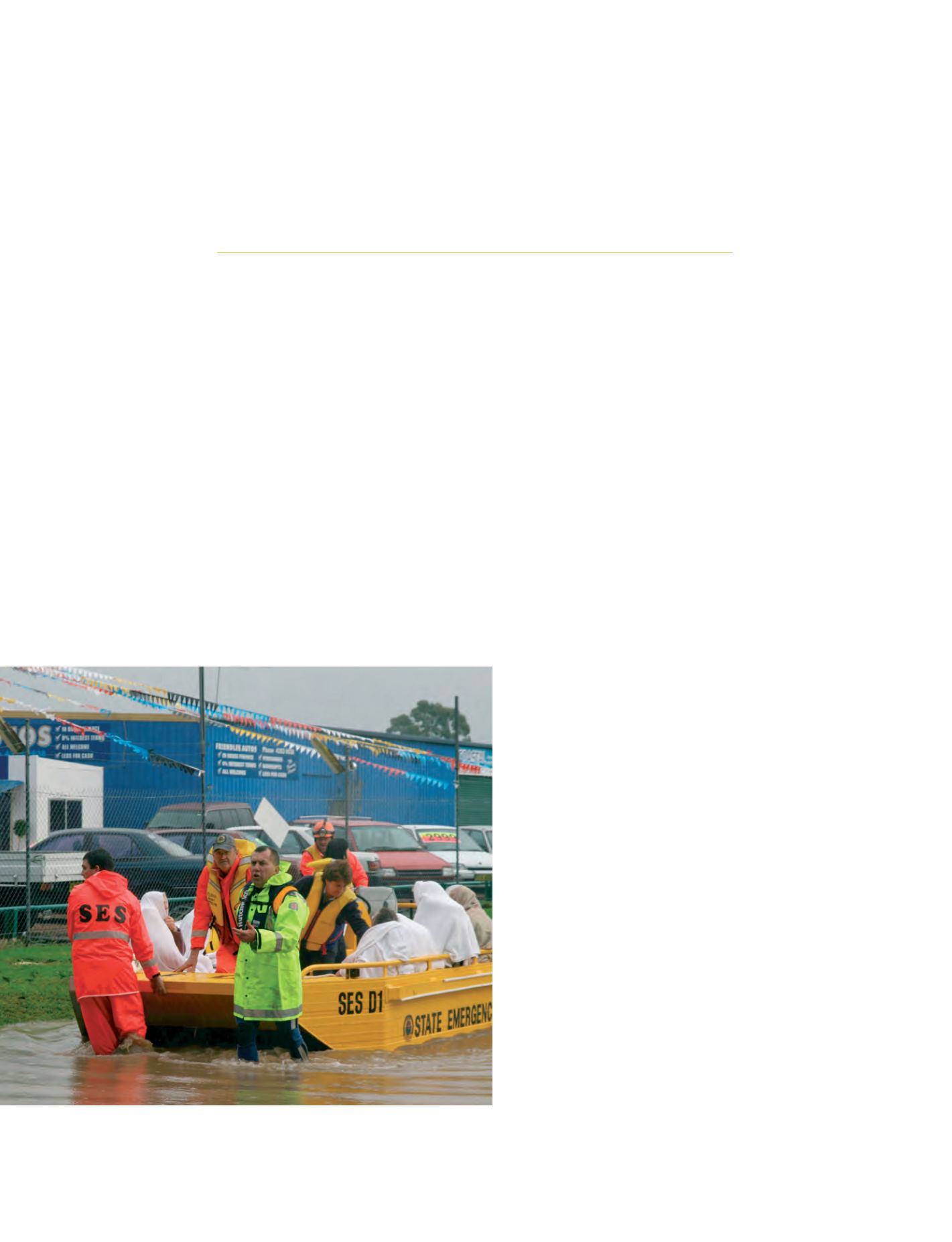
State Emergency Service and ambulance officers evacuate elderly residents from a
flooded nursing home, June 2007
Image: courtesy NSW SES