


 25 / 196

[
] 23
affected by disasters is predicted to worsen, with even
modest temperature rises associated with climate
change.
5
Evidence shows that strategic investment in disaster
mitigation will reduce disaster damage and ad hoc relief
payments over time.
6
The development of long-term
and sustainable mitigation strategies is a key to
Australia’s future security in the disaster management
context.
Focus on mitigation
Key mitigation strategies that EMA has managed for the
Australian Government over recent years, in partner-
ship with other national, state and local governments,
include the following.
Natural Disaster Mitigation funding programme
– This
has the objective of shifting the focus from response to
cost effective, evidence-based measures that contribute
to communities being better able to withstand the effects
of natural disasters. These measures include natural
disaster risk management studies, warning systems,
community education initiatives and structural works
to protect against damage, such as flood levees, cyclone
shelters and bushfire asset protection zones.
Working Together to Manage Emergencies project
– A
funding scheme to provide grants to local communities
– with the objective of developing self-reliance at both
the community and local government level in order to
enhance community safety and build the capability of
communities to prepare for, respond to and recover from
tsunami, Hurricane Katrina, the Pakistan earthquake, and wildfires
in California and in Greece. Within Australia – the 2003 Canberra
wildfires, the Category 5 Tropical Cyclone Larry that impacted
Queensland in March 2006, the Victorian highlands’ bushfires and
extreme east coast storms of 2007.
Current evidence points very clearly in one direction: namely, that
climate change will increase the risk of exposure to climate disaster.
Globally, there has been a five-fold increase in the number of people
affected by disasters over the last four decades.
1
It has been estimated
that natural hazards cost Australia AUD1.25 billion annually.
2
Climate change is also likely to have important ramifications for
security, our existing capacity to respond to natural disasters, and
the global balance of power. It is expected to cause increased
numbers of refugees as a result of flooding in low-lying states and
increase the range of certain diseases – and in turn, such stresses
may bring about conflict.
In a 2006 report by the respected Lowy Institute in Australia, it
was noted that there will be international security consequences of
climate change especially for our country’s Asia-Pacific neighbour-
hood. This report highlighted the implications of temperature
increases and sea level rises on food, water, energy, infectious disease,
natural disasters and environmental refugees, and asked whether
scientists may have underestimated climate change risks.
3
Adding to this, Australian Federal Police Commissioner Mick
Keelty APM recently commented that food and water shortages may
cause mass migration and that “climate change is going to be the
security issue of the 21st century.” Australia’s present government
has stated in its plan for International Development Assistance and
Climate Change that the impacts of climate change “have security
issues which cannot be ignored”.
4
Clearly, the number of people
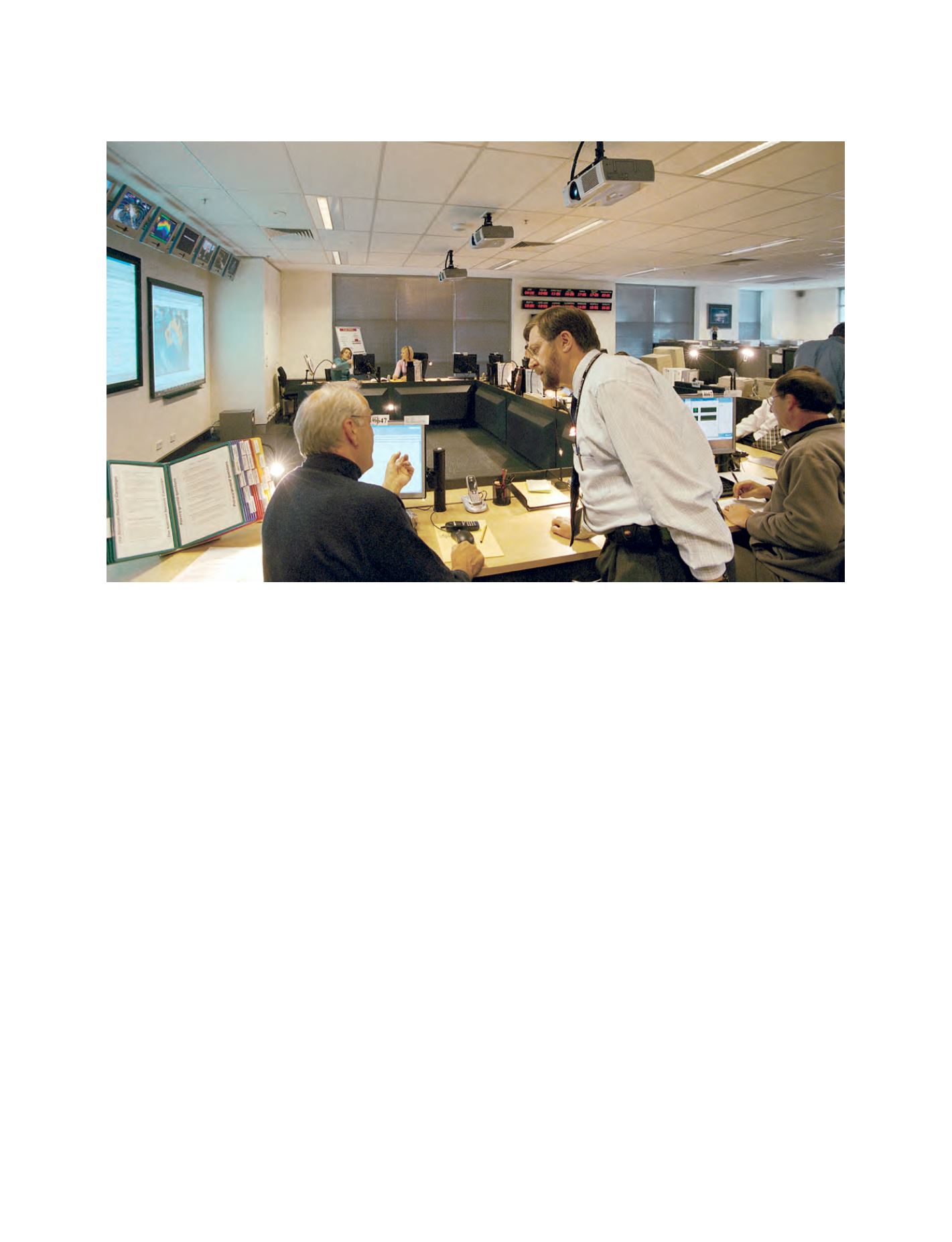
EMA staff focus on planning in the organization’s Incident Management Facility
Image: EMA