


 28 / 196

[
] 26
Future challenges
One of the challenges for the future is to manage
community expectation in such a way that it becomes
realistic. The days of working to the community and
providing to them what we decide they need are long
gone. Today we must work with the community and
our regional partners to ensure that they have owner-
ship of their own safety outcomes, to better be able to
provide a facilitation role, and to better understand
exactly what level of support will be required come that
fateful day when we have to assist them to deal with an
emergency.
With a focus on our government working together to
build partnerships with the private sector, including
volunteers, and to develop evidence-based national miti-
gation programmes, we can expect to see a less
complacent community, better prepared to withstand the
increasing impacts of natural disasters upon Australia.
Furthermore, in engaging with our international part-
ners, we aim to see best practice emerge in our
emergency management practices, as well as a height-
ened level of resilience and, in particular, strong
partnerships able to withstand disasters that could have
a collective impact upon us.
To paraphrase our Prime Minister’s view: When a disas-
ter strikes nationally, the approach to response and recovery
will need to be global. Through cooperation we can reduce
the impact of an emergency on our communities.
Rudd MP, said: “Australia today lives in an increasingly joined-up
world. If Australia fails to engage with the global economic, secu-
rity and environmental challenges, we will simultaneously fail to
deal with their impact on our own country. In order to advance
Australia’s interests at home, we must increasingly be engaged with
other nations in responding to the challenges to those interests
abroad.”
7
To this end, managing public reaction, ensuring efficient cross-
government coordination, and having the necessary capability prior
to, during and following disasters irrespective of their cause, are crit-
ical components in Australia’s emergency management environment.
EMA will be working with its partners in government and within
our region to:
• Develop a national adaptation research plan on climate change
impacts and adaptation options for disaster management and
emergency services
• Look at developing national public education and preparedness
programmes at the grass roots to build disaster-ready, resilient
communities
• Encourage communities to be more self-reliant and harness the
power of volunteers to develop self-reliance
• Enhance greater coordination across governments and in build-
ing partnerships with the private sector, to increase resilience
and ensure that we are at least halfway resourced to limit the
impacts of and respond to large-scale events
• Improve disaster management capacity building for developing
countries in our region in order to aid their own community
resilience efforts.
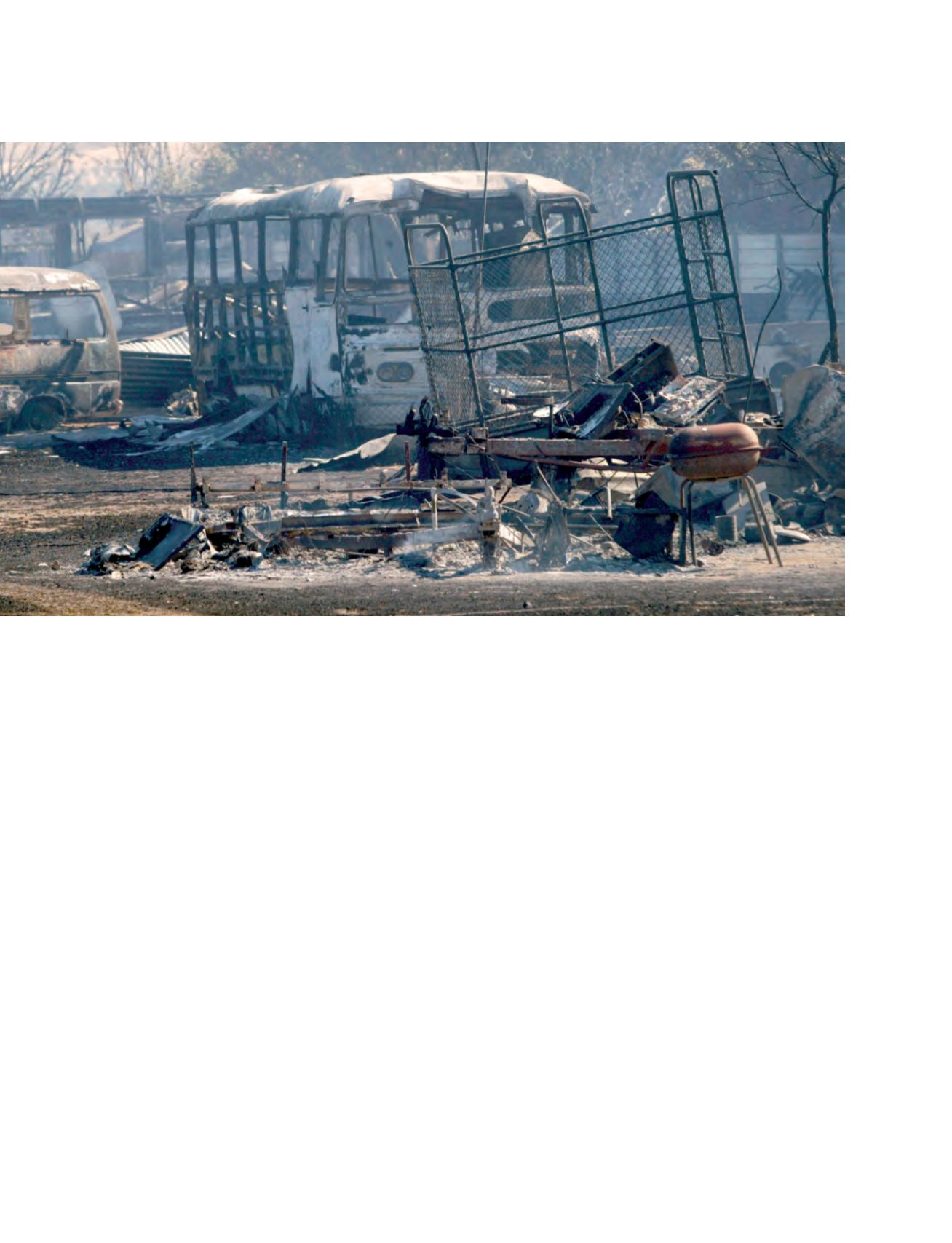
Bushfire devastation in South Australia, 2005
Image: EMA