


 27 / 196

[
] 25
• Managing a whole-of-government disaster risk management
institutional strengthening project in the Solomon Islands
• Reviewing the disaster management capacity and processes of
the Sri Lankan Government
• Working with the Indonesian National Coordinating Agency for
Disaster Management.
The aim of these projects has been to help develop capacity and capa-
bility and to coordinate holistic disaster management programmes
and responses at all levels for these countries.
EMA also maintains relationships with a range of regional orga-
nizations with a role in disaster management, such as the South
Pacific Applied Geoscience Commission and Association of South
East Asian Nations. It has also taken a significant interactive role
with all 21 Asia Pacific Economic Cooperation forum economies, by
managing exercises to increase communication between member
economy emergency management organizations.
Our international partnerships strengthen our ability to jointly
manage natural disasters. Further cooperation will enable us to
develop best practice mitigation strategies, which in turn, will lead
to a new level of regional resilience in managing the impacts of
climate change.
Exposed communities
The 2007
National Climate Change Adaptation Framework
recognized
that Australia’s coastal urban communities and remote communities
are particularly exposed to the risks associated with extreme events.
Australia has established a future framework that states:
“Climate change impacts need to be factored into
natural disaster management risk reduction, emergency
services planning, and recovery management, especially
for areas more vulnerable to extreme events.
Community awareness and developing a culture of
preparedness in conjunction with emergency services
will contribute to effective adaptation responses.”
Building upon the recognition of the role of invest-
ment in limiting the impact of natural disasters, and in
building community resilience, as evidenced by the
various programmes currently administered, the Federal
Government is currently undertaking a comprehensive
review of homeland and border security arrangements.
This review is part of the newly elected Australian
Government’s commitment to examine the need for change
in our homeland and border security arrangements. It will
consider the roles, responsibilities and functions of depart-
ments and agencies involved in security, to optimize the
coordination and effectiveness of their efforts.
Climate change, along with the world disaster envi-
ronment and the increasing level of community and
political expectations placed upon the emergency
management sector, will no doubt heavily influence the
development of future Australian emergency manage-
ment strategies.
In his recent address to the East Asia Forum regard-
ing advancing Australia’s global and regional economic
interests, Australia’s Prime Minister, the Hon Kevin
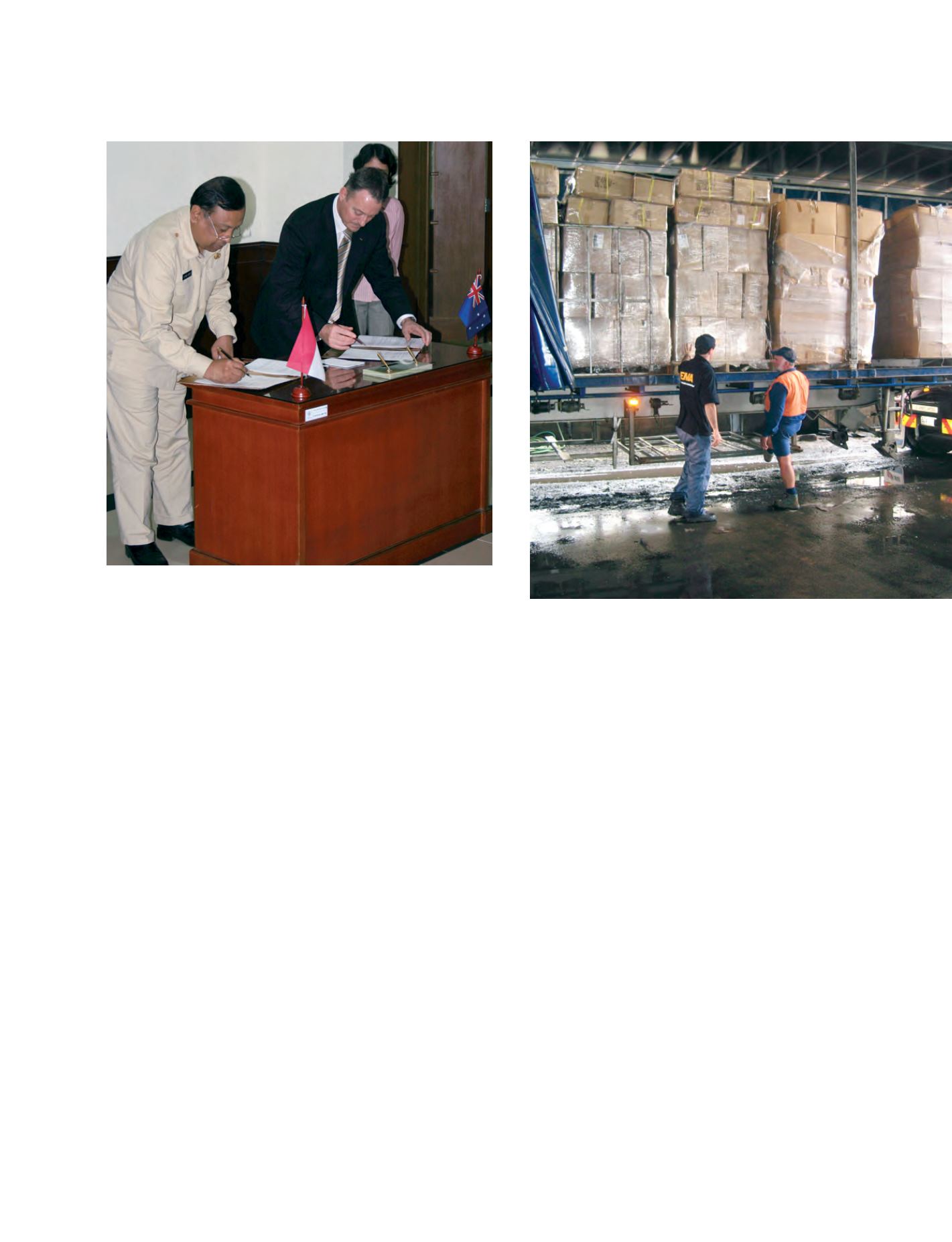
Syamsul Ma`Arif, Executive Officer in Charge of the Indonesian National Coordinating
Board for Disaster Management (BAKORNAS PB) and Tony Pearce, Director General,
EMA, signing a partnership arrangement concerning disaster management,
December 2006
Image: EMA
An EMA officer oversees the loading of tarpaulins to cover homes
damaged in Tropical Cyclone Larry, Queensland, March 2006
Image: EMA