


 26 / 196

[
] 24
disasters and emergencies arising from any hazard. It provides funds
to implement emergency risk management initiatives, identify
vulnerabilities and provide training for local government staff.
National Emergency Volunteer Support Fund
– A fund to boost the
recruitment, retention and training of volunteer organizations at the
frontline of emergency management.
Bushfire Mitigation Program
– The objective of this is to identify
and address mitigation priorities to enable communities to better
prepare for, respond to and withstand the effects of bushfires.
National Aerial Fire-fighting Arrangements
– To ensure equitable
national access to aerial fire-fighting equipment.
Tsunami Warning Implementation Program
– This is aimed at
providing a comprehensive tsunami warning system for Australia;
to support international efforts to establish an Indian Ocean tsunami
warning system; and to contribute to the facilitation of tsunami warn-
ings for the South West Pacific.
An inclusive programme for culturally and linguistically diverse
communities
– This has the objective of raising awareness in such
communities of emergency management facilities, enhancing commu-
nity resilience to the effects of disasters, and increasing community
engagement in emergency management volunteer activities.
National Forum on Emergency Warnings to the Community
– This
works to improve delivery of emergency warnings to all communi-
ties including disabled, culturally diverse and remote and indigenous
communities.
Urban Search and Rescue Capability Development Project
– This
enhances Australia’s overall capability through the provision of train-
ing, policy and equipment.
Capability Research and Development Program for
Chemical, Biological and Radiological events
– To
improve Australia’s ability to prevent, prepare for, and
respond to such incidents.
Fortunately, the increasing awareness of the likely conse-
quences of natural disasters in Australia has resulted in a
further strengthening of relationships between Australia’s
Federal Government and state and territory governments,
as well as the imperative for us to work with our regional
partners in building our emergency management capacity.
EMA, a division of the Federal Attorney-General’s
Department, continues to work closely with state and
territory emergency management organizations and
related Australian Government agencies. There are also
strong links with local government bodies, non-govern-
ment agencies, community-based organizations,
volunteers in the emergency sector, academia and
researchers, the business community, industry bodies
and individuals. There is a clear effort to increase
Australia’s capacity and capability to deal with the poten-
tial consequences of threats to citizens.
Meanwhile EMA’s international partnerships have also
been expanding as Australia takes a greater role in
regional emergency and disaster response and recovery.
International effort
On an international level, EMA has contributed to the
efforts of its neighbours by:
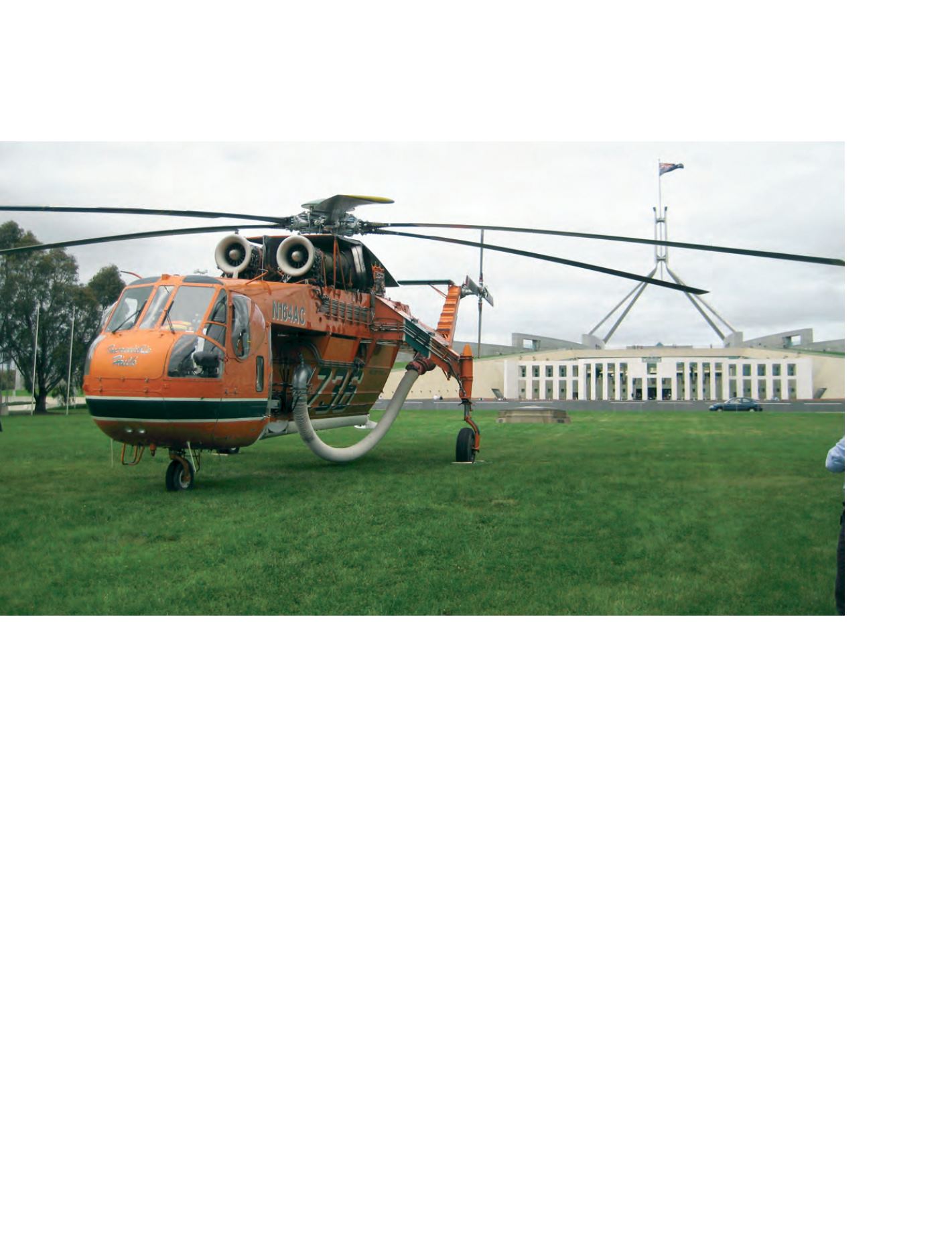
Sky-crane water bombing helicopter
The Incredible Hulk
on arrival in Australia’s capital Canberra in December 2007 – shown in front of Parliament House
Image: EMA