


 30 / 196

[
] 28
because of reliance on distant resources and just-in-time
inventory delivery, with the result that the economic
impact of a natural hazard event can be much broader
than its storm track or rupture zone.
The fifth challenge is to develop standardized methods
for communities to measure and assess disaster
resilience across multiple hazards. A key implementa-
tion step is developing and distributing community
assessment tools that can be applied to setting priorities
in order to maximize resilience. Federal agencies must
work with universities, local governments, and the
private sector to identify effective standards and metrics
for assessing disaster resilience. With consistent factors
and regularly updated metrics, communities will be able
to maintain report cards that accurately assess the
community’s relative level of disaster resilience.
The final challenge is to promote risk-wise behaviour.
The costs of natural disasters are rising as people increas-
ingly move into harm’s way in low-lying coastal areas,
the wildland-urban interface and geologically active
regions. In order to achieve ‘hazards literacy’ and
sustained risk reduction, hazards must be real to people.
Scenarios are a tool that can spell out the impacts of
likely events on high-risk areas, combining scientific
and engineering knowledge with local planning and
emergency management expertise to deliver a compre-
hensive picture of potential losses to encourage
mitigation measures.
From a global standpoint, these grand challenges
reflect the contributions that science and technology can
make towards achieving the Hyogo Framework for
Action. Adopted in 2005 during the World Conference
on Disaster Risk Reduction in Kobe, Japan, the agree-
ment calls on participating countries to:
1. Ensure that disaster risk reduction is a national and
local priority
2. Identify, assess and monitor disaster risks, and
enhance early warning capabilities
3. Use knowledge, innovation and education to build
a culture of safety and resilience at all levels
4. Reduce the underlying risk factors
5. Strengthen disaster preparedness for effective
response at all levels.
The common goals of the Hyogo Framework and the
grand challenges reflect a shared commitment to build-
ing more disaster-resilient communities. Each of the
hazard-specific implementation plans includes a section
that identifies the same set of desired outcomes for
meeting the grand challenges: a nation where relevant
hazards are recognized and understood; where commu-
nities at risk know when a hazard event is imminent;
where individuals can live safely in the context of our
planet’s extreme events; and where disaster-resilient
communities experience minimum disruption to life and
economy after a hazard event has passed. Through the
application of science and technology, the US will strive
to achieve these outcomes at home, as well as encour-
age their application around the globe.
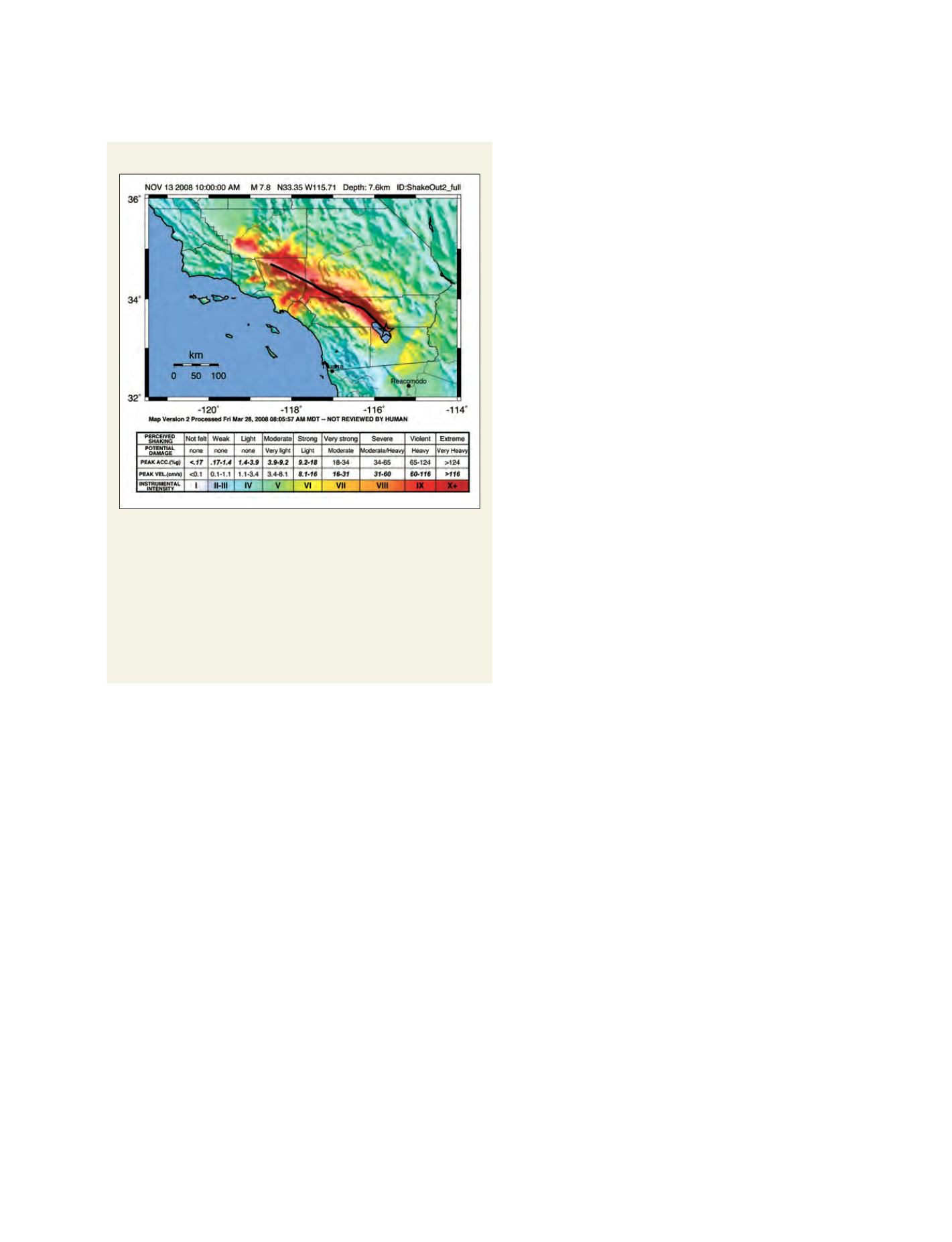
Southern California Earthquake Scenario
Source: US Geological Survey
This ShakeMap depicts expected ground shaking from a magnitude-7.8
earthquake on California’s southern San Andreas Fault. These estimated shaking
intensities were used as the basis for developing a scenario exploring the
economic and social impacts that such an earthquake would have on the more
than 20 million people who live in southern California.
2
In November 2008, the
scenario will be used as the basis for emergency response and public
preparedness exercises in order to improve the risk-wise behaviour in southern
California communities. The colours reflect the Modified Mercalli Intensity scale
with warmer colours representing areas of greater damage
The third challenge is to develop hazard mitigation strategies and
technologies that can reduce the impact of extreme events on both the
built environment and vulnerable ecosystems. Scientists must invent –
and communities must implement – affordable and effective hazard
mitigation strategies, including land-use planning and zoning laws that
recognize the risks of natural hazards. In addition, technologies such
as disaster-resilient design and materials, as well as smart structures
that respond to changing conditions, must be used for development in
hazardous areas. Meeting this challenge will also require developing
an understanding of the social, cultural, and economic factors that
promote or inhibit adoption and enforcement of these and other
promising mitigation technologies. Getting the right incentives in place
for mitigation is the key to successful loss reduction.
The fourth grand challenge is to reduce the vulnerability of infra-
structure. One of the greatest obstacles to recovery in any disaster is
the delayed restoration of critical infrastructure such as transportation,
drinking water, electricity, and gas distribution systems. A key imple-
mentation step is establishing the technical basis for revised codes
and standards for critical infrastructure and essential facilities. Using
integrated models of interdependent systems, additional vulnerabil-
ities can be identified and then addressed. Protecting critical
infrastructure provides a solid foundation from which the commu-
nity can respond to hazards rapidly and effectively. Paradoxically,
advancements in technology can increase society’s vulnerability