


 20 / 196

[
] 18
Ecosystems and community resilience:
the co-benefits of partnerships
Glenn Dolcemascolo, Jen Stephens and Andrew Morton, United Nations Environment Programme;
Carolin Schaerpf, United Nations International Strategy for Disaster Reduction
E
cosystems are our lifeline; they are the basis for human
well being and human security. In addition to their well-
known contribution to livelihoods, healthy ecosystems can
reduce vulnerability to natural hazards, and they are our first
line of defence in adapting to climate change. Protecting these
vital services will take the combined efforts of disaster managers,
development practitioners and environmental managers. This
article begins to consider the benefits of adopting an integrated
approach to the issues of ecosystem management, sustainable
development, disaster risk reduction and climate change adap-
tation, and points to the need for stronger partnership between
practitioners and stakeholders in these fields.
Over the last decade, the global community has come to recognize
that the ever-increasing impact of natural hazards such as floods, wild-
fires, hurricanes and earthquakes poses serious challenges to
development. In addition to the devastating toll measured in human
lives and suffering, disasters erode, and in many cases, reverse hard-
earned gains in terms of political, social and educational progress, as
well as infrastructure and technological development. Often it is the
poorest and least developed countries that are hardest hit. Guided by
the ‘Hyogo Framework for Action 2005-2015: Building the resilience
of nations and communities to disasters’, the global community is
moving to reduce disaster risk as an integral and necessary compo-
nent of sustainable development and climate change adaptation.
Environmental degradation
The
Millennium Ecosystem Assessment (MEA)
1
, which
involved the work of more than 1,360 experts world-
wide, provides compelling evidence that ecosystems are
essential for human well being through the services they
provide. These ‘ecosystem services’, or the benefits
people obtain from ecosystems, include provisioning of
products such as food, fuel and fibre; regulating services
such as climate regulation and disease control; and non-
material benefits such as the spiritual or aesthetic.
The demand for ecosystem services has grown at an
unprecedented rate. Between 1960 and 2000 the world
population doubled to 6 billion people and the global
economy increased more than six-fold. Increased
demand for services (food production increased roughly
2.5 times; water use doubled; wood harvests for pulp
and paper production tripled) corresponds with
dramatic changes in the Earth’s ecosystems. The last two
decades alone have witnessed the loss of 35 per cent of
global mangroves. The MEA reports that forests have
now effectively disappeared in 25 countries and another
29 have lost more than 90 per cent of their forest cover.
In parallel, work by many organizations within the
environmental community has advanced a broader
understanding of the linkages between the health of the
environment and the extent of human loss, suffering
and economic damage resulting from natural hazards.
Healthy ecosystems provide natural defences; for
example, wetland ecosystems function as natural
sponges that trap and slowly release surface water;
mangroves, dunes and reefs create physical barriers
between communities and coastal hazards, and forests
play a critical role in soil stabilization and influence the
risk of floods and landslides. Simply stated, healthy
ecosystems can reduce human vulnerability to natural
hazards – degraded environments commonly amplify
the negative impacts.
The need to reverse environmental losses and the
attendant consequences on poverty are reflected in the
Millennium Development Goals (MDGs), particularly
MDG 7 which calls for, among others, integration of the
principles of sustainable development into national poli-
cies and programmes; a reversal in losses of
environmental resources, and the reduction of biodi-
versity loss.
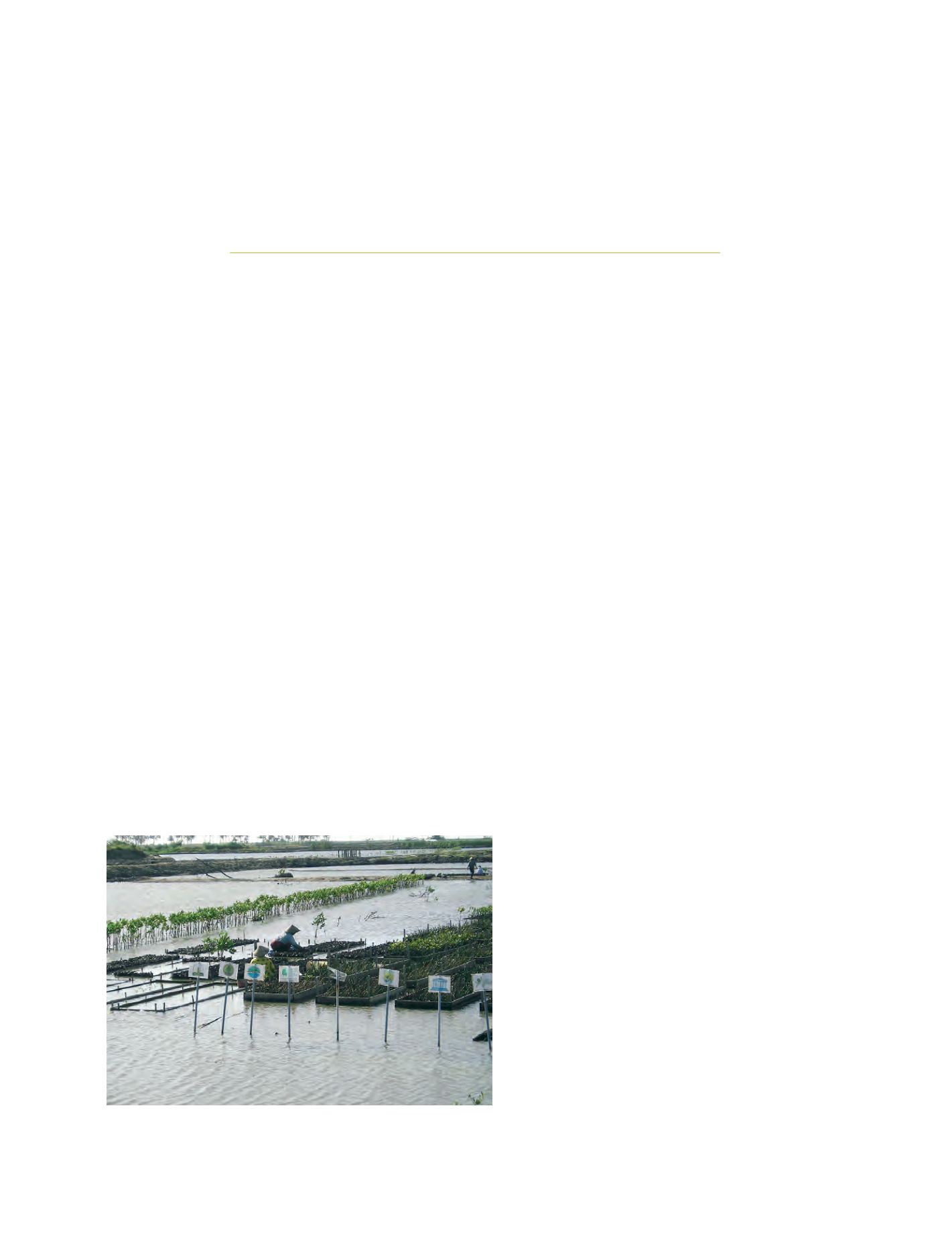
Cooperative efforts to plant and conserve mangroves in places like
Indonesia protects an important ecosystem service for local residents
Image: UNEP