


 188 / 196

[
] 186
Sentinel Asia Step 2
At APRSAF-14 held in Bangalore, India in November 2007, the
following recommendations on SA were adopted:
1. A declaration that the efforts of the current JPT have led to the
successful completion of the Sentinel Asia pilot project. This pilot
project has successfully shared disaster-related information obtained
by several Earth observation satellites, especially those of JAXA and
ISRO, along with training and technical support.
2. A declaration of the launch of the next phase of Sentinel Asia,
running from 2008 to 2012, with the goal of expanding utilization
of disaster-related information, including environmental changes
together with its member countries and international organizations.
Increasing the number of Earth observation satellites from the Korea
Aerospace Research Institute (KARI), the Geo-Informatics and Space
Technology Development Agency (GISTDA) of Thailand, and some
other entities, as well as satellite communication.
3. An agreement to establish the new JPT for implementation of the
second phase of Sentinel Asia early next year, where JAXA will serve
as a secretariat.
In response to the APRSAF-14 recommendation, the new JPT
meeting was held in Kobe, Japan in June 2008, and the Sentinel Asia
Step 2 project was initiated.
The main objectives of ‘Sentinel Asia Step 2’ are as follows:
Participation of various satellites
– In addition to Step 1’s Earth obser-
vation satellites such as ALOS (JAXA), MTSAT-1R (JMA) and IRS
(ISRO), new Earth observation satellites such as the Korean Multi-
purpose Satellite (KOMPSAT, KARI), Thai Earth Observation System
(THEOS, GISTDA), and communications satellites such as the
Wideband Internetworking Engineering Test and Demonstration
Satellite (WINDS, JAXA) are expected to join.
Improvement of accessibility to information
– In addition to data
sharing via the Internet in Step 1, information transmission to facil-
itate access to disaster-related information through
various means including demonstration of the use of
new-generation communication satellites will be intro-
duced.
Value-added data
– A new framework of satellite data
analysis is organized to provide analysed images and
easily comprehensible interpretations from images. AIT,
ADRC, the Center for Remote Imaging, Sensing and
Processing (CRISP, National University of Singapore),
the National Institute of Aeronautics and Space (LAPAN,
Indonesia), and the Ministry of Natural Resources and
Environment (MONRE, Vietnam), among others, are
expected to join the framework.
Expansion of disaster scope
– SA is expected to
contribute to the mitigation of global warming through
strengthening its contribution to wildfire management,
which has a substantial influence on global warming.
User expansion
– A planned expansion of the
user-base to include local disaster authorities in coop-
eration with organizations such as UN ESCAP.
Enrichment of outreach and capacity building
– A new
framework to promote outreach and capacity building
will be organized. JAXA, ISRO, AIT and ADRC are
expected to be among the organizations that join the
framework.
Beyond Sentinel Asia
We propose a new grand concept: ‘Sentinel Earth’ – a
kind of universal expansion from existing initiatives –
beyond Sentinel Asia. Using all present space-based
disaster management initiatives as a component of
Sentinel Earth, we will be able not only to cooperate and
create synergy among existing initiatives, but also to
initiate new activities for areas not covered by them.
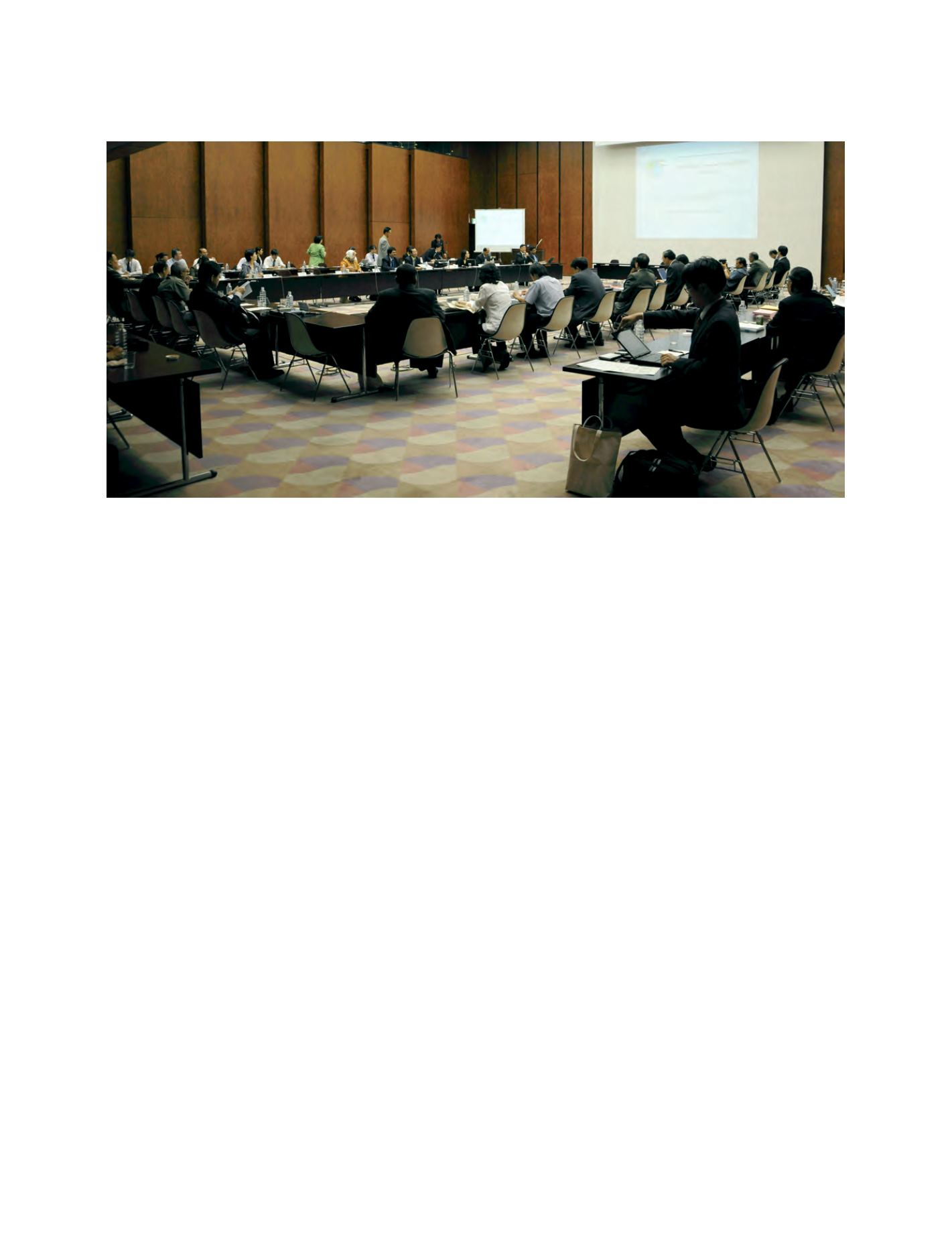
The first Joint Project Team Meeting for SA Step 2 was held in Kobe, Japan on 5-6 June 2008 with participants from 18 Asian countries and severn international
organizations, which initiated the SA Step 2 project
Image: JAXA