


 130 / 287

[
] 131
O
bserving
, P
redicting
and
P
rojecting
C
limate
C
onditions
both, which is key for making decisions on adaptation,
we must improve our observations of the oceans and
the numerical models with which we predict change.
To succeed in generating a global framework, devel-
oping specialized institutions that will turn the available
and new knowledge into useful information for deci-
sions is critical. The impacts on ecosystems, and the
key role that human and social vulnerability plays in
designing the right adaptation strategies, need to be
better understood.
The overriding ethical concerns associated with
climate change need to inform the decisions, not only
of the international community, but also the critical
decisions affecting citizens at the national, regional and
local level. Local communities need to be empowered
to participate in this dialogue. This is not only a chal-
lenge to the hardcore physical and natural sciences, but
also to the social and human sciences. For this reason,
UNESCO and its IOC are fully committed to the goals
of the WCC-3, and ready to contribute to the develop-
ment of the tools and institutions that will help us to
overcome this civilization challenge.
cult and expensive decisions to adapt societies to climate change,
scientific knowledge is more important than ever.
From studying the geological past we know that sea level can
dramatically shift up or down, by up to 120 metres. This has
shaped the coastlines of the world, as seen in the coastal plains
carved by the different sea levels of the past. Evidence of these
changes can also be found in coral reefs. For the organisms living
then, this was a major challenge to which they had to adapt.
Many perished in the process, but many successfully adapted to
the change. Today it is not only nature that will have to adapt to
these changes but our whole civilization. But we have built our
civilization, with the entire infrastructure that supports it, on a
given geological configuration that we take as immutable. Climate
change confronts us with unavoidable change. For example, we
have built mega cities on the existing coastline – cities that now
need to adapt to sea-level rise and solve the problem of relocating
large populations inland
To do this, understanding and prediction of the physical system
will have to be scaled down to focus on local problems. Coming
changes are far less known for a particular region than for the globe
as a whole, likewise they are less known for the coming few decades
than over the next century as a whole. To improve our knowledge of
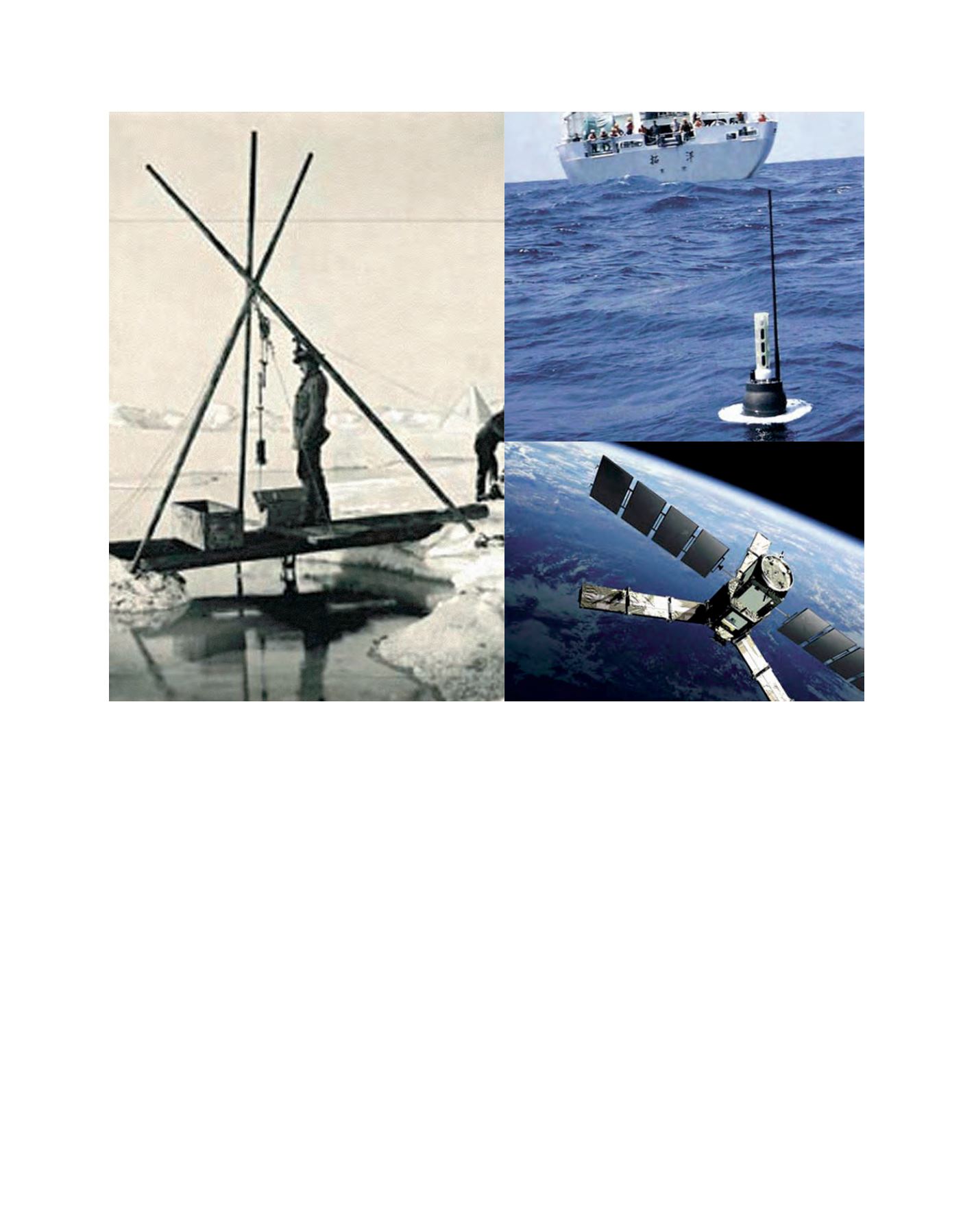
The evolution of ocean observations: from Fridtjof Nansen’s 19th century arctic expeditions to today’s sophisticated satellite technology
Image: IOC UNESCO