



 113 / 208

[
] 113
S
ustainable
agriculture
,
wildlife
,
food
security
,
consumption
and
production
patterns
President of the Tambon Administration Organization in Hong Nam
Khao village and a successful businesswoman with fruit orchards and
a rubber plantation. She credits the transformation to regulations that
were introduced to manage natural resource harvesting, facilitate insti-
tutional strengthening and create community-based knowledge and
livelihood networks. This led to the creation of the Forest Management
Fund in 2003, along with a five-year plan to boost resources. Innovative
techniques were used, such as placing old rubber tyres and rubber
cubes along the embankments for aquaculture.
Recycled reefs
The tyres stopped erosion around young mangroves, while the cubes
became artificial reefs for marine life and also prevented the passage
of fishing trawlers through the nurseries. Along with the spawning
of new fisheries and sedimentation of shrimp ponds, the community
introduced a regulation that was to transform its economy. Like many
far-reaching ideas, it was simple: “Yoot jab roy, khoy jab laan” which
literally translated means: ‘Don’t catch a hundred, wait for one million.’
What the community is referring to is the ban it observed on catch-
ing crabs during the breeding month and the creation of a crab bank.
These restrictions resulted in a bumper crab harvest within a few years,
becoming a major income generator for Prednai. Crab catches increased
from 7-8 kg per person per night in 1998, to 15-20 kg per person per
night by 2004-2005, despite the fact that the number of people catch-
ing crabs had also increased from six to 40. Crabs were bringing in an
income of US$25-30 per person per night in 2005 and by 2009 the
harvest had reached 95 tons – worth a substantial US$1.5 million. In
2008, news of the village’s economic and ecological miracle resulted in
a visit from HRH Princess Maha Chakri Sirindhorn, which remains a
milestone in village lore. Today, high-value produce includes tropical
orchard fruits, sea bass, oysters, crabs and shrimps, which are sustain-
ably harvested and carefully adapted to maintain yield within changing
seasonal patterns, rising humidity and sea water levels. “I
never imagined that we would have all this,” said Renu
Kongpil, when she was interviewed for a film on Prednai,
‘Voices of the Forest – Thailand’, a few years ago. “We
used to have no security. We had nothing; we started
slowly and built it up bit by bit.”
There are now 19 groups actively managing the use of
forest and marine resources in Prednai: the aquaculture
group monitors the release of wastewater, the traders’
group ensures only sustainably harvested produce is sold,
the ecotourism group provides hospitality year round, the
youth group manages public relations, while the savings
group provides support when required for poorer commu-
nity members and is ambitiously planning the purchase of
about 5,000 hectares of degraded forest. These groups are
supported by a network of 25 external agencies, all contrib-
uting in their own way to village progress. A 2009 study by
RECOFTC found the community spends about US$7,500
each year on forest management, including money for
the annual mangrove plantings, investment in livelihood
resources and human resource development through learn-
ing. The villagers place high value on learning and from
the start, research and knowledge activities have been an
integral part of their success. The learning network is now
expanding from 19 villages to six sub-districts, through a
US$168,000 project which is supported by the Norwegian
Government through Mangroves for the Future.
Supporting climate change work and mangrove
restoration
“We have received a lot of training and support in devel-
oping our knowledge centre, mangrove management
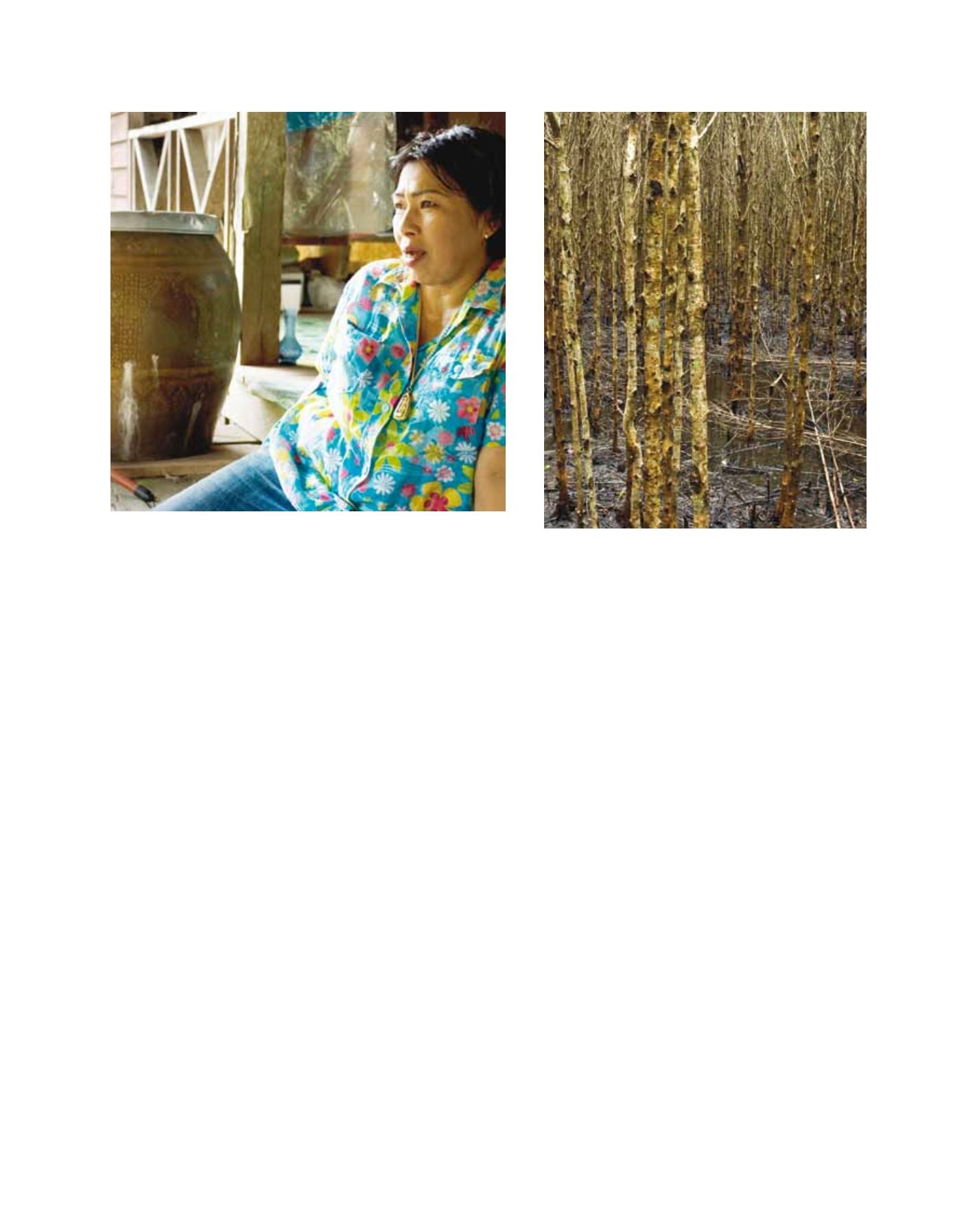
Nopparat Siraroy is now a businesswoman, a plantation manager and a
community forester
Villagers believe annual reforesting of dead trees is vital for biodiversity
Image: Jaturong Hirankarn
Image: Jaturong Hirankarn