



 110 / 208

[
] 110
S
ustainable
agriculture
,
wildlife
,
food
security
,
consumption
and
production
patterns
Biovision was declared by the Agricultural Information Resource
Centre of Kenya’s Ministry of Agriculture to be one of the ‘must
haves’ in an essential information kit for extension officers. This
approach helps improve extension service delivery by equipping
farmers with competencies to demonstrate and teach other farmers.
We can only arrive at a truly integrated sustainable agricultural
development if we share knowledge and experiences, and encourage
the formation of measures and policies supplemented by interna-
tional policies to promote ecological organic agriculture.
A two-way communication
Throughout its implementation, the FCP has ensured that there is
an interactive two-way communication mechanism to capture end-
user feedback. The Farmer Communication Programme is now being
optimized by using an integrated User Response System (URS). The
URS will further contribute to refining existing content as well as
developing new content on sustainable agriculture. It will focus on the
communication activities with SMS and applications for smartphones
to complement other channels. To make use of new opportunities
arising with the spreading of smartphones, an Android application is
currently being developed. The application will allow users to browse
information on ecological organic agriculture, based on Infonet-
Biovision. Moreover, a survey function will be created to enable the
FCP to collect data, manage, and publish findings as needed.
Benefits in the field
The benefits of the programme to people in the field are well
known. Various stories from the field show that access to infor-
mation can actually improve livelihoods. For example, Ibrahim
Wakayula of Kimilili region in Western Kenya read about opportu-
nities for sustainable chicken breeding in an article in The Organic
Farmer magazine in 2007. Convinced of this idea, he started breed-
ing chickens, a practice that is less common in his area. Thanks
to complementary information he retrieved in the magazine, his
endeavours met with great success. Ibrahim was able
to earn a better living, which he used in turn to plant
another field of Maniok. This allowed him and his
family to earn a decent living and have access to enough
healthy food.
Another success story is from the Kimutwa area in
Machakos where women, who initially did not prac-
tise farming due to lack of relevant information, joined
together to form a group – a precondition for getting
trainings from FCP information officer, Ruth. A recent
visit to the group by a Biovision delegate was filled with
testimonies from the women on how well their farming
is doing, thanks to the training programme conducted
by Ruth. They engaged in different activities such as
chicken rearing, vegetable growing and tree nursery
cultivation, among others. Armed with information
from Infonet-Biovision, Ruth is able to meet all their
information needs.
These and other experiences show that by using
state-of-the-art ICT and tested community learning
structures, the Biovision FCP provides a great opportu-
nity for national development. Its efforts can be scaled
up and replicated to cover East Africa and beyond.
The Biovision FCP aims to strengthen farmers’ access
to information on sustainable, eco-friendly agricul-
tural practices through multimedia. This will enhance
innovation uptake and consequently contribute to
improved food security, reduced poverty, better quality
food, a stable environment and national development.
With a rigorous monitoring and feedback system, the
programme will enhance the relevance of agricultural
research, increase its own responsiveness to farmers’
informational needs and create synergies with other
partners to scale up programme activities.
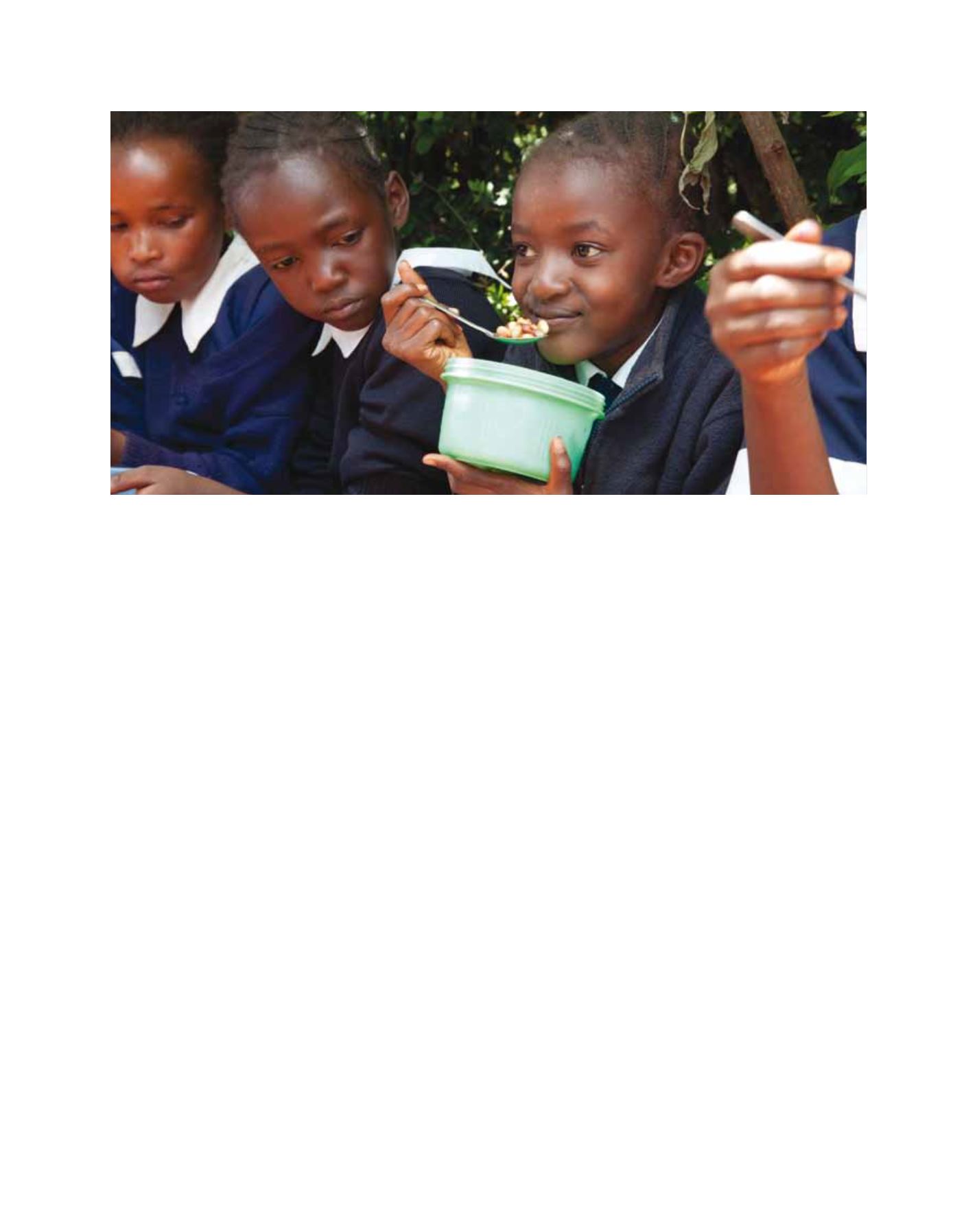
The programme supports small-scale farmers and their families to grow enough healthy food
Image: ©Peter Luethi