



 106 / 208

[
] 106
S
ustainable
agriculture
,
wildlife
,
food
security
,
consumption
and
production
patterns
Committee on World Food Security has the potential to
serve as such a platform. However, its mandate should
be extended beyond food security policy, to include
working towards the implementation of sustainable
agriculture and considering sustainability issues in the
realm of food security and agriculture.
Setting the course
The feasibility of such a paradigm shift and transformation
of agriculture and food and nutrition systems was clearly
demonstrated by the authors of the chapter on agriculture
in the UNEP report. It visualizes the agricultural develop-
ments to be expected until 2050, given the prerequisites
of a sustainable agricultural model and the investment
suggestions from the Stern report, and contrasts it with the
‘business as usual’ scenario in which the current agricul-
tural policy would continue unchanged. The superiority
of the sustainability scenario is impressive, allowing for an
increase in food availability from its current 2,800 calories
per person per day to 3,380 calories. This should create
an additional 47 million jobs in rural areas and thus effec-
tively help alleviate poverty. It uses less water than today,
whereas the baseline scenario would lead to a 40 per cent
higher demand. It would also lead to a situation in which
agriculture would no longer be an emitter of greenhouse
gases by 2050.
We now need to make the paradigm shift a reality to
ensure a food and agriculture system that is resilient to
climate change, restores soil fertility, reduces desertifica-
tion and contributes to locally available sustainable diets
for all. It is possible to nourish our people and nurture
our planet, but we have to set the new course now!
irrigation systems, support biological pest control, facilitate access to
the market for small-scale farmers, and reduce losses between harvest
and consumption.
Third, to arrive at a truly sustainable agriculture and food system,
it is essential to look at the entire food value chain – from produc-
tion to consumption. There are enormous inefficiencies in food use
as post-harvest food losses and waste along the entire food chain
account for at least one-third of all the food produced in the world.
Moreover, the trend to eat more meat and other animal products
will need adjusting, to improve both health and the global food
consumption footprint. To produce a single calorie of meat, two to
seven equivalent crop calories are needed as livestock feed.
Finally, in view of the complexity of these issues, it is clear that
coherent policies need reliable information support systems. The
science-policy-knowledge link in agriculture and food needs to be
strengthened. We need a mechanism that can deal with the changing
needs in agriculture – one similar to the Intergovernmental Panel
on Climate Change in climate policy, that will regularly inform
governments, United Nations agencies and the global public on
the situation and development of agriculture. An example of this
is the International Assessment of Agricultural Knowledge, Science
and Technology for Development, commissioned in 2002 by the
Sustainable Development Summit and sponsored by six United
Nations agencies and the World Bank. The multi-stakeholder
process was a great example of how to bring all interested parties
together to analyse the status of food and agriculture and present
a series of options for action to transition towards agroecological
principles. For a follow-up of the assessments, mechanisms must
be set in place and monitoring of progress and impact assured. A
permanent assessment platform would be a one-stop shop where
a broad range of stakeholders could discuss sustainable agricul-
ture and food and nutrition security policies. The United Nations
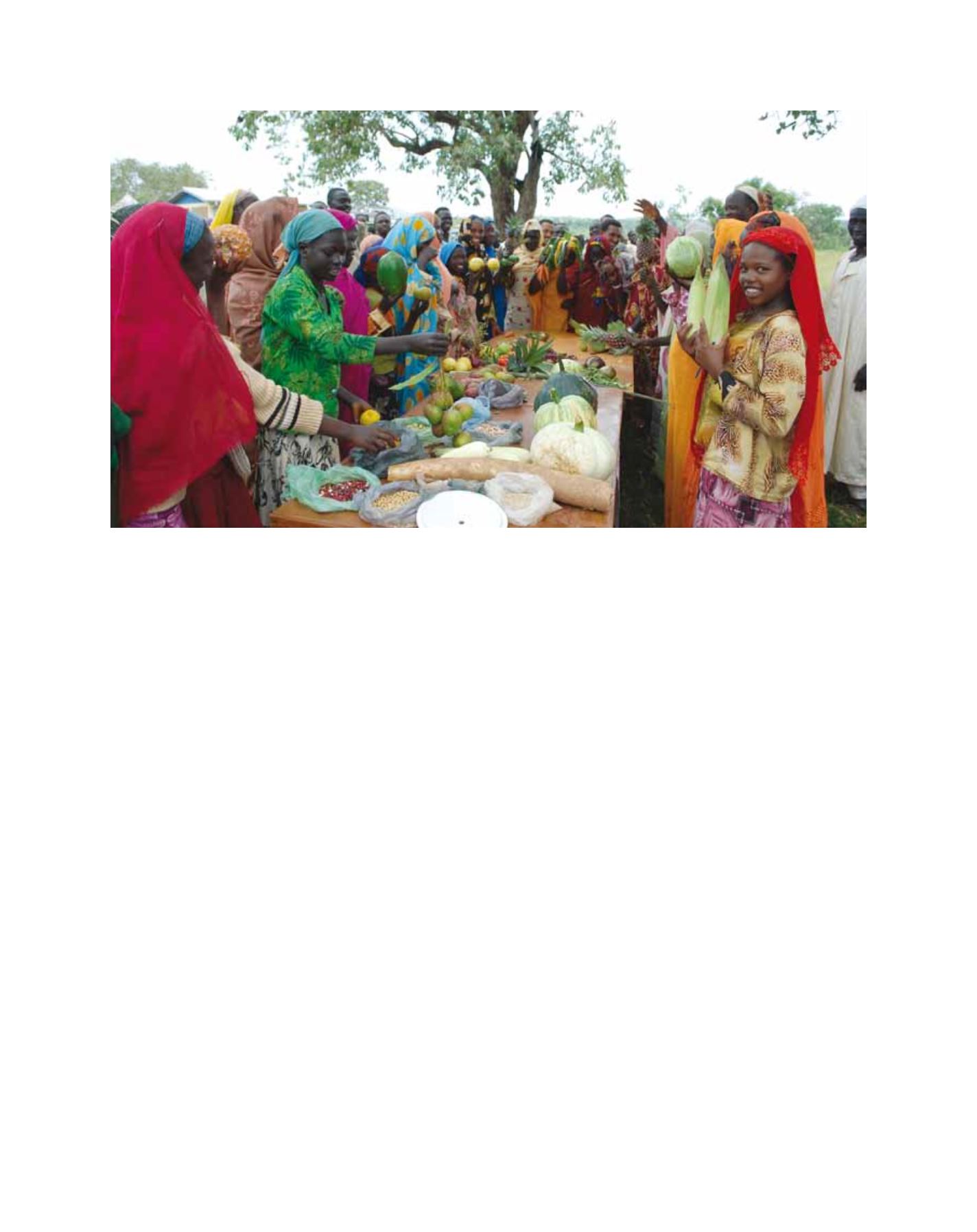
It is possible to nourish our people and nurture our planet, if we shift towards ecological agriculture and primarily smallholder farms
Image: Biovision/Peter Luethi