



 104 / 208

[
] 104
S
ustainable
agriculture
,
wildlife
,
food
security
,
consumption
and
production
patterns
impact; they are also the key resource for agricultural production.
However, land is becoming scarce, with increasing degradation
due to unsustainable practices and growing global competition
for productive agricultural land. Land degradation, and poor soil
fertility in particular, is widely accepted as the most critical limit-
ing factor in constraining agricultural production in sub-Saharan
Africa.
6
There are some 5 billion hectares of land presently avail-
able for the global food supply: 1.5 billion hectares of farmland and
permanent crops and 3.5 billion hectares of grassland, grazing land
and extensively used steppe.
7
Of this land, 1.9 billion hectares have
already been degraded to a greater or lesser extent due to inten-
sive and improper use.
8
Additionally, 10 million hectares are lost to
erosion every year. The need to stop the loss of farmland is urgent,
and this includes regenerating depleted soils so they can be uses in
the future with sustainable production methods.
Sustainable use of natural resources is also especially relevant
when we look at the use of water in agriculture. Agriculture accounts
for 70 per cent of global freshwater consumption today – yet it is
possible to limit water use while still meeting global food and nutri-
tional needs. In various regions such as India, China, North Africa
and the Middle East, depletion of water resources is already a serious
problem. Groundwater levels are falling rapidly. Further, ground-
water resources are only renewable over the very long term, if at all.
Climate change will exacerbate water shortages in drier parts of the
world. Sustainable small-scale farming exhibits a great deal of poten-
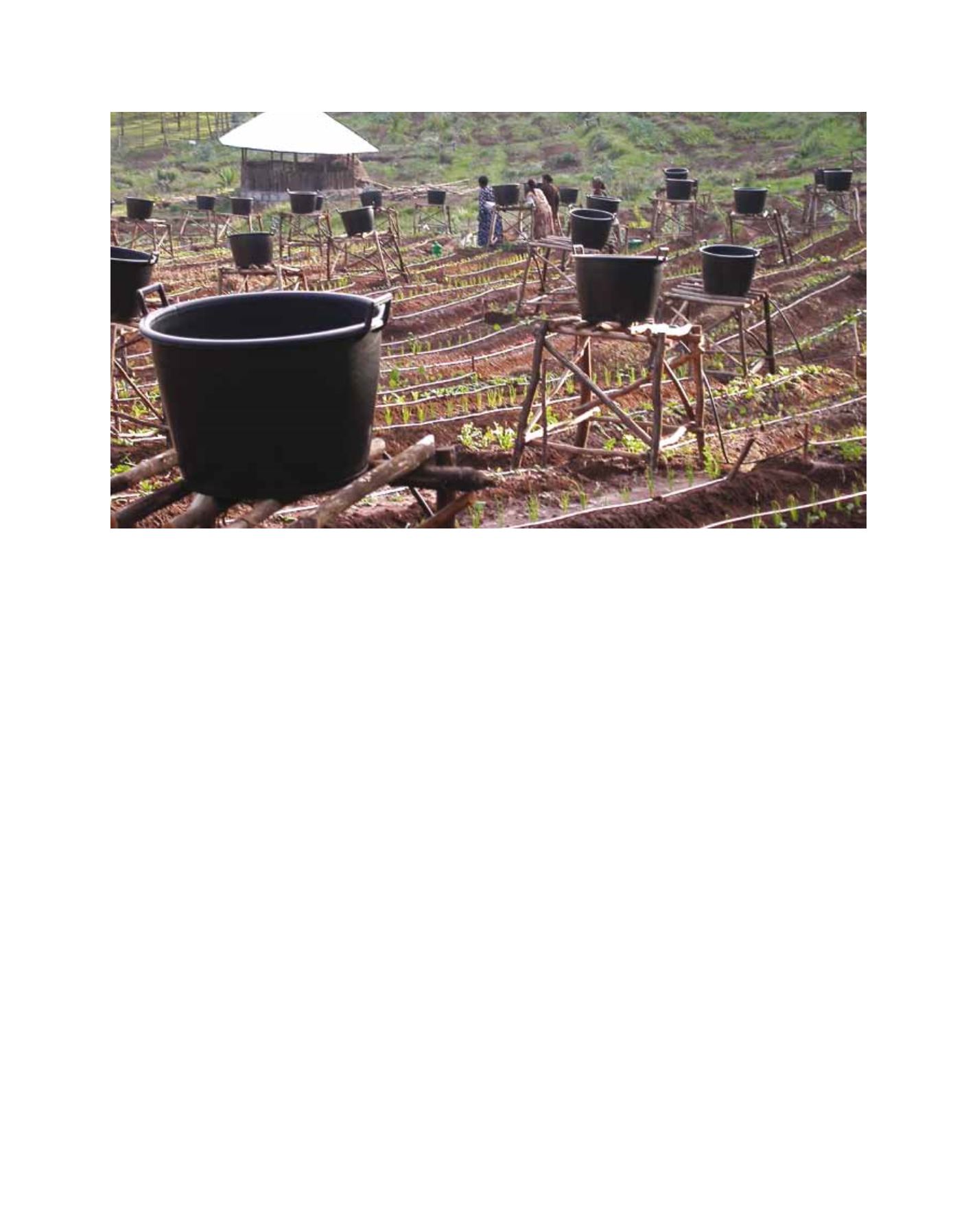
tial with regard to reducing water consumption. Efficient irrigation
systems – such as drip irrigation – could reduce consumption by
several degrees of magnitude. Case studies in developing countries
have demonstrated that water consumption can be reduced by 40-80
per cent,
9
and in 2011 the United Nations Environment Programme
(UNEP) Green Economy report confirmed that production with
sustainable methods, which is adequate to cover humanity’s food
needs in the year 2050 with limited use of water, is
now feasible.
10
Biological diversity is crucial for sustainable food
production, but it is currently shrinking. Over centu-
ries, humanity has used over 10,000 edible plants:
today we use only 150 and just 12 species make up 80
per cent of plant-based food production.
11
The edible
plants being grown are becoming increasingly similar
to one another. The enormous wealth of cultivars that
the world’s farmers have created through cultivation
under a variety of conditions has shrunk in parallel with
the rapid rise to dominance of a few globally grown
high-yield cultivars. An estimated 75 per cent of all
economically useful plant cultivars has vanished from
the world’s farms.
12
With every species that disappears,
valuable genes are lost. Considering that 90 per cent of
pest species have natural antagonists – predatory or
parasitic insects –and over 100,000 species of polli-
nating insects provide their services to the agriculture
sector, this matters a great deal. This is why diversity in
the animal kingdom and plant species is an insurance
against pest problems, and key to ensuring food and
nutrition for all.
A healthy environment, resilience to climate change,
fertile soils, sustainable use of scarce natural resources
including water, and rich biodiversity are the founda-
tion for a secure food supply in the long term. Farms
do produce a number of key ecosystem services that
benefit society, the environment and the economy as
well as agriculture itself, for example with pollination
and natural pest control. Farmers can and should be
supported as needed to assure that these ecosystem
Drip irrigation improves efficiency of water use, significantly reducing consumption
Image: Biovision/Peter Luethi