



 108 / 208

[
] 108
S
ustainable
agriculture
,
wildlife
,
food
security
,
consumption
and
production
patterns
practices and innovations that contribute to improved
profitability, stewardship and quality of people’s life by
investing in carefully validated research and education
The Biovision FCP is based on the assumption that
African farm households are capable of sustainably
increasing food security and enhancing livelihoods
while maintaining and protecting their natural environ-
ment. The programme is also based on lessons learned
from experience: that strengthening and enhancing
farmers’ access to information and knowledge on rele-
vant technologies can lead to healthy and increased
agricultural productivity, thereby ensuring improved
food security, better nutrition and higher incomes
in a stable environment. A key message, then, is that
individual nations can realize the full potential of agri-
cultural development and enhanced food security by
communicating farming knowledge and technologies
effectively – given that other enabling policy condi-
tions are put in place.
Using multiple channels
Being aware of the differences in farmers’ agroecologi-
cal conditions, their farming capabilities and needs,
the FCP has initiated various projects through which
authentic, scientifically proven farming information
and technologies are disseminated to farmers – thus
responding to their both expressed and latent demands.
The FCP aims at scaling up and impacting the agri-
cultural knowledge of rural communities by working
together with a network of agricultural extension
officers. These officers are considered an important
that smallholder farmers can double food production within 3 to 10
years while mitigating climate change and alleviating rural poverty if
ecological methods are sufficiently supported and applied.
4
New approaches to information
Improving access to quality information and developing capacities,
as well as networking and sharing knowledge, are necessary condi-
tions for achieving the targets set by international proclamations
such as Agenda 21 and the Millennium Development Goals. The
Biovision FCP, supported by the Biovision Foundation for ecologi-
cal development, the International Centre of Insect Physiology and
Ecology, the Biovision Africa Trust and partners, is striving towards
bridging the digital divide and removing the information barriers
facing smallholder farmers in East Africa. The programme supports
the dissemination of information based on four health dimensions:
• Plant health
• Animal health
• Environment health
• Human health.
Traditional pathways for accessing and exchanging relevant infor-
mation and knowledge in a timely and effective manner are currently
inadequate. Consequently, greater investments are needed in knowl-
edge creation and management, information dissemination and
enabling the wider use of ICT through space and time. Databases
are needed to store and retrieve the much-needed information.
Broadcast and print media are needed to unlock the power of organ-
ized, accurate and up-to-date information on demand. The Biovision
FCP has been able to make a useful contribution in responding
to these requirements. Its mission is, therefore, to advance and
improve access to information on sustainable agriculture through
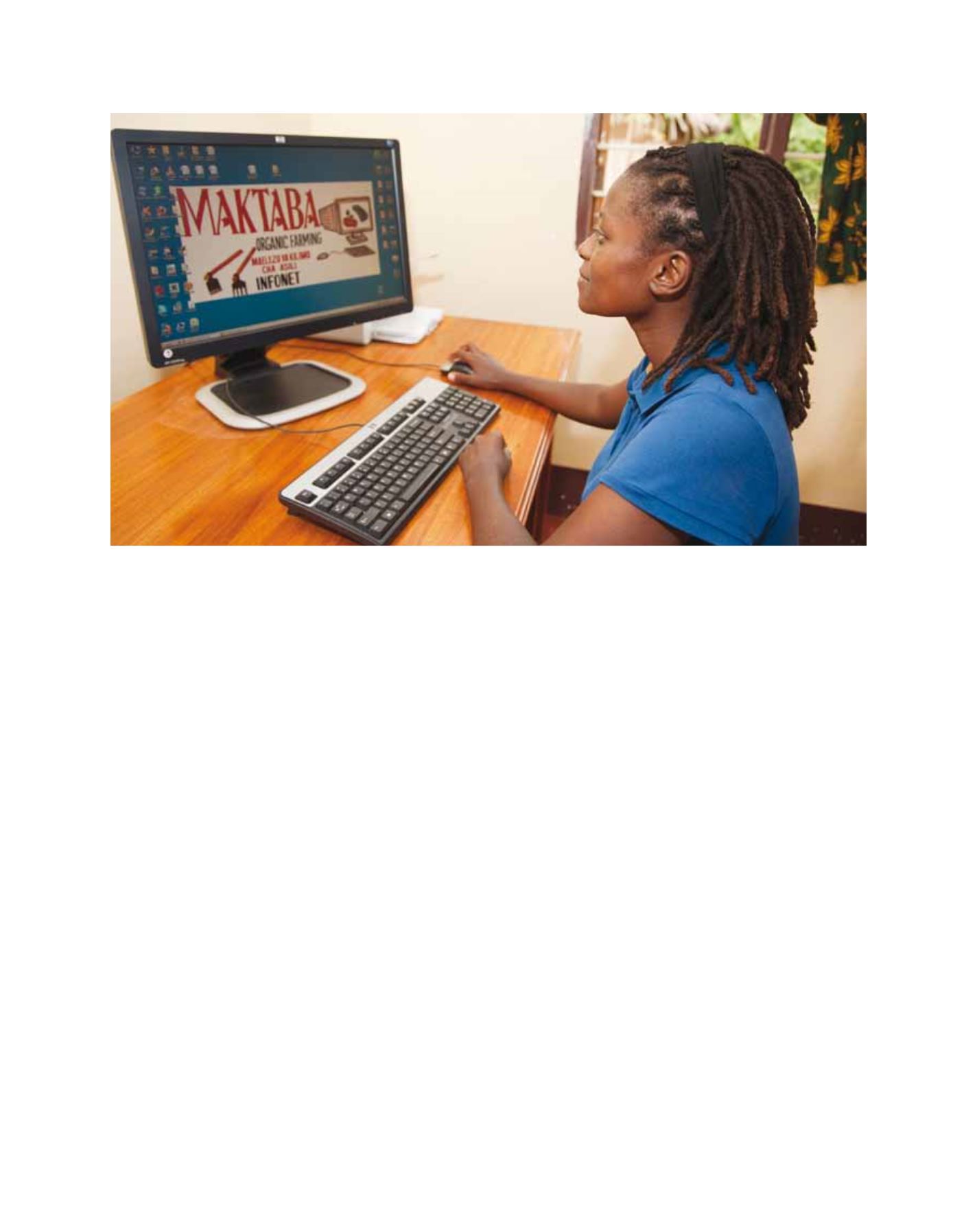
The web-based platform Infonet-Biovision keeps trainers, extension workers and farmers informed
Image: ©Peter Luethi