



 112 / 208

[
] 112
S
ustainable
agriculture
,
wildlife
,
food
security
,
consumption
and
production
patterns
The mangrove forest is our legacy, to be treasured by future
generations.”With this attitude, the villagers set up the first
Community Forestry Group with some assistance from the
Royal Thai Forest Department.
RECOFTC – The Center for People and Forests
became involved in Prednai at the end of logging conces-
sions. It found immediate resonance with villagers on the
core principle of advocating participatory management
of natural resources. Empowering the community to be
stewards of their own land is the first tenet of success-
ful community forestry. Set up in 1998, the Prednai
Mangrove Forest Conservation and Development Group
divided the forest into six zones. RECOFTC provided the
training, specialized knowledge and resources needed to
carry out intensive mapping of forest inventory. Over the
past 15 years, training programmes and research work
have reached hundreds of stakeholders at all levels, from
grassroots to government, and remained a continuous
feature of RECOFTC’s involvement in Prednai. These
days, training is about climate change adaptation and
carbon sequestration, while in the early days it was about
conflict management and livelihoods.
By 2000, a forest management planwas created, prescrib-
ing how each area of the forest should be used to promote
sustainability and rebuild incomes. The mangrove restora-
tion and zoning plan came out of collaborative fieldwork
and long discussions with the community. “It was difficult
to see the mangroves we grew up in being destroyed and
to lose the common land that previous generations had
used,” recalls Nopparat Siraroy, who was a 17-year-old
student when she bravely joined the protests. She is now
affect at least three quarters of Asian forests, the majority of these
escalating into violence year after year, with little resolution in sight.
Luckily, the grit and guile of Prednai villagers eventually helped bring
their case to the attention of higher authorities, resulting in a dramatic
helicopter visit by a senior official and the end of the concession. The
Government was also under increasing pressure to curtail logging
which was blamed for the massive landslide in 1988, which resulted in
the deaths of over 200 villagers. Devastated but not disheartened, the
community of Prednai began the painful journey of rebuilding their
lives. Using traditional knowledge and age-old principles of sustain-
ability and universal participation, they began replanting the mangroves
and regenerating marine life in the 12 major and six minor waterways
intersecting Prednai, rejuvenating the land and its flora and fauna.
Today, about 1,920 hectares of mangrove have been restored; the reefs
are teeming with crabs, shrimp, molluscs and fish, while the orchards
are laden with lush tropical fruit that proves irresistible to returning
monkeys and birds. A locally preserved whale skeleton in the commu-
nity centre is a formidable attraction for visiting city dwellers. In 2009,
more than 1,000 visitors brought ecotourism income into the commu-
nity. Prednai is now a celebrated case study, its inhabitants featuring in
prize-winning films and international forums, while study tours are an
annual event. Awards such as the Green Globe in 1999 and recognition
as a finalist for the United Nations Development Programme Equator
Prize in 2004 have celebrated its success. But how did they do it?
Universal participation is a basic conservation principle
“We worked to unite the community in dealing with officials,” says
Manot, who took over this crucial role fromhis father some years ago. He
remembers the years after the concession when villagers put their tradi-
tional knowledge to work regenerating the land. “I always tell people we
can disagree and have different attitudes, but we must remain together.
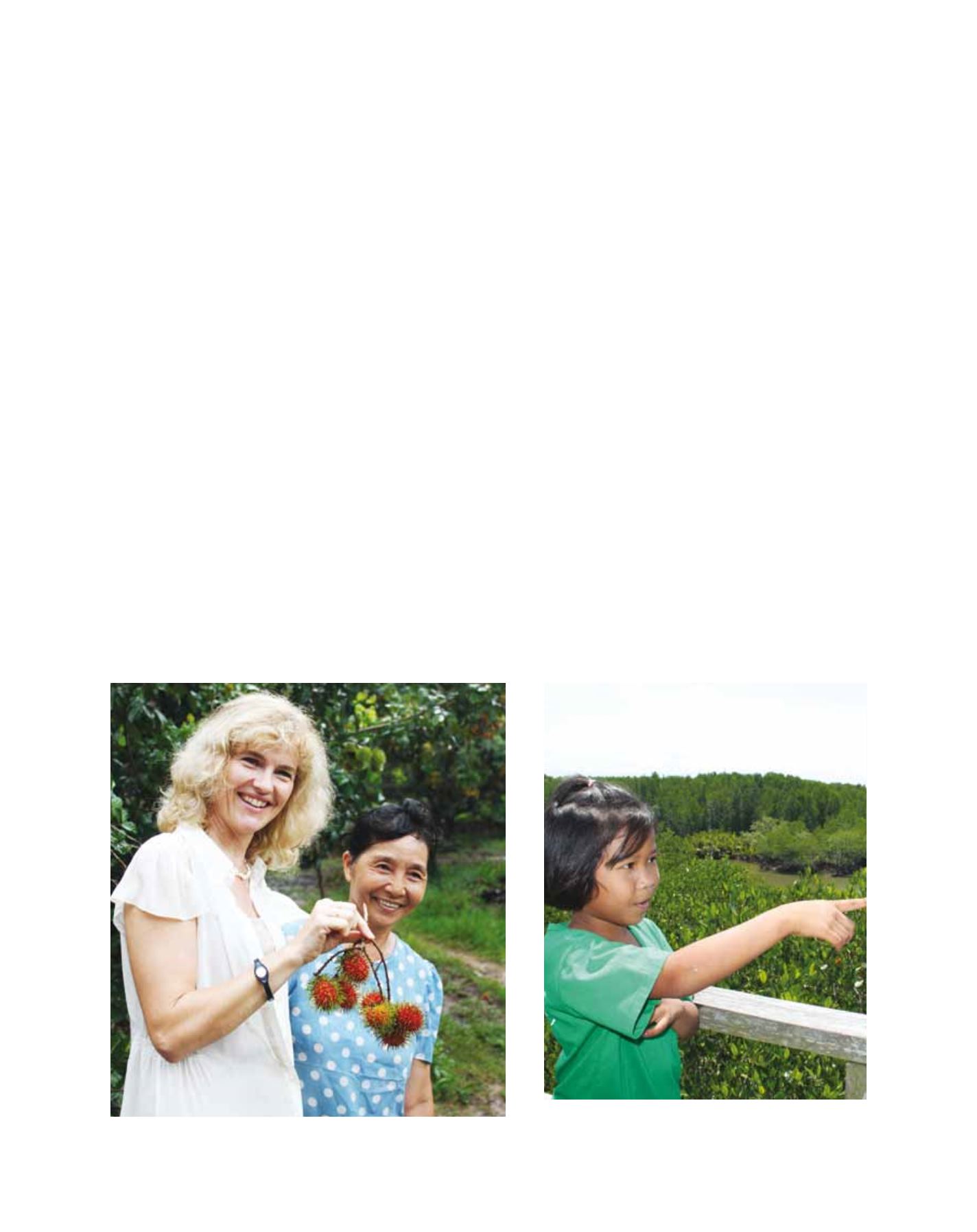
Sharing tropical orchard fruit with Norwegian ambassador Katya Nordegaard
Students benefit from strong school and community partnerships at
the Mangrove Learning Center
Image: Phinyada Atchatavivan
Image: Phinyada Atchatavivan