



 109 / 208

[
] 109
S
ustainable
agriculture
,
wildlife
,
food
security
,
consumption
and
production
patterns
link between information sources and end users. Therefore, the
programme combines investment in content development, technol-
ogy dissemination and human resource development aimed at the
training of farming communities.
To allow trainers, extension workers and farmers quick access
to up-to-date, user-friendly, locally relevant and practical informa-
tion, the web-based platform Infonet-Biovision was developed.
5
The
platform already provides information on more than 45 major crops,
vegetables and fruits grown in Africa, as well as on cultural methods
of controlling more than 685 pests. It also provides information on
various medicinal plants; value addition and preservation of fruits;
sustainable soil, water and land management; animal husbandry
and the control of various plant and animal diseases. This wealth
of information is easily available for farmers practicing ecological
organic agriculture, at no cost through the FCP dissemination chan-
nels or at a little cost by accessing it through the internet.
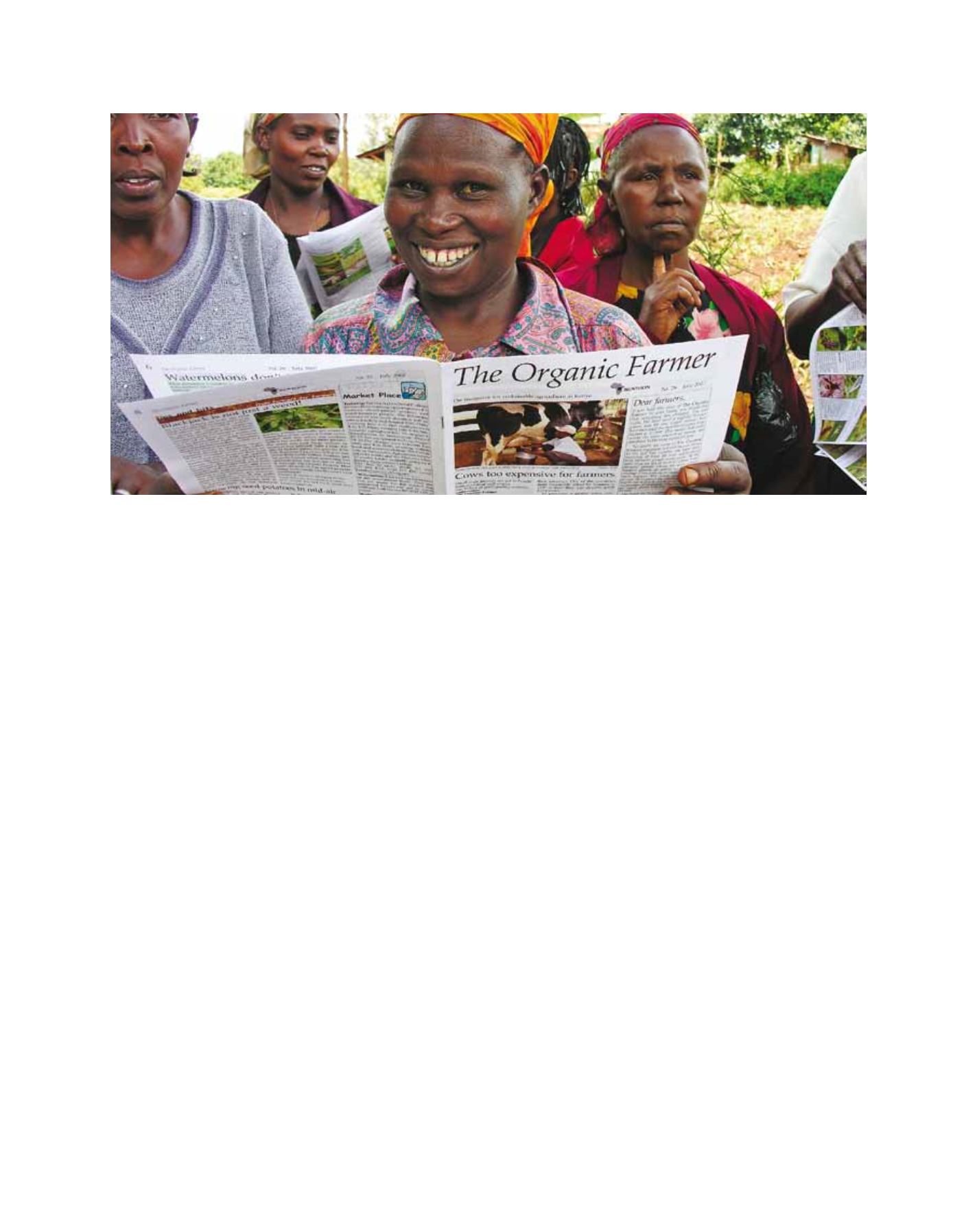
The Organic Farmer magazine is a monthly publication featur-
ing articles on ecological organic agriculture, with 21,000 copies
mainly distributed to farmers’ groups and institutions. The publica-
tion currently reaches about 180,000 farmers in Kenya, Uganda and
Tanzania. Due to the immense success of this magazine in the English
language and growing demand for such information in neighbour-
ing countries, a Kiswahili language edition was launched with 8,000
copies in Tanzania. The demand for this magazine, called Mkulima
Mbunifu (or The Creative Farmer) has grown rapidly and its circula-
tion is likely to increase as more resources become available.
To further improve outreach to farmers, information on ecological
organic agricultural practices and innovations has also been broad-
cast on the radio. Through a partnership with the Farmers’ Radio
Programme (Kilimo Hai), broadcasts on hands-on agricultural prac-
tices and innovations reach farmers once a week via the popular
national station of the Kenya Broadcasting Company and the local
radio station Milele FM. Many more radio stations – in particular
local stations – will join the FCP programme in the future.
Outreach and partnerships
In addition to radio, print and online dissemination chan-
nels, the FCP also strives to be present on the ground in
farmers’ and teachers’ interactions. To this end, the field
outreach programme employs tools to promote ecologi-
cal organic farming methods among farmers through
community managed resource centres and information
hubs. The programme largely uses trained extension staff
as well as a network of community information workers
(CIWs), who are paraprofessionals linked to these facili-
ties. The field officers use a small laptop in order to create
a bridge between the information provided by the FCP and
the farmers. The CIWs assist the communities to improve
organizational matters, visit farmer groups to create aware-
ness about ecological organic farming, and document
information needs to enhance programme responsive-
ness. Moreover, there is also a side benefit of the way
FCP works: since access to knowledge can be a powerful
service to attract members to a farmers’ association, it can
also contribute to strengthening farmers’ organizations.
Working together to build partnerships is crucial
for an effort such as the Biovision FCP. As such, the
programme also includes advocacy to promote a suit-
able policy environment for ecological organic farming.
For example, the FCP programme has a partnership
with the Kenya Agriculture Research Institute (KARI)
and community-based organizations (CBOs). Under
this arrangement, the research institute provides space
and some facilities, while the FCP assists with manage-
ment of the resource centres and equips the network of
CIWs with small laptops and training. The programme
also works with other partners, including the Ministry
of Agriculture, non-governmental organizations and
communities. For example, in 2011, access to Infonet-
The Organic Farmer
magazine is distributed to farmers’ groups in Kenya, Uganda and Tanzania
Image: ©Verena Albertin