



 105 / 208

[
] 105
S
ustainable
agriculture
,
wildlife
,
food
security
,
consumption
and
production
patterns
services are maintained into the future, as our civilization depends
on them. One way is to create incentives for farmers, and remuner-
ate their efforts in maintaining ecosystem services.
Transforming policies, governance and investments
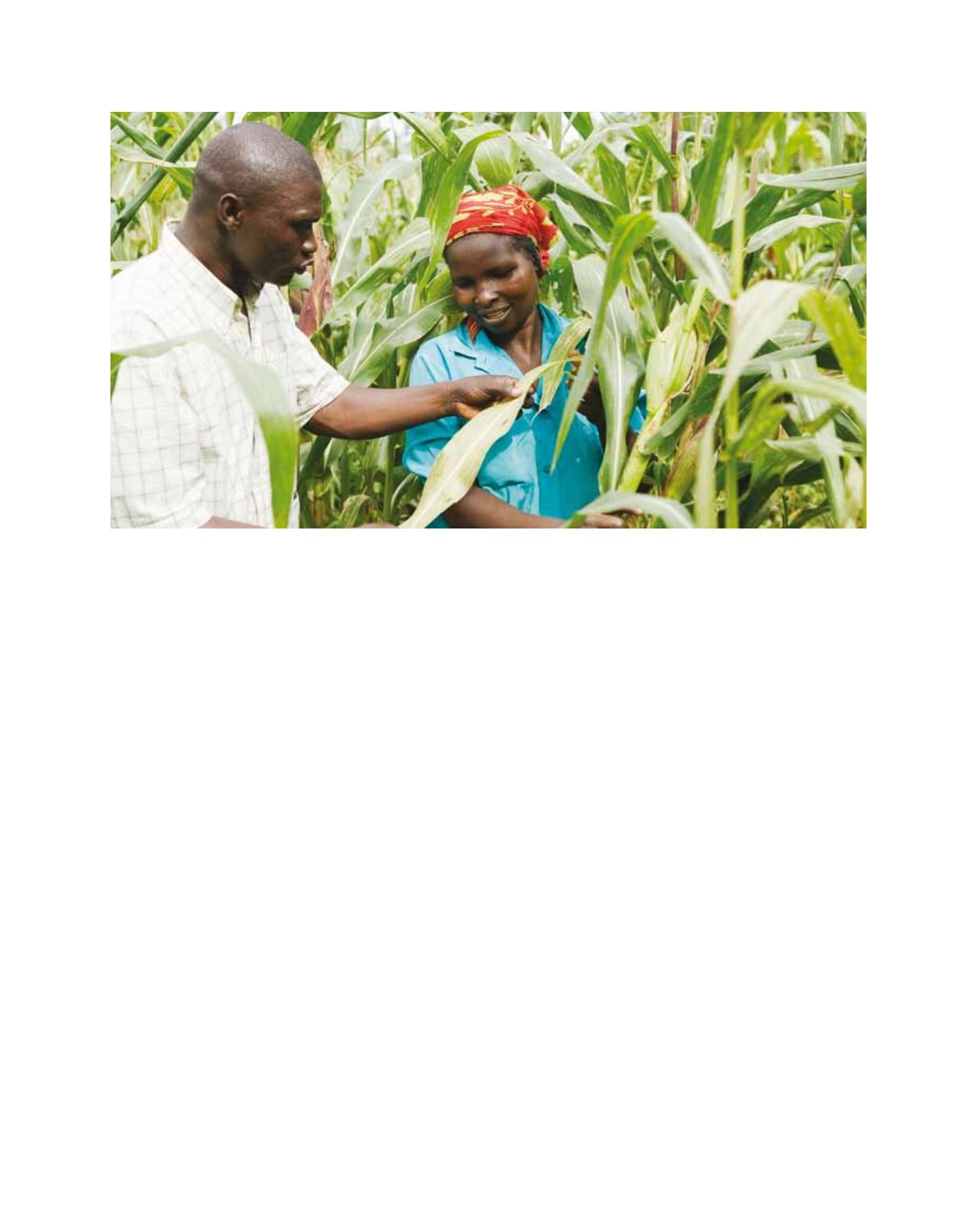
One example of an agricultural method meeting these challenges
is the ‘push-pull’ system for maize cultivation, developed by the
International Centre of Insect Physiology and Ecology (ICIPE) in
Kenya. The system is widely accepted and adopted by smallholder
farmers because it addresses their major production constraints.
The key drivers of its adoption are the control of striga, stem-
borer and soil erosion, and the increase of soil fertility and fodder
production. These combined benefits, together with the low
cost, make it highly attractive to farmers. An impact assessment
concluded that push-pull contributes significantly to reducing the
vulnerability of farm families by ensuring higher yields. Of the
assessed farmers, 75 per cent indicated threefold to fourfold maize
yield increases and, more importantly, better yield stability.
13
Furthermore, as push-pull does not depend on external inputs
such as synthetic pesticides and fertilizer, it is an environmen-
tally friendly method that is likely to increase agro-biodiversity
and contribute to provisioning of ecosystem services. With push-
pull, ICIPE has developed the most successful and widely used
intercropping system in East Africa and beyond, with current
adaptations underway for more arid climates, focusing on millet
and sorghum as the main crops.
The agricultural sector represents countless interests; yet given its
essential role in reducing poverty and achieving economic growth
in developing countries, and in ensuring sustainable development,
there is broad agreement among diverse stakeholders to transform
our agriculture and food system. Efforts to upscale successful agri-
cultural applications from the ground need to be combined with
four efforts outlined below to transform global policies,
governance and investments.
First, to reach a breakthrough, the international
community must take on the responsibility of working
to strengthen these methods and develop an agricul-
tural and food system that manages natural resources
sustainably, advances resilience to climate change,
improves food and nutrition security and benefits the
livelihood of millions of small-scale and family farmers
around the world. Seventy per cent of global food
production is produced by 525 million small farms and
there is significant potential to increase their yields and
revenues using solely ecological methods. Numerous
projects in the tropics and subtropics have shown
that organic agriculture can generate 50-150 per cent
more income.
14
Small-scale farmers are actually able
to nourish people in developing countries – without
expensive inputs, forest clearing or destruction of valu-
able ecosystems. However, they need to be supported
and sustained by the appropriate agriculture and trade
policies and research, development and education insti-
tutions.
Second, investment flows need to be redirected. In
view of the United Nations Conference on Sustainable
Development, the UNEP Green Economy report calls
for a sustained investment of 2 per cent of our global
economic power to begin the transition to a low-carbon,
resource-efficient world economy. Of this, US$198
billion – or 0.16 per cent of the global GNP – should
flow into agriculture. The funds should be used to regen-
erate degraded soils, promote diversified farms integrated
with crops and livestock, fight erosion, establish efficient
The ‘push-pull’ system helps farmers control pests and improve soil quality and increase their yields
Image: Biovision/Peter Luethi