



 100 / 208

[
] 100
S
ustainable
agriculture
,
wildlife
,
food
security
,
consumption
and
production
patterns
Governance of marine resources is central to success
beyond the community level. ACIAR’s support of the
Strategy will also focus on strengthening the capacity
of the Ministry of Fisheries and Marine Resources and
the development of an impact assessment programme
for the Ministry will be central to this work. The frame-
work that is being developed through this research
will also be transferred to Vanuatu and Kiribati, using
the lessons learned in the Solomon Islands to identify
approaches for other island nations.
ACIAR is also supporting other aspects of the blue
economies of the Pacific region, by examining returns
from sustainable management of deep-sea fisheries.
With the Forum Fisheries Agency, a bioeconomic
model used in determining harvest levels and rents
payable for the South Pacific tuna fishery was updated
with biological, catch, price and cost parameters. Two
potential charging systems for obtaining access fees
from distant-water fleet nations fishing in the exclu-
sive economic zones of the Pacific Island nations were
examined. The project identified that ‘charge-on-effort’
schemes should be considered, using a formula based
on catch limits and fishing days.
A sustainable management plan for the live reef fish
trade in the Solomon Islands was developed, with the
plan presented at a final seminar attended by poli-
cymakers, local communities, fishery managers and
researchers in Honiara. The seminar covered potentially
controversial aspects, such as seasonal closures.
A second support component for blue economies is
developing aquaculture capacity in the region. Farming
freshwater fish and marine species can be a sustainable
alternative to fishing, while reducing pressure on wild
capture fisheries.
Numerous communities in Papua New Guinea (PNG)
are dependent on coastline marine resources for the
livelihoods of their families. Whilst coastal waters, reefs
and fish stocks are comparatively healthy, communities
are failing to capitalize on the potential economic and
job opportunities this environment provides.
The development of mariculture in PNG can now be
supported by the recently completed National Fisheries
Authority Nago Island marine hatchery and training facil-
ity. The role of the facility is to develop marine aquaculture
opportunities for PNG and to become a training centre for
students from the National Fishing Centre. However, for
the facility to achieve its goals, there is an immediate need
for capacity-building from both technical and mariculture
perspectives. This ACIAR project will develop Nago Island’s
capacity relating to the management of the facility and the
husbandry of cultured marine organisms and will involve
training facility staff at established research institutions that
have similar roles, expectations and support needs. It includes
basic production trials using coral and spiny lobsters, which
will generate baseline information relating to their potential
as food or income sources. Another part of this research is the
restocking of depleted fisheries, with particular attention to
sea cucumbers, which have been chronically overexploited
throughout the Asia-Pacific region.
From 2005 to 2008, ACIAR and the WorldFish Center worked with
communities in Kia District (Santa Isabel Island and Isabel Province) and
Jorio (Vella Lavella Island and Western Province) to establish commu-
nity-basedmanagement plans for the sea cucumber. At community level,
the project involved a participatory process of household interviews and
focal group discussions to facilitate the development of a management
plan. At the request of the community, plans were broadened to cover
all marine resources. From the Kia community, the project expanded in
2007 to include all of Kia district and led to the establishment of a marine
managed area covering approximately 450 km2.
Through a similar participatory process, a management plan
covering 170 km2 of the Jorio region was implemented in September
2008. Responsibilities for administration, enforcement and penalties
now rest with communities through their own governance struc-
tures. Community technical teams have been trained in simple
methods for conducting reef surveys of benthic invertebrates, such
as the sea cucumber.
In mid-2008, representatives from both Kia and Jorio (along with
representatives from related projects in other parts of the country)
attended the first community workshop for coastal fisheries, held
by the Solomon Islands Ministry of Fisheries and Marine Resources.
The goal was to tap into community knowledge to ensure better
coastal community participation within the Solomon Islands inshore
and coastal fisheries management.
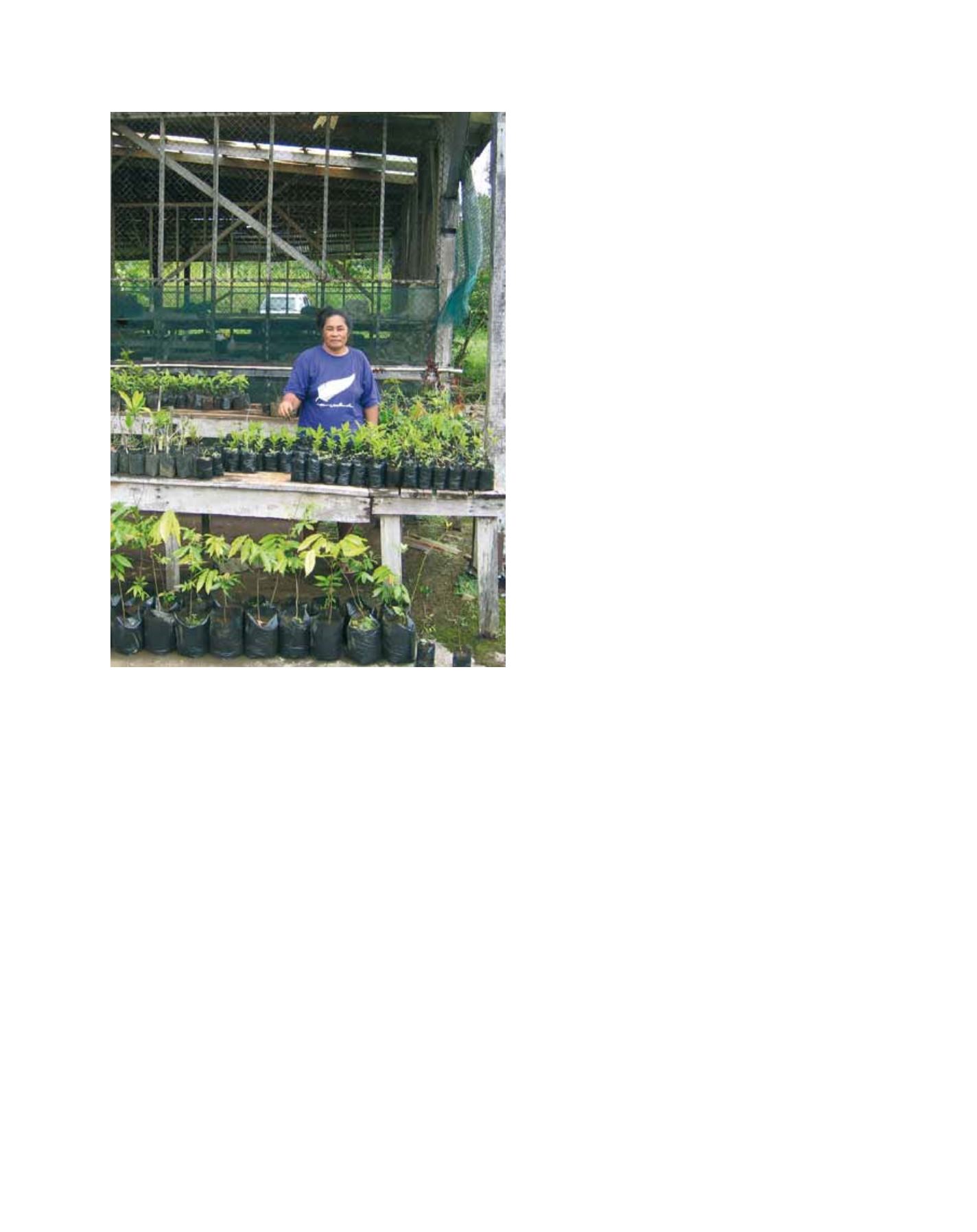
Rich forest resources offer job opportunities if sustainably managed
Image: ACIAR