



 96 / 208

[
] 96
Advancing the green economy in
solid waste management across
the Middle East and North Africa
Joy Jadam, Technical coordinator and Sherif Arif, Consultant, SWEEP-Net
W
aste management is one of the main sectors consid-
ered in a green economy, where ‘greening the waste
sector’ means shifting from conventional to solid
waste management (SWM) methods of collection, treatment
and disposal, towards achieving the 4Rs (reduce, reuse, recycle
and recover) so that waste is transformed from a liability to an
asset, generating both economic and environmental benefits.
1
Despite worldwide advances in SWM during past decades, the
Middle East and North Africa (MENA) region still suffers unsus-
tainable waste management practices, including open dumping,
waste burning and mixing hazardous waste with municipal waste.
Economically, this is exacerbated by low levels of waste reduction,
recycling and material recovery that includes separation at the
source and composting.
Given these circumstances and a crucial need to improve the sector, in
2009 the Regional Solid Waste Exchange of Information and Expertise
Network (SWEEP-Net) was established. Its general objective is to
advance sustainable SWM in the political agenda of partner countries
and to set up a common regional platform for technical
assistance, capacity-building and exchange of best prac-
tices, expertise and experiences in the field of SWM. The
current partners include Algeria, Egypt, Jordan, Lebanon,
Mauritania, Morocco, Palestinian Territory, Syria, Tunisia
and Yemen.
How far from changing to a greener waste sector
are the SWEEP-Net partner countries?
Challenges
Greening the municipal waste sector in MENA is still
in its early years, as governments pay little atten-
tion to the 4Rs, lack the political will to change and
are without the proper institutional, legal, financial
and technical structures for effective SWM, let alone
greening the waste sector. If not adequately addressed,
these factors put SWEEP-Net partner countries at a
competitive and technical disadvantage to other
MENA nations. With the expected population growth,
partners will be faced with a number of challenges,
including an increased impact on public health due
to unsanitary waste disposal, increased pressure on
natural resources, contribution to climate change and
more complex SWM requirements, along with costs
due to waste composition changes, such as e-waste.
The World Bank’s Mediterranean Environmental
Technical Assistance programme has estimated that
the cost of environmental degradation due to poor
municipal SWM ranges from 0.2 per cent to 0.5 per
cent per capita Gross Domestic Product (GDP).
2
This situation worsened in the aftermath of the Arab
Spring, when many regional investments were discon-
tinued or suspended, including those in SWM. The
revolutions in Tunisia, Egypt and Yemen, although
laudable for seeking democracy, social equity, freedom
and employment, contributed to the downturn of
economic growth, from about 3.2 per cent of GDP
in 2010 to 2.1 per cent in 2011, leading to higher
unemployment in many sectors.
3
During and after the
revolution, municipal waste was left to accumulate on
the streets and waste workers went on strike in many
countries, demanding formal recognition of their
status and improved economic and social benefits,
issues being addressed by many governments.
E
nvironment
:
air
,
water
,
oceans
,
climate
change
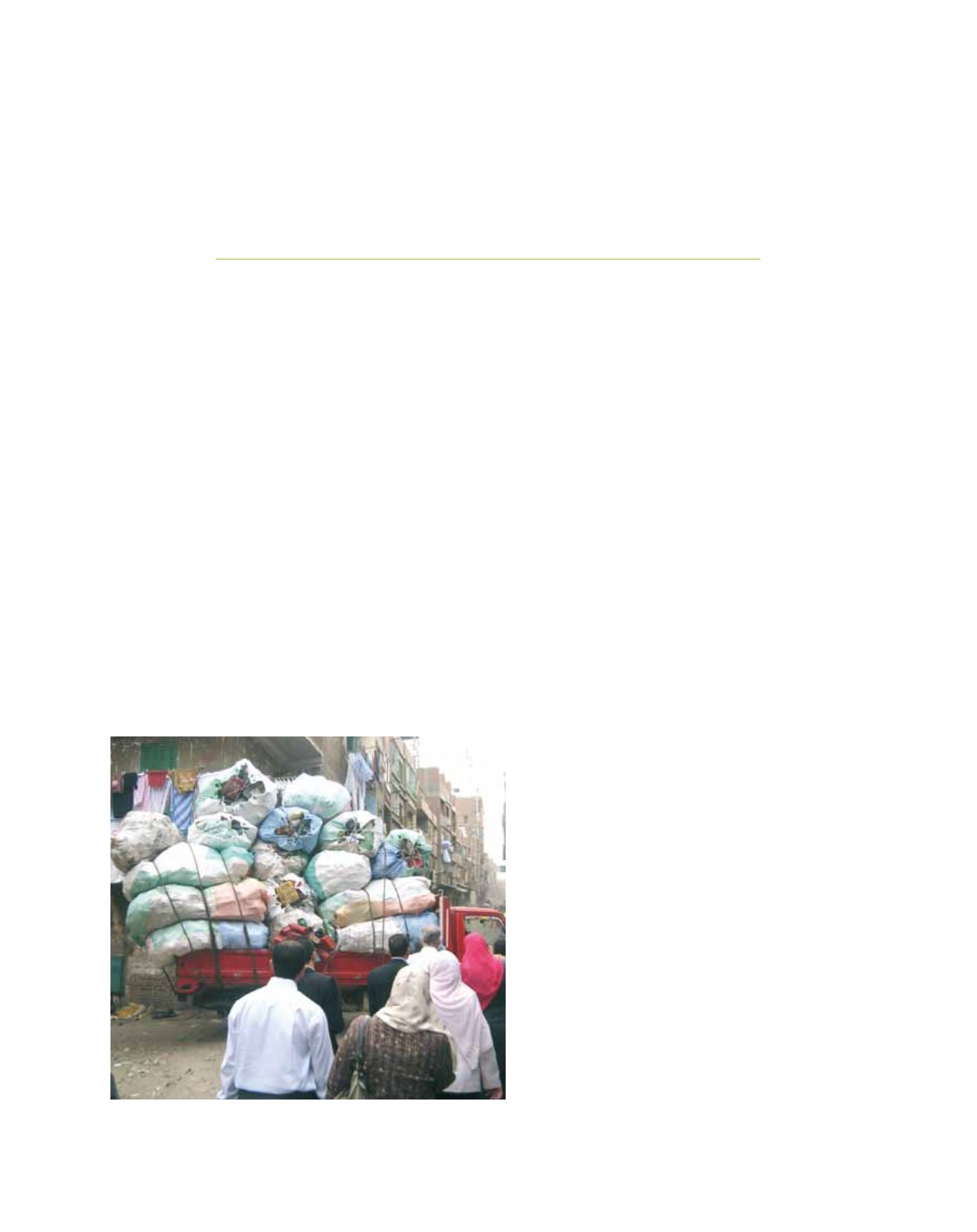
The cash value of waste is mostly appreciated by the informal sector, who collect,
recover, reuse and sell waste materials
Image: GIZ – Egypt