



 99 / 208

[
] 99
Agricultural sustainability research
and development projects
Warren Page, Manager, Communications and Public Affairs,
Australian Centre for International Agricultural Research
T
he Pacific Islands cast an alluring image of white sands
and tranquil sunsets. While tourism remains an impor-
tant industry, trading on the promise of these images to
travellers, the future may be less idyllic.
Apart from tourism, the natural resource base of many Pacific
Islands is the main source of income for residents. Fisheries and
forests account for the livelihoods of more than 70 per cent of people
in the Melanesian countries of the Pacific, who derive their basic needs
from subsistence fishing and agriculture. In the Solomon Islands 75
per cent of the population are smallholder farmers and fishers.
In a 1999 census, 50 per cent of women and 91 per cent of men
were engaged in fishing activities. Fish is a staple food, with this
source accounting for 73 per cent of all expenditure on animal
protein. Such a high level of dependence on the natural resource
base, particularly the rich fisheries of the region, provides a real
challenge for long-term management. Telling fishers that catches
must be limited today to ensure their viability tomorrow is diffi-
cult, particularly when fish are an important part of diets. The task
becomes harder the farther into the future that timeline extends.
Yet sustainable resource management of fisheries is vital to both the
current and future blue economies (sustainable economies driven by
nature-inspired technologies) of the small islands of the Pacific. Coastal
fisheries are the most important source of fish across
several island states and are those under the most stress.
Alleviating these stresses is an important prior-
ity for the Australian Government’s aid programme.
The work of the Australian Centre for International
Agricultural Research (ACIAR) is contributing to
understanding the factors at play in managing these
resources, by encouraging promising opportunities for
alternative agricultural livelihoods and strengthening
governance arrangements.
Inshore fisheries and marine resources are central to
many facets of life in the Solomon Islands, Vanuatu and
Kiribati. The fisheries supply daily protein and a poten-
tial cash resource. These resources also have cultural
value for fishing communities, so sustaining them is
central to their life.
Growing populations, the impacts of climate change
and the threat of overfishing are combining to threaten
the long-term viability of fisheries. The prospect of dimin-
ishing returns from inshore fisheries will place greater
pressure on food security. This situation has the poten-
tial to threaten political stability in individual countries
and to reduce the impact of governance structures. Once
this cycle has started it is difficult to break. However, with
practical solutions the difficulties can be overcome.
ACIAR is focusing on the Solomon Islands as a pilot
for linking and aligning the multiple strands involved
in managing inshore fisheries to form a cohesive thread
running from local communities to national scale interven-
tions, and extending these approaches to other island states.
In 2010, the Solomon Islands developed a National
Strategy for the Management of Fisheries and Marine
Resources. The Strategy articulates the steps needed to
achieve a series of national goals relating to managing
inshore fisheries to 2020.
Community-based co-management of marine
resources is central to the successful implementation of
the Strategy and in providing a platform for the imple-
mentation of sound environmental practices, along with
sustainable development of blue economies.
ACIAR’s role is to support the development of struc-
tures, processes and capacity, to implement and sustain
the national programme of community-based marine
resource management. This builds on past ACIAR work in
developing community-based fisheries management plans.
S
ustainable
agriculture
,
wildlife
,
food
security
,
consumption
and
production
patterns
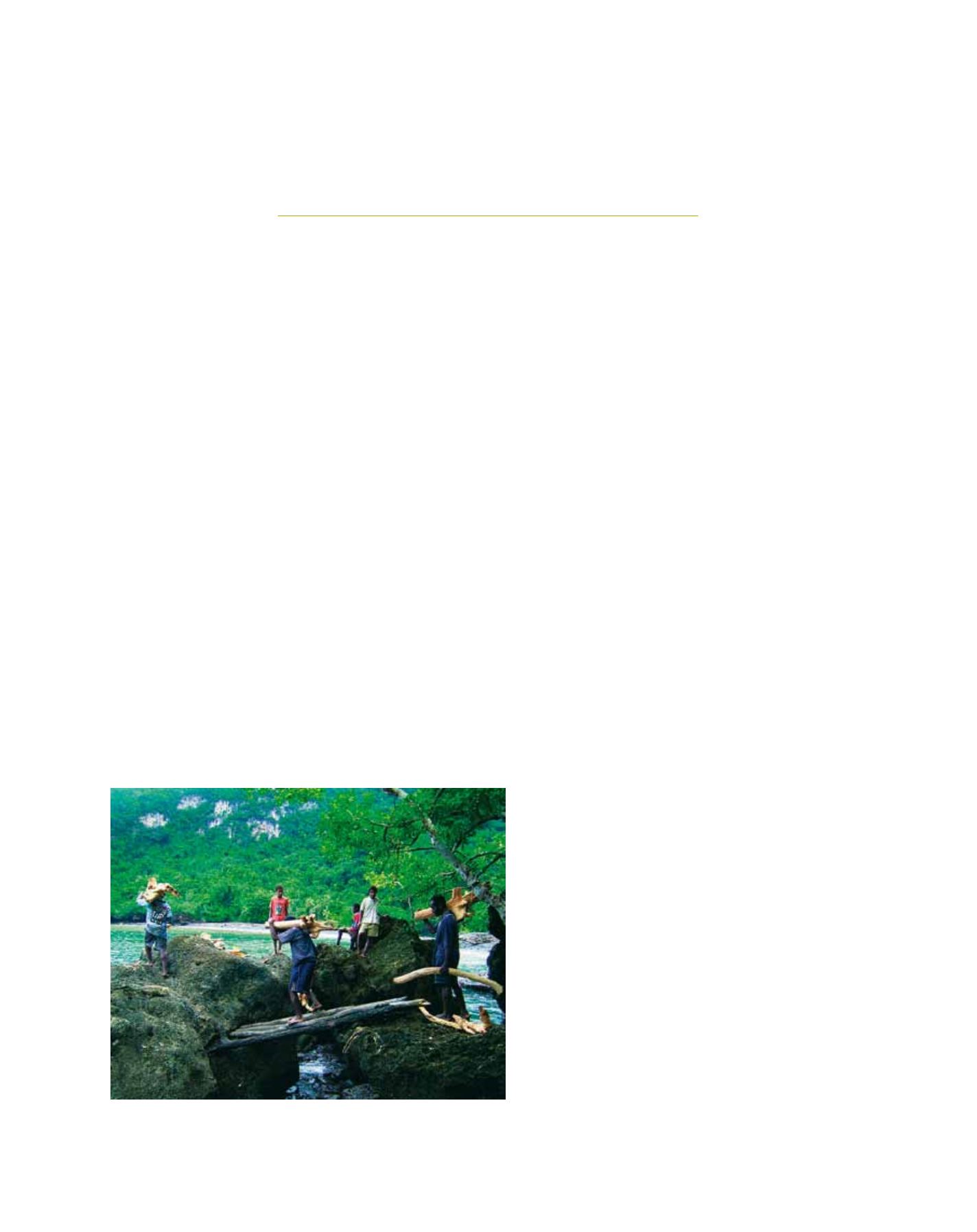
Supporting blue economies means developing alternative livelihoods in other
agricultural fields
Image: ACIAR