



 97 / 208

[
] 97
E
nvironment
:
air
,
water
,
oceans
,
climate
change
On the other hand, waste produced in the MENA
region is more than 50 per cent organic, which has
potential for composting and a further reduction
in GHG emissions through landfilling.
7
However,
composting is practically nonexistent due to lack of
both awareness and incentives to separate waste at
the source. This results in cross-contamination of the
organic component and, where practised, a degraded
compost quality.
8
A number of promising initiatives
to divert more of the waste stream to composting is
underway in Egypt and Lebanon. The Cairo south-
ern zone composting project began in 2008 with the
aim of treating about 1,100 tons a day of domestic
waste through recovering recyclables and compost-
ing, reducing landfill-produced GHG to an equivalent
estimated CO
2
reduction of 55,656 tons/year.
9,10
As an alternative to incineration, a technological
breakthrough in the use of waste-to-energy is being
considered in Lebanon and Egypt, alongside the use of
biomethanation as well as mechanical and biological
treatment to produce high-grade compost.
Material recovery and recycling – including
plastics, glass and paper – is also very low at less
than six per cent on average. In 2009, the German
International Cooperation (Deutschen Gesellschaft
für Internationale Zusammenarbeit (GIZ) GmbH)
estimated that Egypt was losing an average of US$500
million each year by not recycling all its potential
Opportunities
Steps have been taken to green the waste sector, with most partner
countries developing their own strategies and national programmes
for improving waste collections, promoting closure of open dumps
and disposal in sanitary landfills, recycling and material recovery,
applying the polluter-pays principle and raising public awareness.
But despite the establishment of laws and regulations, enforcement
is largely absent and much waste continues to be disposed of in open
dumps.
4
Sanitary landfilling is not only environmentally sound but
economically viable, through the Clean Development Mechanism
(CDM) to reduce greenhouse gas (GHG) emissions. Some coun-
tries have started to benefit from CDM, including Morocco, Tunisia,
Egypt, and Syria (through methane gas capture) as well as Jordan
(through energy recovery from waste).
5
These nations have regis-
tered 10 CDM projects in total, which are designed to avoid 1.87
million tons of CO
2
emission annually, equivalent to about €18.7
million certified emission reductions each year.
According to the Intergovernmental Panel on Climate Change
model of 2006, it is estimated that the amount of CO
2
equivalent
being emitted from present landfills in SWEEP-Net’s partner coun-
tries will be 8.16 million tons by 2025.
6
Assuming the amount of
waste dumped in these landfills remains the same, the generated
amount of CO
2
equivalent will be about 130 million tons by 2025,
clearly on the conservative side. This could generate between
US$0.9 billion and US$1.2 billion in the region by 2025, at a unit
price for CO
2
in CDM projects of US$ 7-10 per ton, excluding the
market price of recyclables. The latter are estimated to be in the
range of US$2.2 billion to US$7.0 billion.
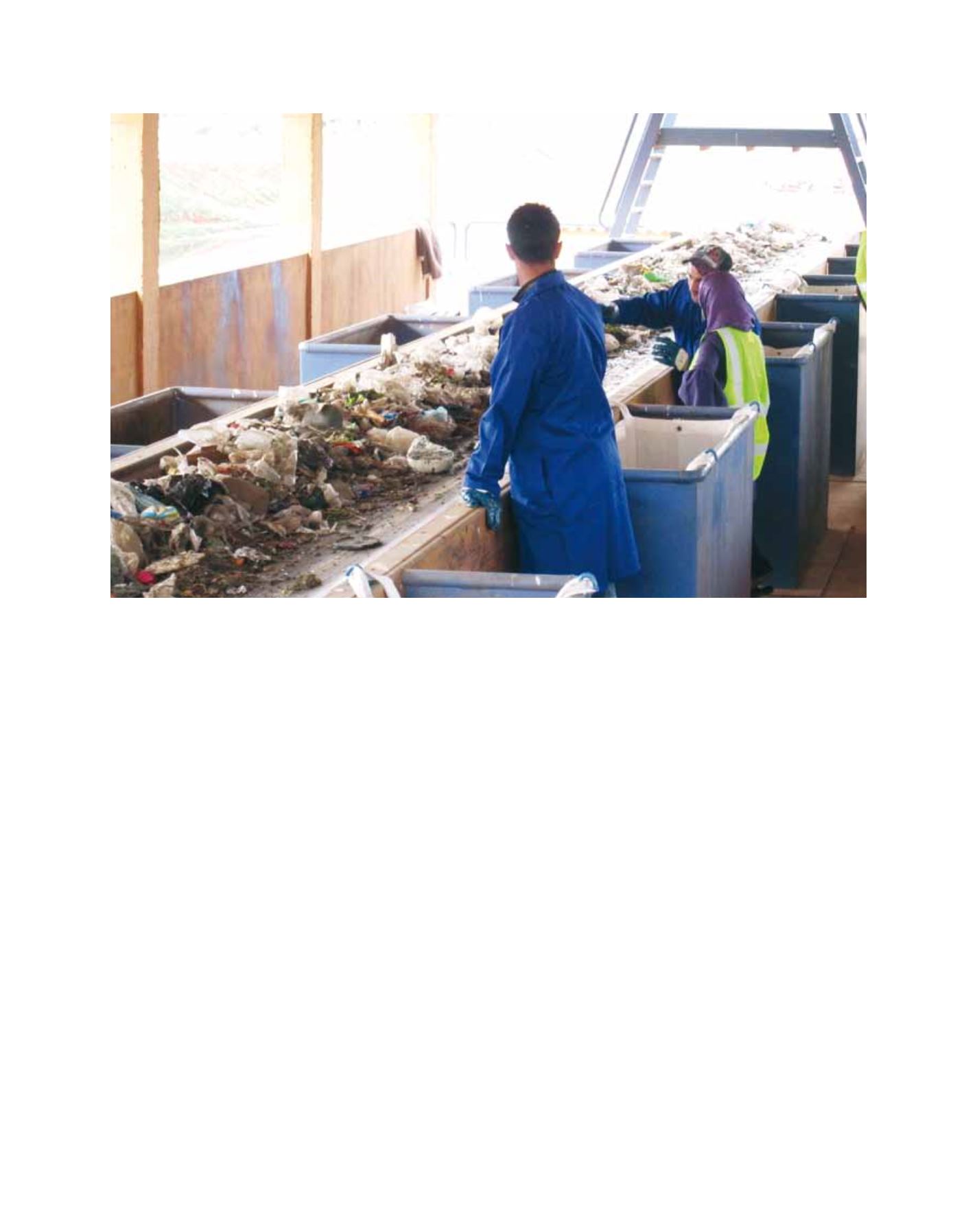
High potential to compost organic waste is undermined by lack of awareness and incentives to separate at the source
Image: SWEEP-Net – Morocco