



 92 / 208

[
] 92
E
nvironment
:
air
,
water
,
oceans
,
climate
change
farmer said of the MASIPAG training: “It widened my vision and
knowledge in terms of the role of local rice seeds for farmers.”
Meanwhile, network partners have shared how these initiatives have
helped them build capacity to upscale BEA initiatives at the local
level and empowered local communities to do better.
The capacity-building activities have facilitated the upscaling of BEA
practices; built BEA skills among farmers, non-governmental organi-
zation (NGO) staff, agricultural extension workers and others; and
supported local action and network building. Collectively, the activities
have significantly contributed to the sustainable human development of
small rice farming communities in various countries in Asia.
In 2009, the rice fields of Yunnan, China, were destroyed by the
rice plant hopper and we collaborated with our network partner
in Yunnan, the Pesticide Eco-Alternatives Center (PEAC), to
address the situation. A short study was carried out, followed by a
cross-country workshop on the results, involving NGOs, academ-
ics, scientists and policymakers from China, Vietnam, Lao PDR
and Burma. In addition, we produced factsheets on the rice plant
hopper and Integrated Pest Management. All these efforts were
timely responses by PAN AP and PEAC to the crisis, to convince
agriculturalists and policymakers that the use of pesticides actually
exacerbates rice plant hopper attacks and is unsustainable, whereas
BEA methods are effective and sustainable in dealing with pests.
Fact-finding missions on displacement and land-grabbing
As part of its continued support of small producers in their strug-
gle for livelihoods and sustainability, including rights over land
and other productive resources, PAN AP has been organizing
international fact-finding missions (FFMs) to some countries
where communities were being forcibly displaced from produc-
tive land to enable the building of power plants or
industrial and mining projects.
In a successful intervention, PAN AP organized an
international FFM to Sompeta in Andhra Pradesh, India
in September 2010. Local communities were resisting a
planned coal-based power project which was to be built
on 779 hectares of lush farmland that the Government
had declared ‘wasteland’. The FFM documented the
plight of the farming communities and the problems
of displacement and loss of livelihood for about 20,000
small farmers. The likely impact of the project and the
paradox of unsustainable development could be best
summed up in the words of Sheshamma, an elderly
local woman: “Who will enjoy electricity in our villages
when we will be begging on the streets in big cities?”
Based on the FFM report, PAN AP mounted an inter-
national online campaign and also sought interventions
from United Nations Special Rapporteurs. With strong
local protests and international pressure building up,
India’s National Environmental Appellate Authority
denied environmental clearance to the project, which
was then scrapped in June 2011, saving the land and
livelihood of the communities.
PAN AP also supported communities fighting
displacement from land acquisition for mining in the
Philippines when, in November 2008, it exposed the
destructive oil and gas exploration projects in Tañon
Strait on the island of Cebu. The project was spear-
headed by Japan Petroleum Exploration Co. with
support from the local government. Tañon Strait was
declared a protected seascape by the Philippines as early
as 1998, and is a migration route of whale sharks. In
addition, the exploration project prevented the local
communities from having access to the sea, thus violat-
ing their rights to decent livelihoods. As a result of the
FFM and the campaigns that followed, the company
withdrew the project and the exploration was stopped.
Making a difference
PAN AP has been working with organizations and groups
of small farmers, agricultural workers, rural women,
indigenous peoples and other marginalized groups to
take up the challenge to ensure a healthy environment,
safe food, and food security and sovereignty. We have
realized that we cannot work in isolation and that we
must see this struggle within the framework of human
rights and environmental sustainability. This has meant
that PAN AP not only confronts dependency on pesti-
cides and chemical agriculture, but also supports people’s
rights to produce food ecologically and to have access
to productive resources such as land, water, biodiver-
sity and seeds. There is a need to organize and mobilize
support from a wide range of people to champion food
sovereignty and ecological agriculture and to show that
alternatives to pesticides exist. Our greatest strength
and most powerful resource is the network of people’s
organizations, particularly of marginalized communities
that also represent diverse movements and organizations.
Together we can make a difference.
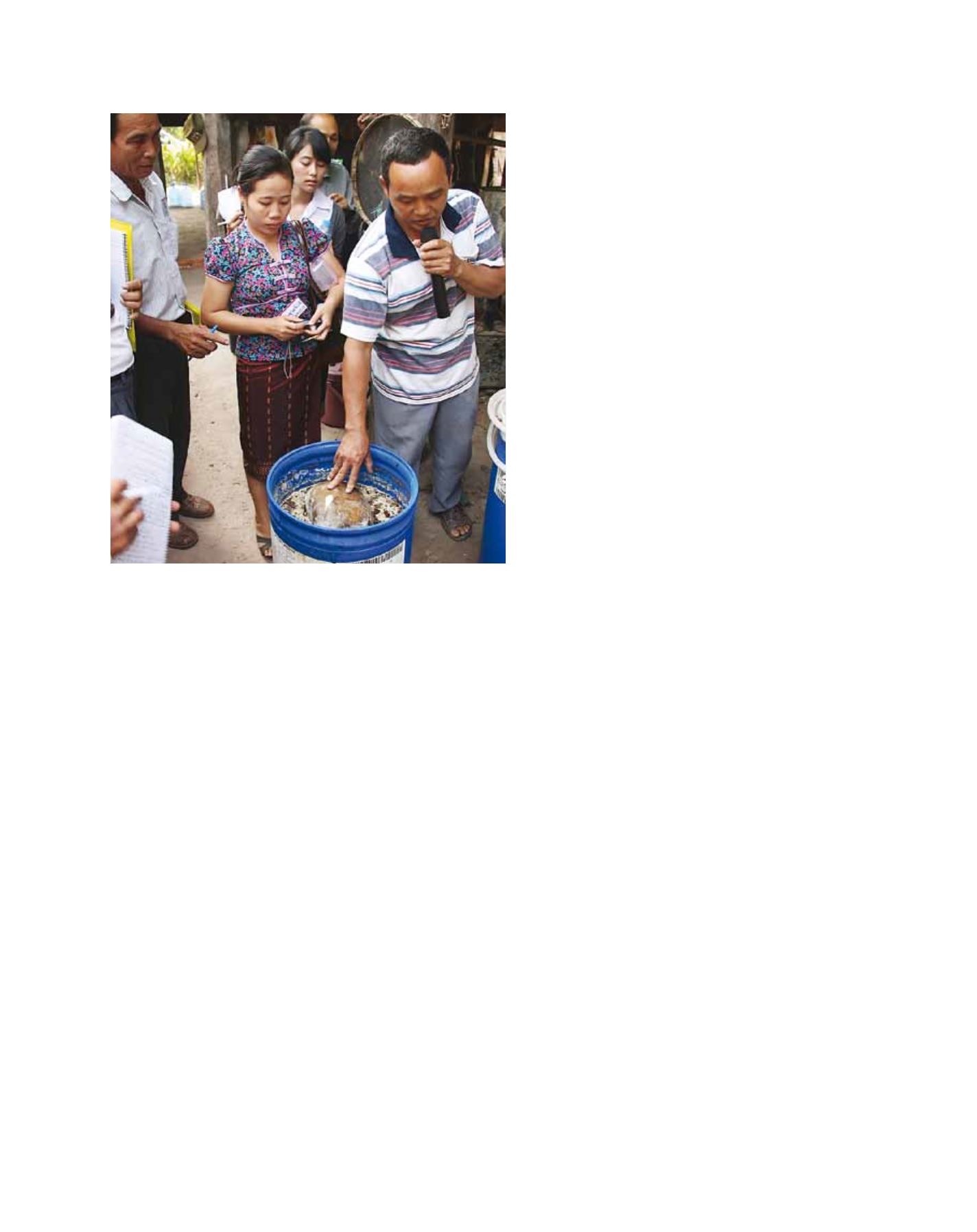
PAN AP works with marginalized groups to ensure food security and a healthy environment
Image: PAN AP