



 91 / 208

[
] 91
E
nvironment
:
air
,
water
,
oceans
,
climate
change
members, many of whom are now practising organic agriculture in
their home gardens and in their rice fields.
PAN AP has been a strong advocate for small-farm BEA as a
sustainable alternative to the toxic model of modern agriculture.
BEA is also a fundamental component of food sovereignty. It
provides sustainable livelihoods for small farming communities and
strengthens community resilience in coping with climate change. It
is one of the Five Pillars of Rice Wisdom that form the foundation
of PAN AP’s Save Our Rice campaign, launched in 2003. With the
global food, financial and climate crises which emerged in 2008, the
importance of BEA in sustaining the food security and food sover-
eignty of small, vulnerable rice communities all over Asia took on
greater urgency. Thus, capacity-building has featured largely in our
activities in recent years.
We identified the System of Rice Intensification (SRI) as an impor-
tant BEA technology for sustainable livelihoods. This was because
SRI had proven to reduce production costs while increasing yields
and net incomes significantly in several Asian countries over the past
three decades. Two regional workshops for network partners and
farmers from eight Asian countries were organized in Cambodia and
India, with partner organizations
Centre d’Etude et de Développement
Agricole Cambodgien
(CEDAC) and Kudumbam respectively acting
as trainers due to their expertise in SRI. Another regional training
programme on farmer empowerment, seed breeding and climate
change adaptation using diversified integrated farming systems was
organized for partners and farmers from 11 countries to meet the
need for rice communities to learn to organize themselves, save
seeds and adapt to climate change. This training was conducted by
MASIPAG, a farmer-scientist partnership for development in the
Philippines, due to its expertise in the areas of focus. These were
fundamental areas for the sustainable development of
poor rural communities.
Having close network partners with BEA expertise
has been very significant and a major strength for our
network. With these partners, we have managed more
effectively to meet the needs of our other network
partners and the sectors both we and they serve.
Other than training, such partners have also helped
us to develop important factsheets on BEA and farmer
empowerment, which have been translated by network
partners into local languages to strengthen their BEA
sustainability initiatives.
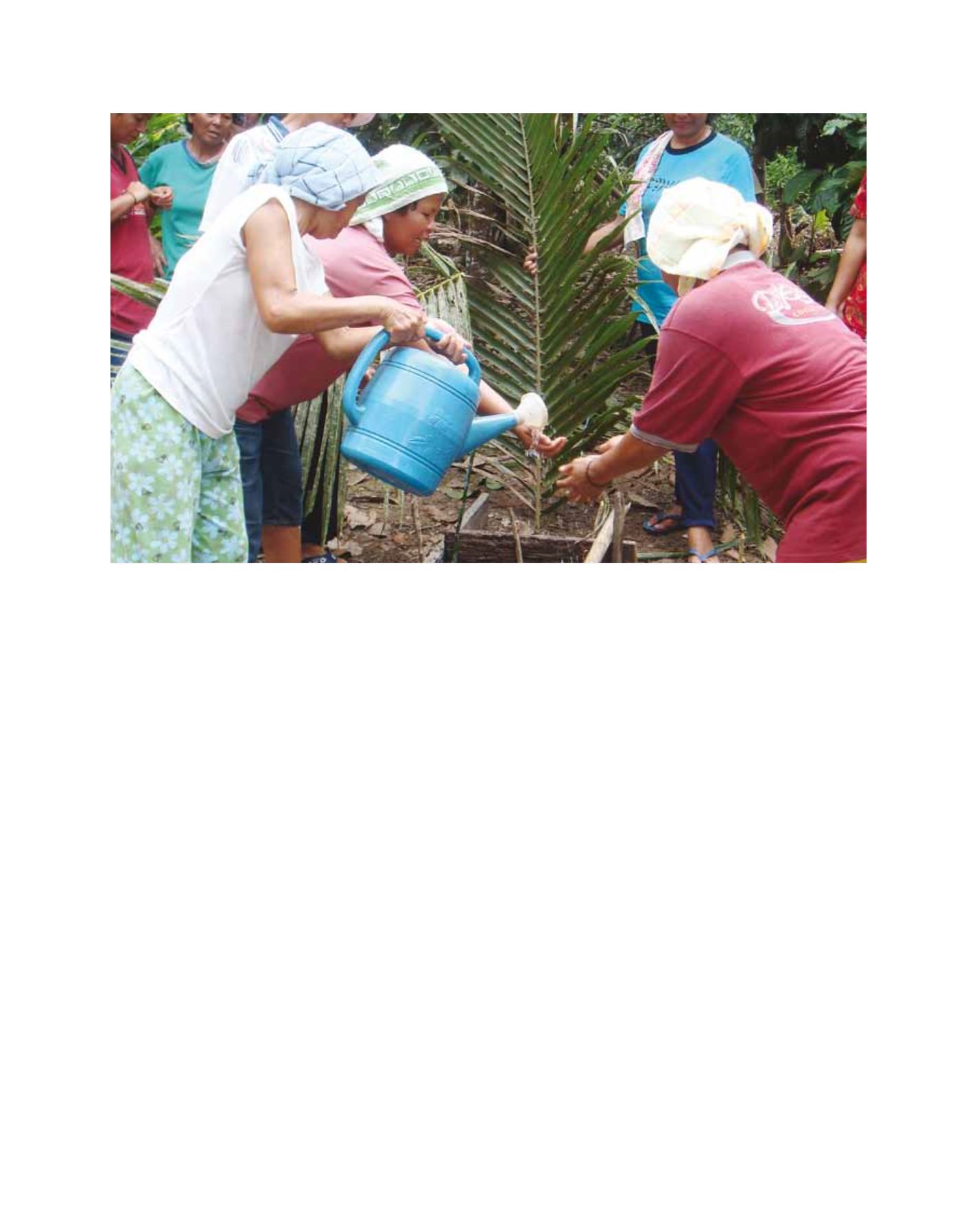
We also responded to local needs for capacity-build-
ing in BEA where local communities were found to be
struggling with low yields and incomes. Local indigenous
communities in East Malaysia and small rice farmers in
Andhra Pradesh and Uttarakhand, India, received special
hands-on training in BEA and SRI skills.
All the BEA projects were very much appreciated by
the participants, who said they had gained a lot from
the training and who continue to practise and benefit
from their new skills. Trainees have reported gains such
as minimizing pest attacks by using organic pesticides
they have learned to make. They have also achieved
improved yields, better incomes and a more diversified
diet (for example from kitchen gardens), and have even
increased their adaptive capacity to climate change.
Seed breeding techniques learned from MASIPAG have
been upscaled at the local level in several countries,
including Indonesia, Nepal, Cambodia and India. One
Indigenous women preparing a nursery bed as part of the BEA training in Sarawak
Image: PAN AP