



 90 / 208

[
] 90
E
nvironment
:
air
,
water
,
oceans
,
climate
change
Plantations, a Danish plantation company operating in
Malaysia and Indonesia, phase out the use of two HHPs,
paraquat and monocrotophos, from their plantations. In
India, PAN AP partner Thanal and the local community
in Kasargod were successful in their actions to stop the
health and environmental devastation caused by the
HHP endosulfan after more than 10 years.
PAN AP provided extensive documentation on the
severe health and environmental impairments caused by
endosulfan, which was widely used in Asian and other
developing countries, to the Conference of the Parties
(CoP) to the Stockholm Convention on Persistent
Organic Pollutants (PoPs). Following strong worldwide
campaigns by PAN and various groups, in 2011 CoP
finally recognized endosulfan as a PoP, leading to a ban
on its manufacture and the phasing out of its use world-
wide. Further, in 2011, paraquat was recommended for
inclusion in the Rotterdam Convention, which requires
prior informed consent for trade in certain hazardous
chemicals. The Governments of Sri Lanka, Malaysia
and China have been reviewing the impact on health
of certain HHPs, particularly endosulfan and paraquat.
Promoting ecological agriculture
With CPAM creating strong awareness among farming
communities, many of them not only pledged to reduce
pesticide use, but also wanted to move towards farming
without chemicals – that is, towards organic or ecologi-
cal agriculture. After the CPAM process, PAN AP’s
partner Vikalpani, the Sri Lankan Women’s Federation,
was motivated to work with PAN AP to organize a
series of training workshops on organic farming for its
PAN AP’s strong pesticides programme challenges the power of
the agrochemical companies and small farmers’ dependency on
pesticides, while empowering communities to work towards the
reduction and elimination of pesticide use. The programme rests
on four complementary strategies:
• Community empowerment through Community-based Pesticide
Action Monitoring (CPAM)
• Policy research and advocacy
• Campaigns addressed at targeted pesticides and companies
• Institution-building and alliance-building towards these ends.
CPAM, a self-surveillance monitoring and recording methodol-
ogy developed by PAN AP and its partners, enables communities
to measure the effects of pesticides on their health and the environ-
ment and take actions to reduce or eliminate pesticide use. Based on
participatory action research, this comprehensive programme helps
communities to document the adverse impacts of pesticides, raising
awareness and motivating them to adopt ecologically sound and
sustainable agricultural practices. Further, it prompts them to pres-
sure governments and campaign for better pesticide regulation and
implementation of international conventions on pesticides.
In the past 10 years, learning exchanges and capacity-building
workshops have been organized and CPAM surveys carried out in
several countries including Cambodia, China, India, Indonesia, Korea,
Malaysia, Mongolia, Philippines, Pakistan, Sri Lanka and Vietnam.
The results were compiled and discussed at national and international
meetings, stressing the need for national and global action.
The year 2010 saw the release of the landmark Asian Regional
Report (produced by 12 organizations from 8 Asian countries),
followed by the Communities in Peril: Global Report on Health
Impacts of Pesticide Use in Agriculture. A significant outcome of
these reports and the folow-up media reports made the United
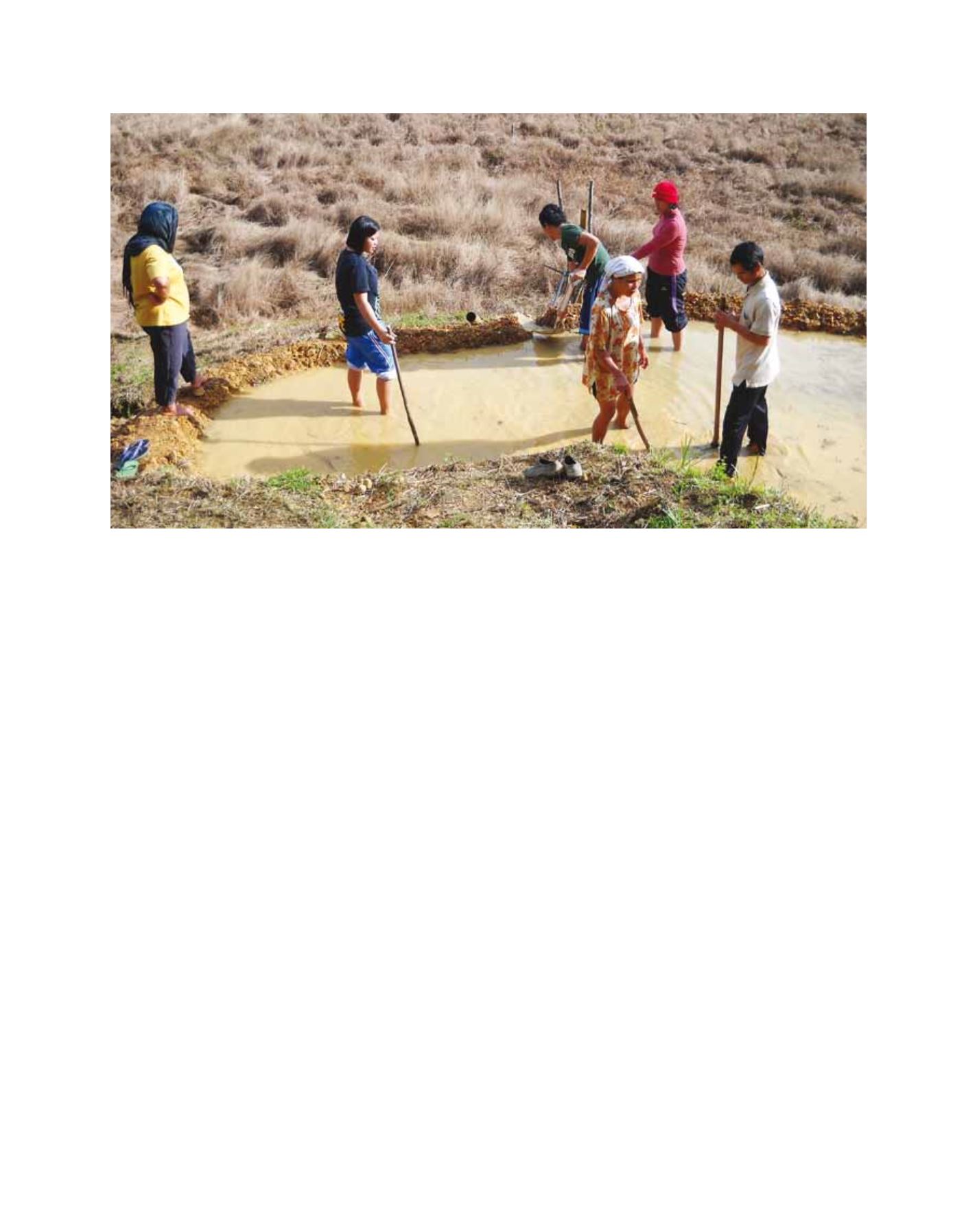
Indigenous farmers preparing a hill rice plot for sowing during the BEA training in Sabah
Image: PAN AP