



 94 / 208

[
] 94
E
nvironment
:
air
,
water
,
oceans
,
climate
change
and monitored to maintain a focus on sustainable
development.
The implementation of the strategy was carried
out through a decentralized process with District
Development Plans focusing on implementation
modalities that are results-based and monitored
through a home-grown approach known as ‘Imihigo’.
The key EDPRS flagship, which primarily focuses
on reducing predominantly rural poverty, relies on
improving the management of environment and
natural resources as an important input towards
sustainable development. Progress monitoring is
conducted through this approach, using indicators
and targets that are aligned to localized MDGs.
The policymaking processes were initiated in the
aftermath of the reconstruction phase around 2003,
during which the environmental policy was first
formulated. The policy informed the formulation
of the Organic Law on Environment in 2005. This
was a significant milestone in the pursuit of national
sustainable development.
Environment was considered a cross-cutting issue
among other issues such as gender, youth and social
inclusion in the EDPRS. To this end the Ministry of
Finance and Economic Planning, which is responsible
for sector coordination at the national level, played a
critical role in integrating environment and climate
change in other sectors, particularly economic sectors
such as energy and agriculture. Cross-cutting aspects
such as the environment and climate change, gender
promotion and participation in development, youth
a key message for Rio+20 as the world reviews the path of sustain-
able development from 1992 to today.
Follow-up on national sustainable development is conducted at
the highest level of Government, and results shared at the 2012
Government of Rwanda Leadership Retreat highlighted the progress
made.
3
Of the original 47 indicators and targets:
• 12 (26 per cent) were already achieved
• 16 (34 per cent) were well on track to be achieved
• 8 (17 per cent) showed good progress (achievable)
• 11 (23 per cent) needed significant efforts given the trend of
progress.
Notably, Rwanda plans to redouble its efforts towards accelerating
the pace of development beyond what was originally envisioned
in the recent Seven-Year Government Programme, which peri-
odically reviews and redirects national development targets. This
lends credence and support to Rwanda’s Economic Development
and Poverty Reduction Strategy (EDPRS).
The Economic Development and Poverty Reduction Strategy
The EDPRS is Rwanda’s second-generation national medium-
term strategy, developed in the aftermath of PRSP 1 to implement
the Vision 2020. The EDPRS development process was highly
participatory, bringing together all national and subnational
stakeholders in a consultative process that culminated in a
nationally owned strategy. Since Rwanda was committed to
achieving sustainable development goals, the medium-term strat-
egy sought to integrate the environment and climate change as a
cross-cutting issue. The integration of environment and climate
change from 2008-2012 was clearly intentional in ensuring that
the links between poverty and environment were implemented
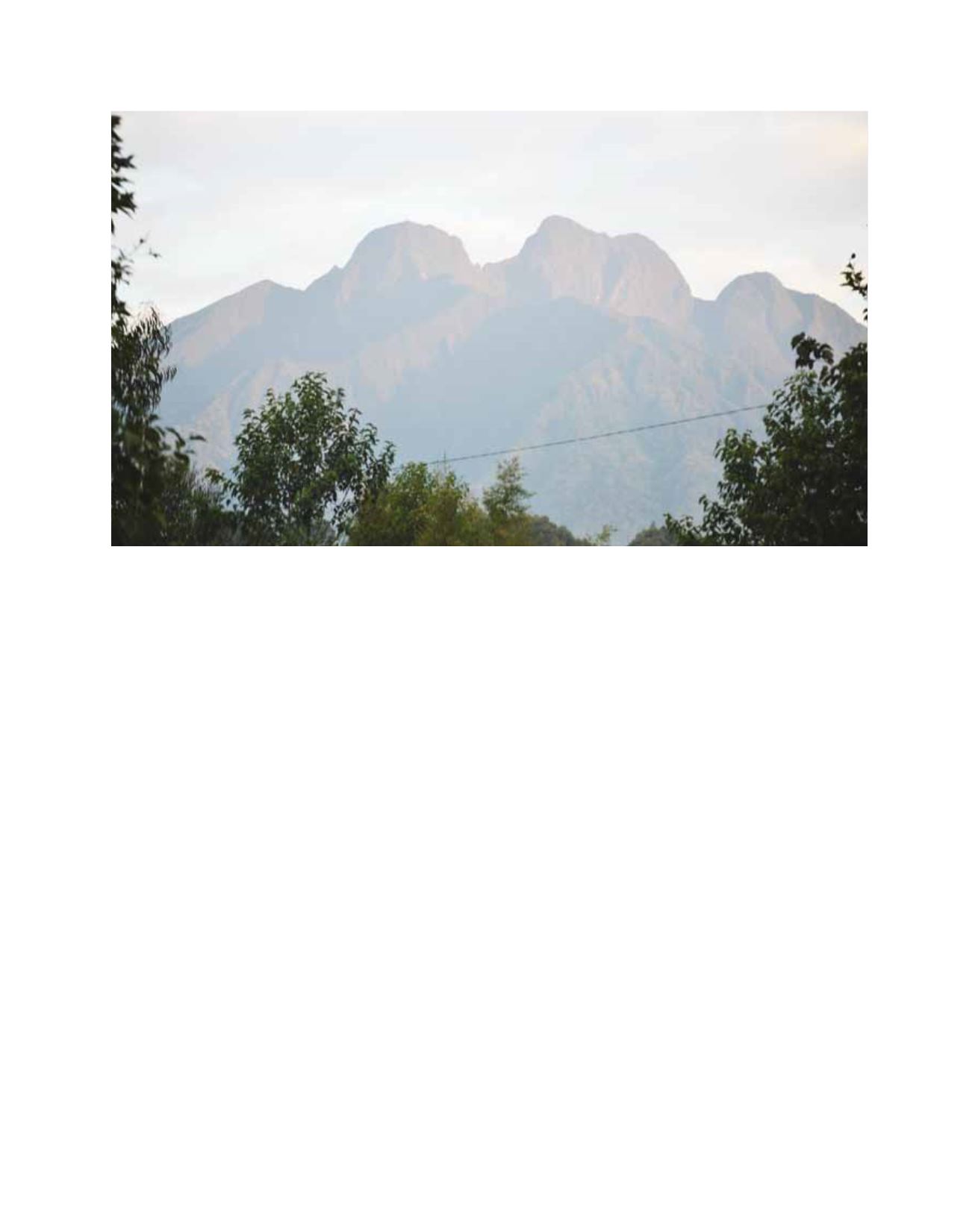
Sabyinyo mountain gorilla natural habitat
Image: REMA 2012