



 95 / 208

E
nvironment
:
air
,
water
,
oceans
,
climate
change
[
] 95
Embedded within the strategy is a fund to foster the
harmonization and sustainability of environment financ-
ing in Rwanda (FONERWA). This is a multisectoral
sustainable financing mechanism that provides an oppor-
tunity for sectors to climate-proof development and open
up sector-specific green jobs. Rwanda has experienced
remarkable growth in tourism, which is currently among
its top four sources of national revenue. This serves as an
entry point towards the diversification of revenue sources,
positioning Rwanda for green jobs and investments as well
as for overall economic growth that will reduce depend-
ence on fossil fuels and other high-carbon options.
In 2011, Rwanda hosted a regional workshop as an
input towards institutionalizing green growth through the
policy, legislative and regulatory frameworks, and towards
institutional mechanisms to reinforce green growth and
opportunities at both national and regional levels. The
consensus generated from the regional workshop is poised
to augment the national efforts that will move Rwanda
towards consistent green economic growth.
Challenges
Rwanda is a developing country, and it faces sustain-
able development challenges that are typical to other
developing countries. Rwanda suffers from the impacts
of globalization, including trade imbalances, green-
house gas accumulation in the atmosphere leading to
climate change impacts, and transboundary environ-
mental impacts such as pollution and other forms of
atmospheric deposition that cross boundaries between
and among nations. These issues increase the cost of
regulation on the part of Rwanda.
The country faces extreme challenges in terms of
energy availability, access and cost, which is increas-
ingly imposing a burden on sustainable development.
The Rwandan population is primarily dependent on
biomass as a source of energy and this has multiple
implications, including increasing deforestation rates
and exacerbating soil erosion and the siltation of
national water resources. These issues pose challenges
to Rwanda’s efforts towards poverty reduction goals
and make it more costly to achieve sustainable develop-
ment. Rwanda’s private sector is still young, and is yet
to develop the capacity (human and technical/technol-
ogy transfer) required to provide alternative off-farm
employment that may reduce pressure on the environ-
ment and natural resources.
Rwanda has the highest population density in Africa.
Thus, population pressure is increasingly constrain-
ing natural resource use and there is a need for creative
ways to manage the environment and natural resources
– especially in a situation of climate change from global
impacts. Whereas policies and government are key ingre-
dients in improving management, there are intractable
problems that require cooperation and support from the
international community. The FONERWA fund for the
environment and climate change, an innovative solution
for sustainable financing, serves as an example of the inno-
vations the country has undertaken.
employment and social protection measures, have all evidently
accelerated the pace of Rwanda’s progress towards inclusivity and
sustainable development. Rwanda leads the world in women’s
representation in parliament, with a current level of 56 per cent.
As a result, national policies, legislations and strategic plans in
economic and social sectors as well as planning and implementa-
tion processes are aligned to overarching policy prescriptions such
as Vision 2020, MDGs and EDPRS, which are driven by sustainable
development objectives.
Climate change and low carbon development strategy
The Government of Rwanda has developed a renewed commit-
ment to address climate change following data and information
that was gleaned from the first and second communications in the
UNFCCC. It became apparent that climate change had far-reaching
implications in influencing national economic development. In an
effort to develop a clear country position on climate change, a study
sponsored by the UK Department for International Development
(DFID) was conducted and concluded in 2009. The study high-
lighted that climate change costs Rwanda about 1 per cent of gross
domestic product.
4
Among other highlights from the DFID sponsored study, it
became apparent that a cross-sectoral strategy on climate change
in Rwanda was crucial. Thus, a national strategy on climate
change was formulated to address climate resilience and green
growth with a focus on promoting low-carbon options. A signif-
icant achievement of the strategy was its focus on a range of
sectors that contribute to national sustainable development. This
has informed the revision of Vision 2020 to incorporate climate
change targets as a key input towards national sustainable devel-
opment goals.
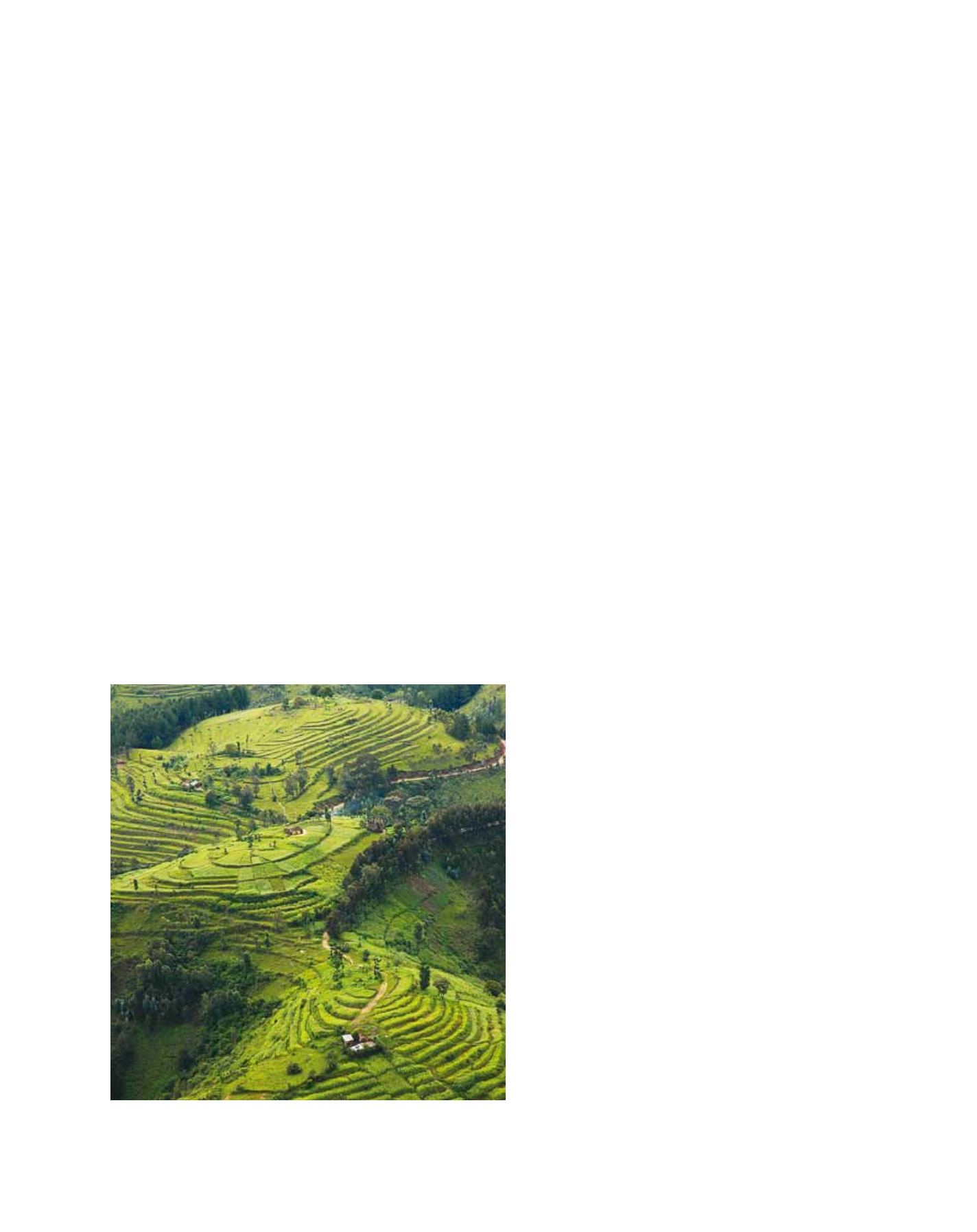
Land husbandry is crucial in Rwanda, Africa’s most populous country. Agroforestry
and terracing make good use of available land
Image: Gilles Tordjeman