



 101 / 208

[
] 101
S
ustainable
agriculture
,
wildlife
,
food
security
,
consumption
and
production
patterns
ACIAR-funded studies of the sandfish (Holothuria scabra) – a
high-value sea cucumber harvested easily from inshore habitats
– have led to technologies for breeding these in hatcheries and
releasing them into the wild. The research concludes a significant,
long-term research investment into sandfish culture in the Asia-
Pacific. Three large projects have covered the hatchery culture of
sandfish, techniques for releasing them into the wild, and aquacul-
ture practices of sea ranching and pond culture. The research results
were disseminated in a symposium – supported by the Secretariat
of the Pacific Community – on recent advances in hatchery produc-
tion technology, release strategies, farming techniques, management
practices and supply chains, and marketing. The symposium led to
informed recommendations being developed for guiding strategic
research into sea cucumber aquaculture for the next decade.
Inland aquaculture is an important component of ACIAR’s fisheries
strategy. Fish demand and supply scenarios indicate that the supply
of fish through aquaculture will be essential in supporting future food
security and nutritional requirements. For example, in the Solomon
Islands – under current scenarios – there is predicted to be a shortfall
of between 6,000 tons and 20,000 tons each year, by 2030.
ACIAR-funded research is assessing the feasibility of inland cultur-
ing of two further species. Initially, the focus will be on researching
the feasibility of milkfish farming, followed by farm trials of husbandry
and management systems for milkfish and/or Nile tilapia.
Increased capacity for aquaculture management within house-
holds, schools and business enterprises can reduce pressure
on inshore fisheries. The research will link to investments that
support the sustainable growth of aquaculture and help strengthen
Government institutions at both national (Ministry of Fisheries and
Marine Resources) and provincial levels.
Lessons will have been widely shared within Pacific nations facing
future fish supply shortfalls, with the goal of developing an inland aqua-
culture industry that makes a significant contribution to
food and nutritional security in the Solomon Islands.
The final component of supporting the blue econ-
omies is to develop alternative livelihoods in other
agricultural fields. The rich forest resources of the
Pacific, like the fisheries sector, offers job opportuni-
ties if sustainably managed.
Vanuatu, which comprises about 80 islands with a
population of 220,000, has about 35 per cent of its land
area covered by primary forests and another 35 per cent
by dense thickets of low trees. Forests provide wood
and non-timber products for customary landowners,
while forestry activities include small-scale logging,
agroforestry and conservation programmes.
ACIAR research is introducing improvements in silvi-
cultural management of whitewood (Endospermum
medulosum) for plantations in Vanuatu. This helps
custom landowners achieve good returns from growing
high-quality native timbers. The project has established
15 hectares of trials – located on six sites in East Santo
– covering site preparation, fertilization, weeding,
spacing, thinning and pruning operations, in both pure
whitewood and mixed species plantings.
The silvicultural trials have indicated that there is
little or no benefit from using sophisticated site prepa-
ration techniques or fertilizer, but that the key issue
for seedling survival is good weed control, particularly
in relation to controlling the aggressive Merrimia vine.
In many Pacific countries, there are large areas of
senile coconut palm (Cocos nucifera) plantations that
are no longer producing commercial returns. While
coconut palms have been used to produce furniture and
handicrafts in the Pacific, there has not yet been a viable
enterprise using this resource on a sustained basis.
Value-added products from coconut stems could
assist with clearing of the old plantations, while
generating income for landowners. ACIAR’s project
on improving the value and marketability of coconut
wood included research on the most appropriate
processing techniques for producing both sawn timber
and engineered flooring, suitable for international
markets. Coconut palms have higher-density fibre
near the outside of the stem, with the lowest density
in centre of the stem. The lower sections of senile
stems can produce high-quality cocowood which is
suitable for either tongue and groove or laminated
flooring, if the back-sawn material is carefully graded
and appropriately dried. The project determined the
physical and mechanical properties of the material and
published a best practice manual for producing high-
value cocowood flooring products.
Creating sustainable approaches for enhancing
management of the natural resource base within the
Pacific region is central to ensuring that possibilities in
the blue economies of small island states are inclusive
and provide opportunities for all, including smallholders
who depend on agriculture and the fisheries. ACIAR’s
research is a modest component of an Australia-wide
approach for ensuring a future for the region.
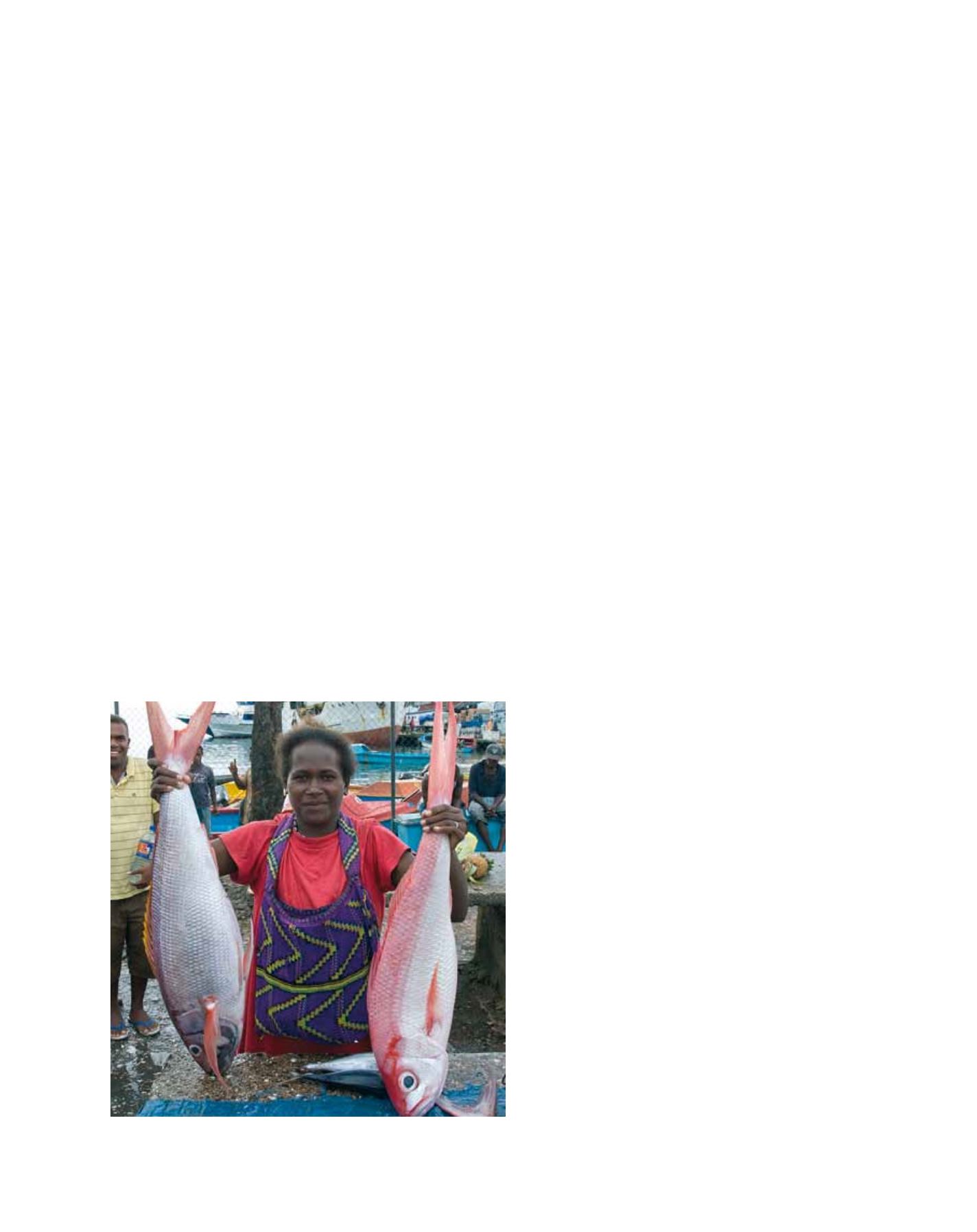
Sustainable fisheries management is vital to blue economies of the Pacific
Image: ACIAR