



 103 / 208

[
] 103
S
ustainable
agriculture
,
wildlife
,
food
security
,
consumption
and
production
patterns
Climate change
Intensive industrial farming is one of the causes of
climate change, and we need to switch to ecological
methods to provide relief. Agriculture accounts for 30-50
per cent of man-made greenhouse gas emissions – more
than the total for global transport.
2
Agriculture accounts
for 50-60 per cent of emissions of nitrous oxide (N
2
O)
and methane (CH
4
),
3
which are both potent greenhouse
gases: 1 kilogram of methane has the same impact as 21
kilograms of carbon dioxide (CO
2
), and nitrous oxide
has 310 times the impact. Animal factory farms have
the highest greenhouse gas emissions in the agriculture
sector.
4
Moreover, the potential impact of climate change
on agricultural production is huge.
On the other hand, some methods of sustainable
and organic farming can reduce climate change impact
while increasing resilience.
5
One example is the seques-
tration of CO
2
in fertile soils where the humus content
is higher. CO
2
from the atmosphere ends up in dead
plant materials in the soil, where it is mineralized before
being released again as CO
2
, but some of it is also stored
in the humus for a long time. If the humus content
increases, more CO
2
will be stored in the soil than
will escape. Studies have shown that soils on organic
farms are richer in humus than soils on conventional
farms. Furthermore, ploughless farming techniques can
further increase CO
2
capture in soils, because ploughs
promote the breakdown of humus.
Sustainable use of natural resources
Not only are fertile soils crucial to mitigating climate
change and building resilience for adaption to its
in calories, losses between harvest and consumption today amount
to about 50 per cent.
Meanwhile, agricultural resources are shrinking. Almost 40 per
cent of the soil used by agriculture is already degraded. In many
places, water supplies are running low; species diversity, the very
basis of plant breeding, is declining; and in regions such as the
tropics and subtropics, climate change will further severely impact
both the profitability of agricultural production and food security
in rural and urban Africa. Moreover, with a major share in global
greenhouse gas emissions, agriculture is a major contributor to
climate change.
In view of these challenges, global consensus is growing that
‘business as usual’ is no longer an option if we want to nourish
a growing population while maintaining and protecting natural
resources. As United Nations Secretary-General Ban Ki-moon
states: “We need to transform the way we approach food secu-
rity, in particular by unleashing the potential of millions of small
farmers and food producers.”
1
A widespread paradigm shift is
needed in our agriculture and food system; a global transfor-
mation towards an agriculture based on ecological principles,
which strengthens small and family farms. Although challenges
exist, there are already many proven solutions available that can
more than double present productivity in developing countries.
Biovision, together with international partners, is implementing a
global initiative to highlight the alternatives available and reshape
global policy and governance.
When considering the issue of sustainable development and a
green economy, we need to recognize that in some cases agricul-
ture is a source of environmental problems, but also a major part of
the solution to address urgent issues including climate change, land
degradation and desertification, or scarcity of natural resources such
as fossil fuels and water.
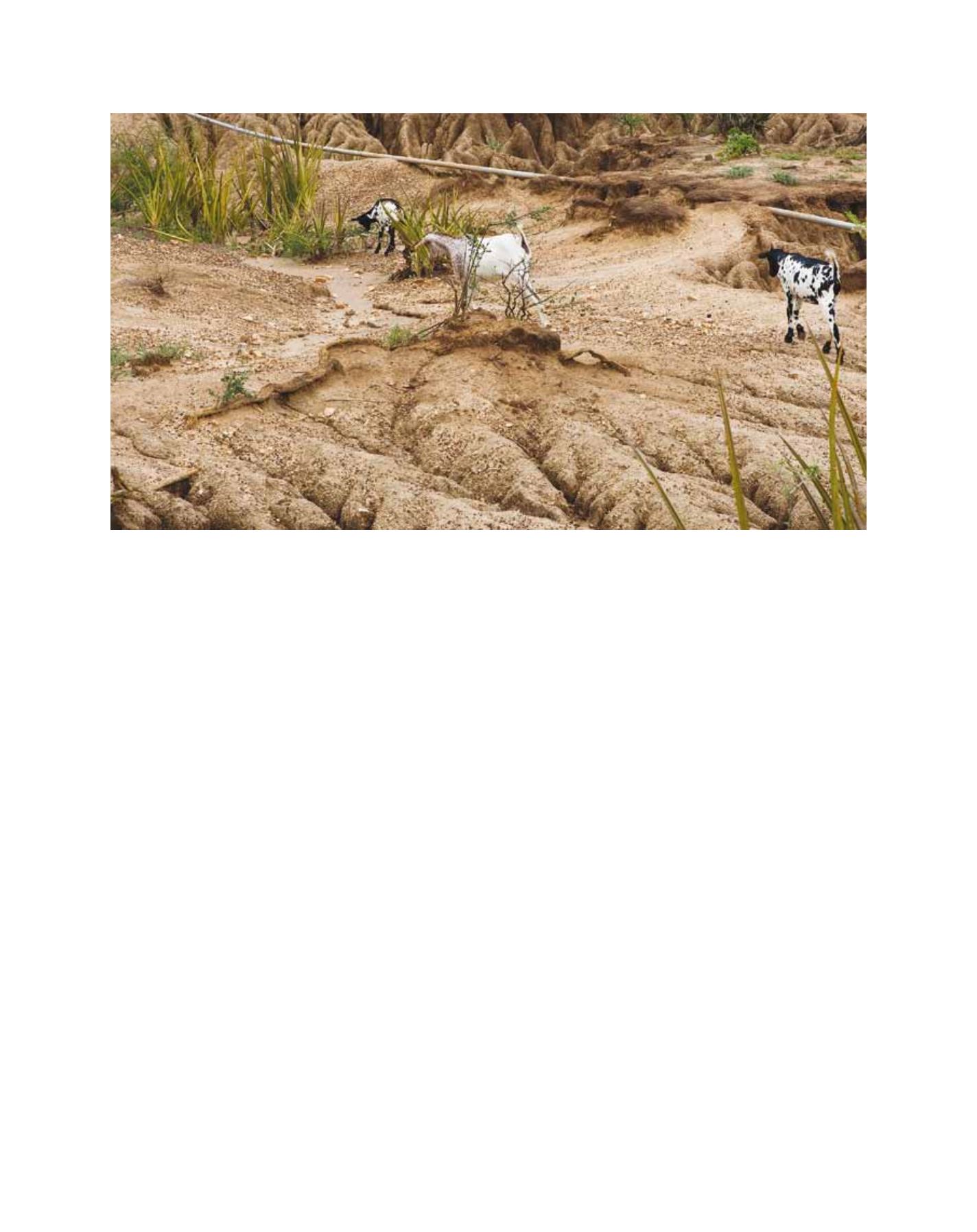
Regeneration of depleted soil can reverse the loss of farmland caused by erosion
Image: Biovision/Peter Luethi