



 102 / 208

[
] 102
Food, nutrition and sustainable
agriculture within a green economy
Hans Rudolf Herren, Biovision
I
n order to sustainably secure food and nutrition for all
human beings, a profound transformation of our global
agricultural and food system is required – a shift towards
ecological agriculture, which primarily relies on smallholder
and family farms. The international community will have to
develop and implement a set of actions to inform and design
new agricultural policies to achieve this.
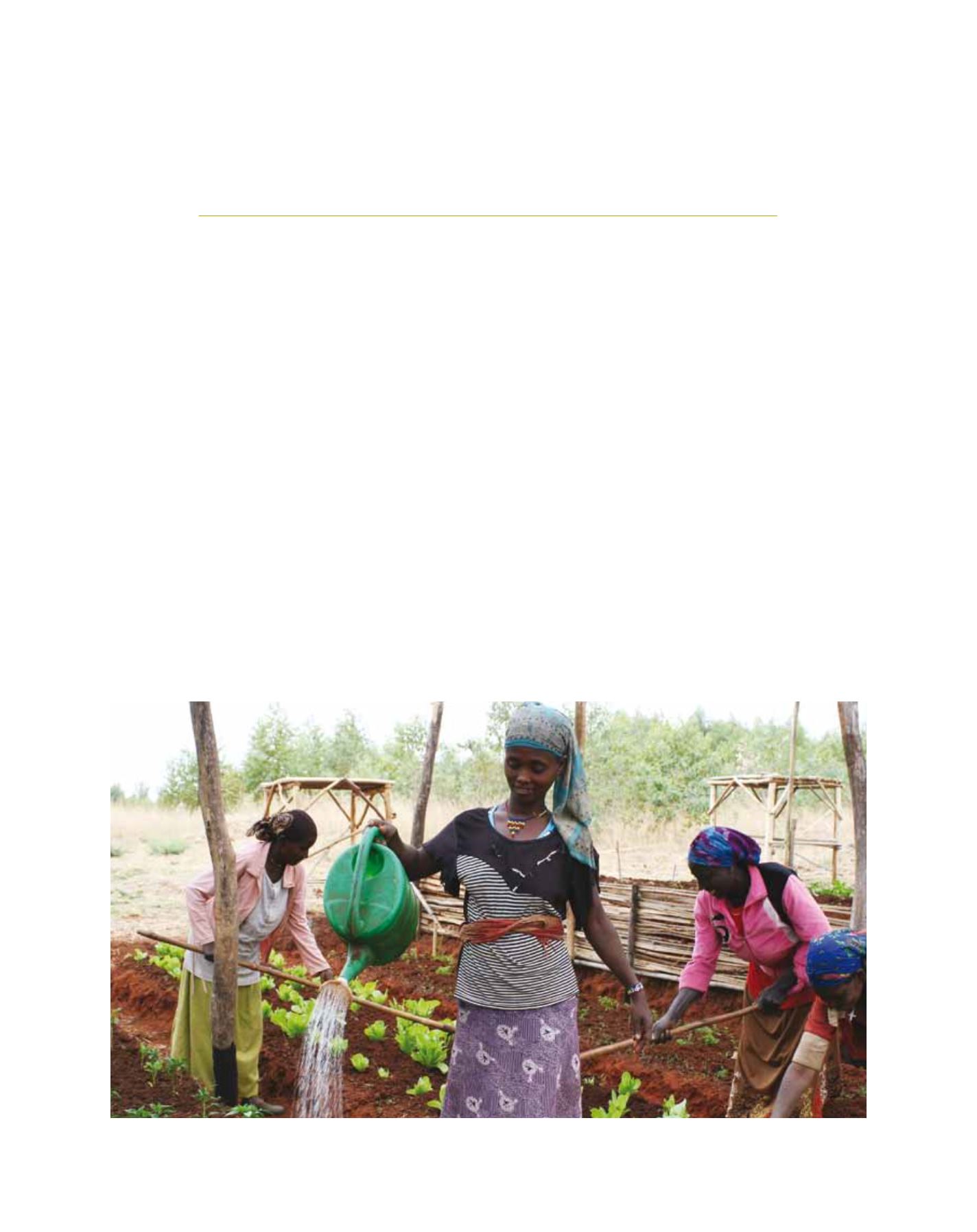
“By selling my vegetables on the market I used to earn ETB160
(around US$10) in two months on average,” says Haraba
Abdulamahid, a smallholder farmer in Assosa, Ethiopia. Farming
is a challenge in this region as the soils are threatened by erosion,
and many farmers lack the means and knowledge to adopt sustain-
able farming practices such as organic agriculture. Faced with this
challenge, Haraba signed up for a training course at a biofarm – a
model farm where feasible, low-cost, but highly effective farming
methods are demonstrated to farmers. The farm, which is run by
the Ethiopian non-governmental organization BioEconomy Africa
and supported by Biovision, has a very hands-on approach. After
the course Haraba went back to her own farm and
started to apply what she had learned. She explains
that she was able to get a better price for her organic
products as they are now of better quality: “I am very
successful on the market – I have earned ETB700
(US$40) in only two months.” The Swiss and Kenyan-
based Biovision Foundation is now supporting efforts
to further disseminate this approach to giving farmers
access to information and hands-on knowledge in
sustainable agriculture.
Everyone should be able to have enough healthy food
and enjoy a decent livelihood, as Haraba Abdulamahid
does in Assosa. It is not acceptable that every fifth
child born today will grow up hungry. But progress
is very slow. Since the mid-1990s, the number of
malnourished people has increased by more than 100
million, despite the fact that the world’s farmers have
been producing a daily average of 4,600 calories per
person – about twice as much as needed. Calculated
S
ustainable
agriculture
,
wildlife
,
food
security
,
consumption
and
production
patterns
Biofarms provide training in low-cost, highly effective farming methods
Image: Biovision/Flurina Wartmann