



 111 / 208

[
] 111
Voices of the forest: a community
reclaims its livelihood
Prabha Chandran, Strategic Communications Manager,
RECOFTC – The Center for People and Forests
I
t’s our forest, it’s our lives, the place we depend on…we have
to protect it. It’s as if we are taking care of our elders. We
must help each other to conserve it.” – Manot Peungrang,
Headman, Prednai village, Trat, Thailand
Summed up in these stirring words is a 20-year struggle by villagers in
Prednai, on the east coast of Thailand, to reclaim not just their liveli-
hoods but their identity. The villagers say the forest is “like a mother and
father”, providing succour, shelter, healing and a cultural and spiritual
heritage that informs their world view. In the 1990s, that mother was
dying. Decades of logging and intensive shrimp farming had decimated
the country’s rich mangrove forests; from 1979-1993, Thailand lost 75
per cent of its mangrove cover, of which up to one third was due to inva-
sive shrimp aquaculture. In Trat, about 50 per cent of the mangroves had
been cut down by 1987 and the giant shrimp beds were dying and leach-
ing salt into once fertile croplands. Large scale commercial exploitation
had enriched the companies –Thailandwas the world’s leading producer
and exporter of shrimp in the 1990s –but beggared the local community
that had thrived there for over a century. In destitution, the
villagers of Prednai turned to the Government.
‘We fought for our lives’
“Why are you complaining? Do you want to die?” said
a senior Government official when villagers went to
petition him. With powerful interests against them, the
villagers began an existential fight, “since the existence
of the forest ensures our own survival,” says Amporn
Phetsart, now a renowned community leader from
Prednai. “It was dangerous,” he recalls, “the loggers
had money, power and connections, but we fought for
our lives.” His friend, Sa-Nga Peungrang, remember-
ing those fearful days and said: “They hired a gunman
from the next village to threaten me. We agreed that
if a single shot was fired we would block the road…
I was scared every night; sometimes I hid behind my
rice shelter.” Tragically, conflicts like this continue to
S
ustainable
agriculture
,
wildlife
,
food
security
,
consumption
and
production
patterns
“
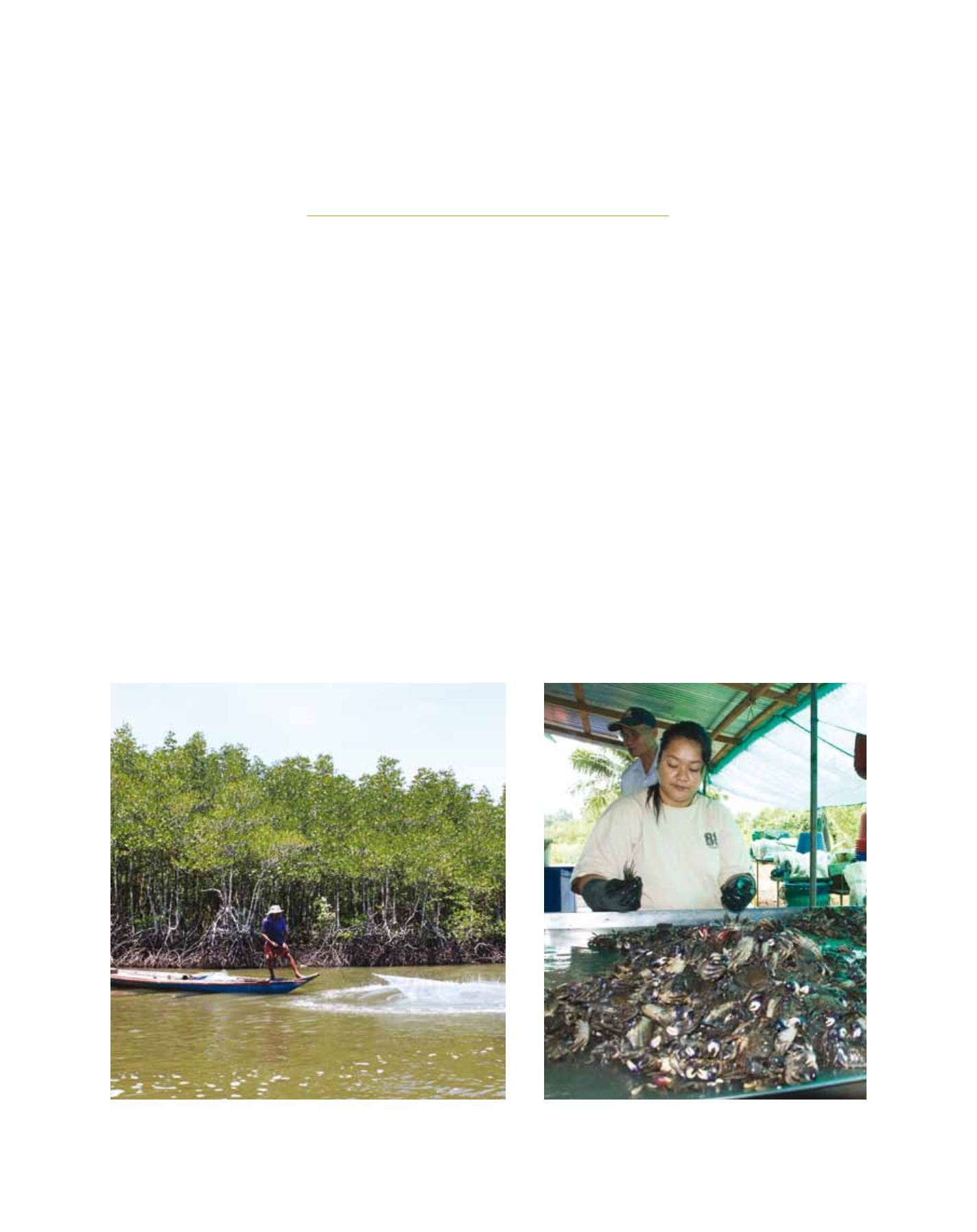
Waterways offer rich marine harvests and mangroves protect the village from wind
and tidal surges
Restrictions on crab fishing during the breeding season has
doubled harvests
Image: Phinyada Atchatavivan
Image: Jaturong Hirankarn