



 114 / 208

[
] 114
S
ustainable
agriculture
,
wildlife
,
food
security
,
consumption
and
production
patterns
systems and creating the sub-district network through RECOFTC
and other organizations,” says Amporn Phetsart, President of the
Prednai Mangrove Conservation and Development Group, “but we
are facing new challenges now from climate change and need techni-
cal and institutional support.” In the past two years, RECOFTC has
run more than 50 workshops to help villagers handle conflict and
climate change impacts through adaptation techniques. Field studies
have corroborated the enormous climate change mitigation result-
ing from mangrove regeneration. In 2010, the Good Governance
for Society and Environment Institute found that mangroves help
absorb 1,205 tons of carbon dioxide each year. They act as a power-
ful wind shield, while their massive root systems help protect the
village against extreme weather events like hurricanes and tsunamis;
according to a study by the Food and Agriculture Organization of the
United Nations, “mangroves can absorb 70-90 per cent of the energy
of a normal wave.”
In April last year, the Norwegian ambassador to Thailand, H.E. Ms
Katja Nordgaard, visited Prenai with RECOFTC and Mangroves for
the Future, to launch the first phase of coastal resource management
through the Community-based Learning Centers project. A green
economy is a knowledge economy and the project will research the
restoration of about 5,150 hectares of mangrove forest, to serve as a
greenbelt, carbon sink and income source from seafood. Two other
innovative pilots include the adoption of a low-carbon lifestyle in one
community and the leveraging of the Prednai Community Mangrove
Forest Management Fund, which could provide a prototype for a
future village climate change fund. Recently, the Fund supported
the purchase of seven hectares of land for mangrove expansion. The
six Learning Centers will be teaching the skills and knowledge for
sustainable mangrove practices to locals, who will return as teachers
and mentors for their communities. RECOFTC has been collecting
information from the 19 villages from June 2011, to study differences
in how these communities use natural resources and
how this impacts their livelihoods and surroundings.
This research will result in an action plan for sustainable
coastal resource management along the entire eastern
seaboard of Thailand, once the most degraded along
the Andaman Sea. The learning network will provide
economic, environmental and climate change solutions
to communities within this coastal province, while at the
same time engaging the younger generation in the chal-
lenges of future sustainability.
None is more pressing than the legal passage of the Bill
for Community Forestry, which would greatly enhance
the tenure rights of marginalized forest communities and
give them access to development funds. For two decades,
RECOFTC has been working with civil society and the
Royal Forest Department in helping 10,000 community
forests get legal recognition and take on the challenge of
sustainable development. Forests are the last frontier for
development in the world’s fastest urbanizing continent,
inviting us to find green solutions to the looming food,
water and energy crises threatening to undermine our
future prosperity. The people of Prednai have found a
green growth solution that has helped them flourish in
what was once an inhospitable swamp.
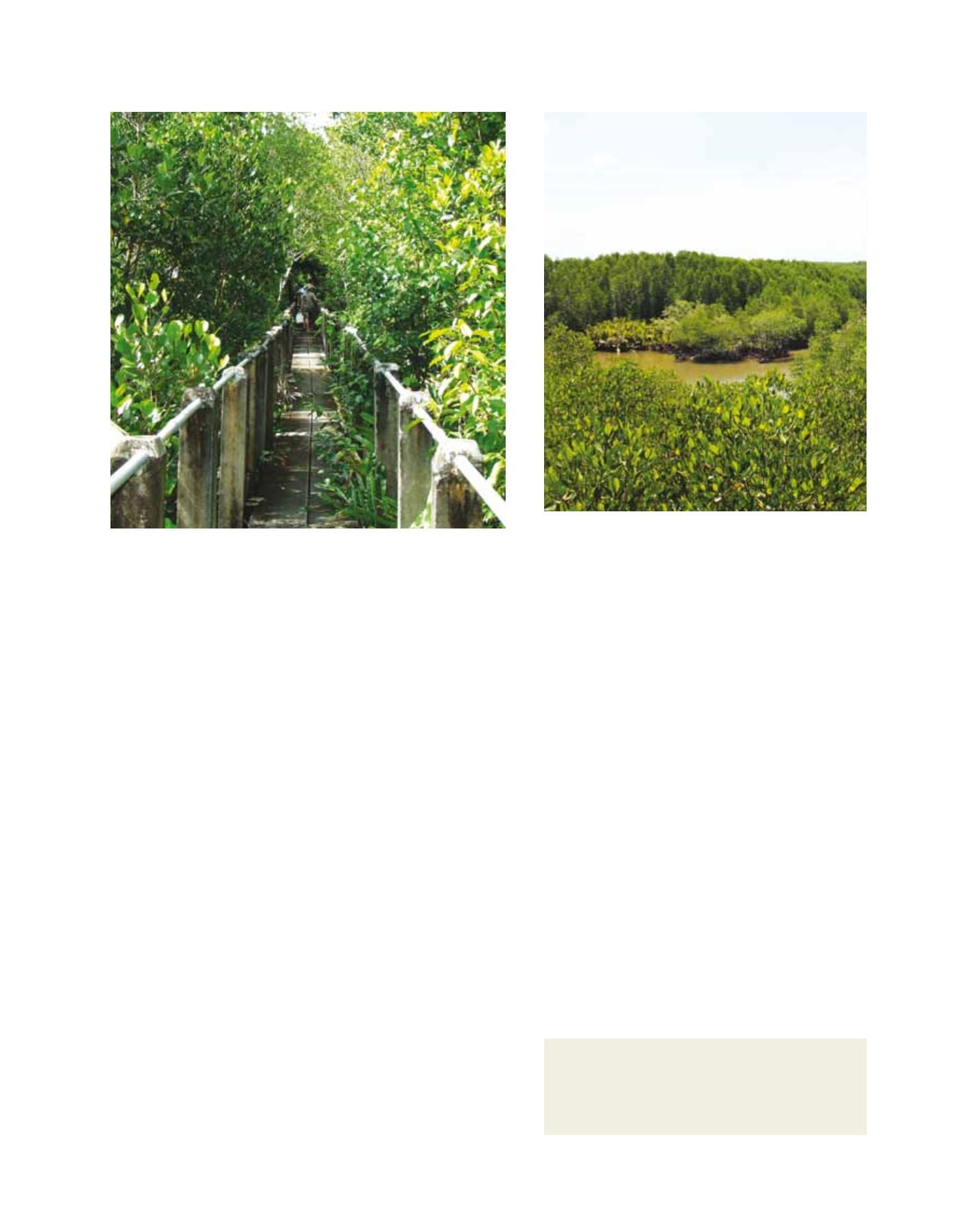
Mangrove walkway built by villagers attracts 1,000 tourists each year
Nearly 2,000 hectares of mangroves were restored through
community efforts
Image: Phinyada Atchatavivan
Image: Phinyada Atchatavivan
RECOFTC’s Vision:
Local communities can actively manage forests in Asia
and the Pacific to ensure optimum social, economic, and
environmental benefits.